
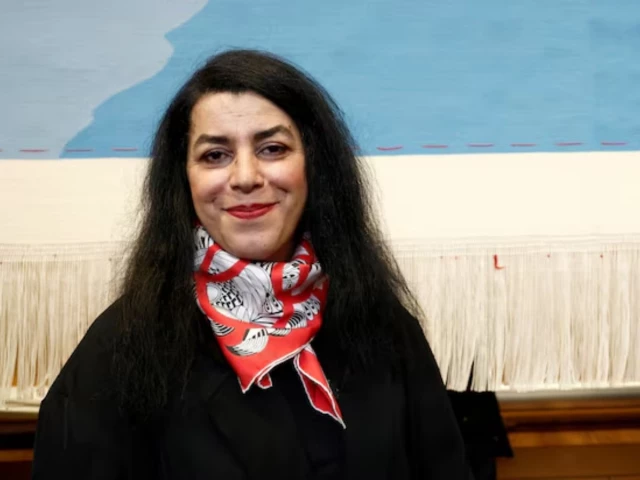
She also designed nine-metre wool triptych for Paris 2024 Olympics, showing athletes competing around Eiffel Tower
French-Iranian artist Marjane Satrapi poses in front of the Olympic tapestry in Paris, France, March 12, 2024. Photo: Reuters
Marjane Satrapi, the Iranian-French artist, filmmaker and author of the autobiographical graphic novel “Persepolis”, has died aged 56, French President Emmanuel Macron’s office said on Thursday.
“Her passing is that of a figure of French culture and of an artist enamoured of freedom, whose work carried a universal message and had earned her immense international renown,” the Elysee said in a statement.
A statement released by members of her family to the French news agency AFP said she had died of “sadness”, a little over a year after the death of her husband, Swedish actor, producer and screenwriter Mattias Ripa. No further information about the cause of her death was available.
Born in 1969, Satrapi spent her childhood in Tehran in a communist-leaning household. Her parents sent her to Vienna as a teenager, before she returned to Iran to study fine arts and later settled in France, where she continued her training in Strasbourg.
Read More: French author becomes an Urdu novelist after coming to Pakistan
She drew on that life of revolution, exile and return in “Persepolis”, the stark black-and-white memoir that chronicled her childhood during and after Iran’s 1979 Islamic Revolution. The book became an international success and was later adapted into an animated film, which won the jury prize at Cannes and was nominated for an Academy Award.
Satrapi’s work mixed political defiance with dark humour and a stripped-down visual style, making her one of the best-known graphic novelists of her generation. She went on to direct films including “Chicken with Plums”, “The Voices” and “Radioactive”, about scientist Marie Sklodowska Curie.
Satrapi also designed a nine-metre wool triptych for the Paris 2024 Olympics, showing athletes competing around the Eiffel Tower.
Satrapi also became a prominent voice on exile, women’s freedom and authoritarianism, frequently using her public platform to denounce repression in Iran.
Also Read: Novelist Kenize Mourad: At home in the world
In 2025, she refused the Legion of Honour, France’s top order of merit, citing France’s “hypocritical attitude” toward Iran, French media reported.
“I can’t continue seeing the children of Iranian oligarchs come to spend their holidays in France, even become naturalised, while at the same time young dissidents have difficulty in obtaining a tourist visa to come to see what the country of the Enlightenment and human rights looks like,” she wrote at the time.