

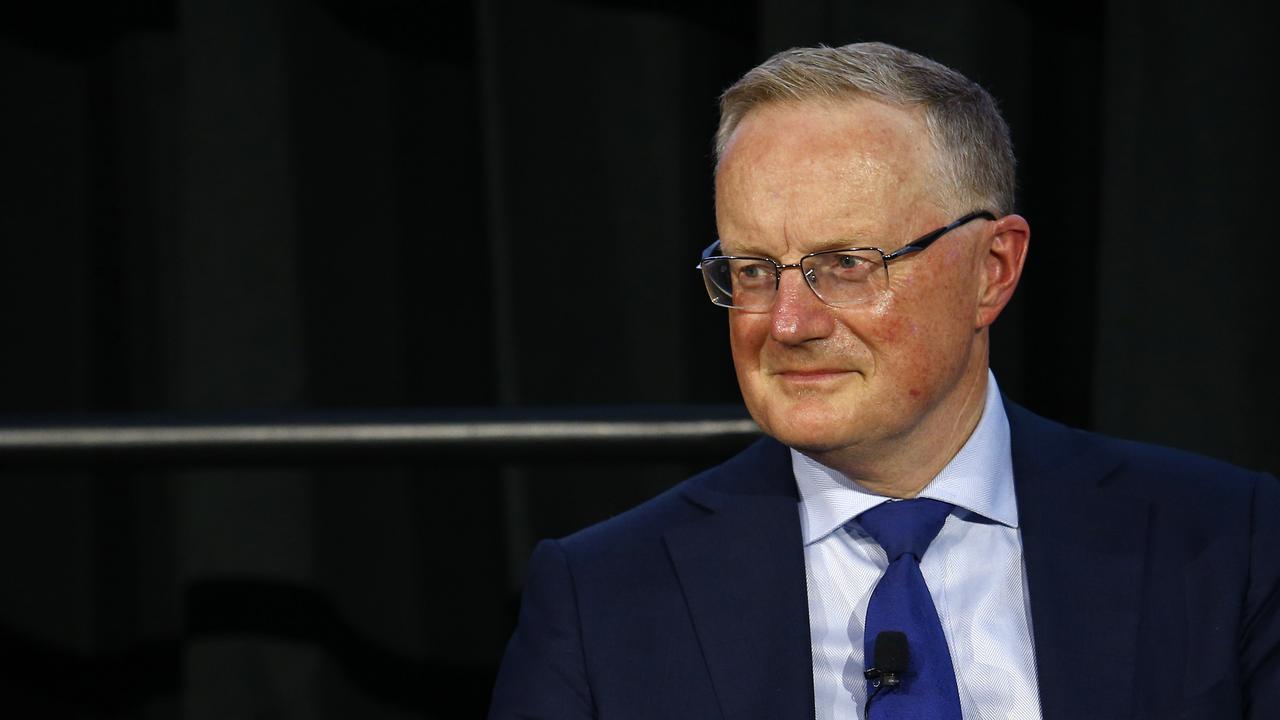
Ousted RBA boss has used his final speech to drop a thinly veiled barb at government across the country, warning the RBA alone cannot be responsible for the nation’s economic success.
In a speech entitled ‘Some Closing Remarks’ in his annual address to the Annika Foundation in Sydney, the outgoing governor defended his leadership of the Reserve Bank before he exits its Martin Place headquarters for the final time in just 10 days.
Taking aim at governments over their lack of co-ordination with the RBA’s efforts, Dr Lowe made the case for improving policy alignment.
“We are likely to get better outcomes if monetary policy and fiscal policy are well aligned,” he said.
“During my term, there have been times where monetary and fiscal policy worked very closely together and, at other times, it would be an exaggeration to say this was the case.”
Arguing that policy co-ordination was “most effective” during the pandemic, Dr Lowe’s comments will likely be viewed as a veiled swipe at governments pre- and post-pandemic financial management.
Government’s inability to tackle the nation’s anaemic productivity growth was also within Dr Lowe’s sights, labelling it “fundamentally, a political problem.”
“The problem is not a lack of ideas. Instead, it is in building the consensus within society to implement some of these ideas,” Dr Lowe said.
On Wednesday, new data showed that Australia’s productivity problem had deteriorated even further, with productivity growth sinking by 3.5 per cent in the year to June 2023 to reach its lowest level since March 2016.
“If we can’t build a consensus for changes, the economy will drift and there is a material risk that our living standards will stagnate,” he said.
Dr Lowe also criticised governments for being too ambitious in their pursuit of new infrastructure projects, amid concerns the RBA’s struggle to tame inflation is being exacerbated by soaring public spending from state and federal governments.
“A well-established framework, based on rigorous independent cost-benefit analysis, would help the country plan and sequence public investment,” Dr Lowe said.
The intervention comes after fresh GDP numbers, released yesterday, showed public investment spending rose by 5.5 per cent in the June quarter, spurred on by a wave of new infrastructure programs.
Economists argued the public investment boom was unfortunate and ran contrary to the RBA’s efforts to slow the economy and bring inflation to heel.
While persistently low inflation would mark the first half of Dr Lowe’s term, the onset of COVID-19 and the associated economic certainty saw the bank initiate an unprecedented $188bn round of monetary stimulus and consecutive cash rate cuts to a record low 0.1 per cent.
But a perfect storm of supply-side constraints complicated by the war in Ukraine and soaring demand driven by pandemic-era stimulus, pushed the RBA to later deliver its punishing round of 12 rate hikes in just 13 months – the fastest rate tightening cycle since the 1980s.
While inflation has since eased, Dr Lowe also sought to hose down the backlash over his infamous comments he made in 2021 that interest rates would not rise again until “at least 2024”.
“There are many other points that have been attributed to me, including: a promise that interest rates would not go up until 2024, everybody needs to get a flatmate; people need to work more hours to make ends meet; and young adults should stay at home because of the rental crisis,” Dr Lowe said.
“I did not make these points.”
In July, Treasurer Jim Chalmers opted not to extend Dr Lowe’s term, despite Dr Lowe expressly stating that he wished to continue in the position.
The task of keeping the Australian economy on an even keel now falls to Dr Lowe’s successor, Michele Bullock, who will begin her seven-year tenure as Australia’s top central banker on September 18.


