
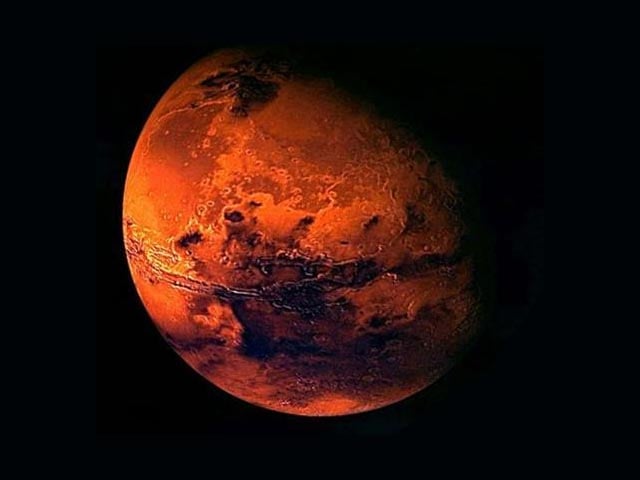
Mars may have experienced rainfall and river flow billions of years ago, reshaping the Red Planet’s surface and supporting a once wetter and warmer climate, according to a new study published in the Journal of Geophysical Research.
Researchers from the University of Colorado at Boulder used computer simulations to compare two competing theories about ancient Mars: one positing a cold, icy world with brief thawing periods, and the other a planet where rain and snow fed widespread erosion.
Their models suggest that valley networks on Mars, particularly in equatorial regions, align more closely with patterns expected from precipitation rather than ice melt.
“You could pull up Google Earth images of places like Utah, zoom out, and you would see similarities to Mars,” said lead author Amanda Steckel. “We see valleys beginning at a large range of elevations. It’s hard to explain that with just ice.”
Satellite data shows dense branching channels near the Martian equator, which may have drained into ancient lakes or even an ocean. NASA’s Perseverance rover is currently exploring one such site in Jezero Crater.
In the simulations, rainfall scenarios produced valley headwaters at both low and high altitudes, while ice melt was largely confined to higher elevations. This discrepancy led researchers to conclude that rainfall better matches the actual Martian terrain.
“We let the virtual water flow for tens of thousands of years,” said study co-author Brian Hynek. “The resulting terrain looked a lot like what we see on Mars.”
The findings add weight to the hypothesis that early Mars had a climate capable of sustaining flowing surface water. While not conclusive, the study offers new insight into the planet’s geological evolution.
“Once the erosion from flowing water stopped, Mars almost got frozen in time and probably still looks a lot like Earth did 3.5 billion years ago,” Dr Hynek said.