Successful test and precise satellite deployment mark the new commercial rocket’s entry into service
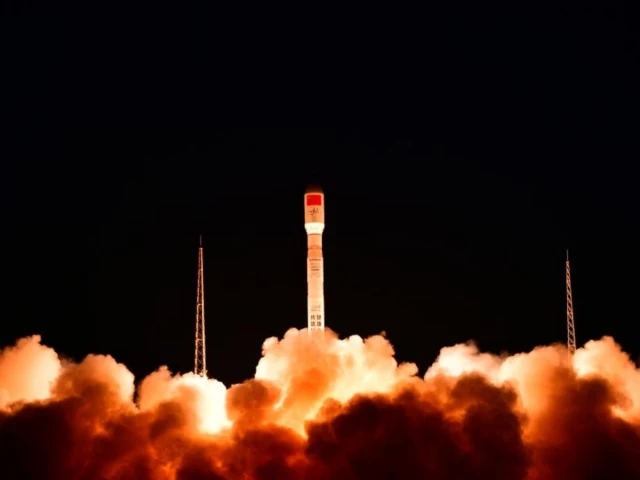
A CERES-2 Y3 carrier rocket with four satellites onboard blasts off from the Jiuquan Satellite Launch Center in northwest China, Nov. 7, 2026. PHOTO: XINHUA
The rocket blasted off at 7:37 a.m. (Beijing Time) from the Jiuquan Satellite Launch Center in northwest China and successfully sent the satellites into a 535-km sun-synchronous orbit.
The four satellites belong to different fields, ranging from ocean remote sensing and commercial meteorology to university-led scientific research and space situational awareness.
The rocket development team said the successful flight test and the precise orbital insertion of the four satellites mark the official entry into service of a new commercial launch vehicle.
Read More: Pakistani astronaut to join China space station’s Shenzhou-24 mission
The CERES-2 is a medium-lift launch vehicle developed for the commercial launch market. As an upgraded model in the CERES series, it features a configuration of three tandem solid stages plus a liquid upper stage. With a liftoff mass of about 100 tonnes, it can deliver a payload of 1.3 tonnes to a 500-km sun-synchronous orbit and is capable of both land and sea launches.
A representative from the rocket’s developer, Galactic Energy, said the company will continue to focus on improving the efficiency and reliability of its solid launch vehicles, helping meet China’s multi-tiered launch needs for small and medium satellite constellation deployment, replenishment, and the build-out of medium-to-large constellations.