
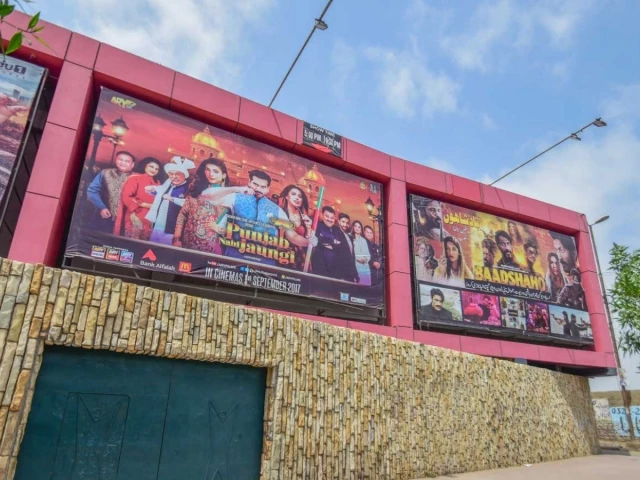
On weekday afternoons in Karachi, cinema halls once filled with rickshaw drivers, labourers, students skipping lectures, and families looking for relief from the heat. The seats were worn, the projectors unreliable, but the promise was simple: for a few hours, everyone could sit in the dark and disappear into a story.
That version of cinema is now almost gone.
As single-screen cinemas continue to shut down and movie-going shifts into mall-based multiplexes with ticket prices touching Rs1,500, Pakistan’s film community is asking a question that goes beyond box office numbers: what happens to a city when affordable mass entertainment disappears?
This concern surfaced repeatedly at the four-day International Urdu Conference in Karachi, where actors, directors, and producers gathered for a session titled The Journey of Film. What unfolded was less a nostalgic lament and more a warning. Cinema made for the masses, many argued, was not just entertainment. It was a social pressure valve.
For actor Shahryar Munawar, the loss feels personal.
“After classes, we used to go to Capri Cinema to watch films,” he recalled, speaking at the session. “It broke my heart when I recently heard that even that cinema has shut down.”
Munawar drew a sharp line between multiplexes and what he considers real cinema.
“Karachi needs more cinema screens, but ones meant for the masses,” he said. “Multiplexes are not real cinemas. Cinema is for ordinary people. A cinema with a Rs1,500 ticket cannot represent the masses.”
The consequences, he warned, extend far beyond the industry.
“When people don’t see action and expression on screen, they release it in their own lives,” he said. “Without emotional outlets, frustration builds and that frustration finds other, often dangerous, ways to express itself.”
For working-class communities, cinema once offered something rare: an affordable release at the end of a long day. “For labourers, cinema was an escape,” Munawar said. “The real question isn’t whether more cinemas should be built. It’s who they are being built for.”
Karachi’s disappearance from the cinema map has been swift. In the 1980s and 1990s, the city reportedly had over 100 active cinemas, most of them single-screen halls embedded in dense neighbourhoods. Across Pakistan, there were nearly 2,500 cinemas at their peak.
Today, only a handful remain in Karachi, largely expensive multiplexes tucked inside shopping malls. The geography of cinema has changed, and with it, its audience.
Veteran actor Javed Sheikh believes the appetite for films has not vanished, only access.
“People want to watch films, but they simply can’t afford to,” he said.
Pointing to India, he described a pricing model built around inclusion. “In India, the first show at 9am can cost as little as 100 rupees. Rickshaw drivers watch films in the morning. By night, the same ticket might cost 1,000 rupees.”
“If Pakistani cinemas adopted this model,” Sheikh added, “our films could return to the masses.”
Senior actor Mustafa Qureshi placed the conversation in historical context.
“There was a time when Pakistan had around 2,500 cinemas,” he said. “Some had 1,500 seats, others 1,200, 1,000 or even 700.”
Even conservatively, he noted, hundreds of thousands of people sat in dark halls every day. “There was less money then than there is today,” he said. “But entertainment existed.”
According to Qureshi, cinema’s role extended well beyond leisure. “Film doesn’t just entertain. It educates. It exposes the evils that drain society.”
He recalled reports from that era suggesting that crime fell when late-night shows kept streets active and people occupied. As cinemas closed, artists argue, Karachi lost not just screens but a subtle form of social regulation.
“We once locked millions inside dark halls,” Qureshi said. “And it worked.”
Some speakers offered practical solutions. Munawar suggested state-backed travelling cinemas, particularly for areas with no access to screens.
“If the government introduces mobile cinemas, we are ready to provide our already-released films free of charge,” he said. “We won’t take a single rupee.”
Arts Council of Pakistan Karachi President Ahmed Shah also used the platform to announce plans to establish a production house and produce films himself, signalling institutional support for reviving cinema culture.
For actor and filmmaker Yasir Hussain, however, the priority is simple. “If you want films to work, you must increase footfall,” he said. Commercial successes, he argued, bring audiences back. Art films alone cannot.
The disappearance of mass cinema, some warned, also affects whose stories survive.
“If we don’t tell our stories, others will,” Hussain said, pointing to international productions set in places like Lyari. “Our stories remain confined within four walls.”
Censorship and restriction, he added, further limit local storytelling. Actor Behroze Sabzwari echoed this, saying that the moment reality-based narratives are attempted, creators are told “Islam is in danger.”
Actor Imran Ashraf spoke less about policy and more about belonging.
“This city raised me like a mother,” he said. “It gave me respect, opportunity, everything.”
For many at the conference, that sentiment captured what single-screen cinemas once represented: shared space, shared stories, shared emotion.
As Karachi grows more fragmented and entertainment more exclusive, the question facing Pakistan’s film industry is no longer just about revival. It is about whether cinema can once again belong to everyone.