A World Cup, by its very nomenclature, implies the involvement of the world — a sporting spectacle that makes space for a wide array of countries, with distinct customs, cuisines, quirks and languages, to converge in one location in pursuit of a shared dream.
It is a concept that football comes closest to pulling off on a quadrennial basis because of its universal spread and appeal. Cricket on the other hand?
Not inclusive enough
Historically, the willow game, whose roots can be traced back to 16th century England, has been the preserve of a select few.
Sure, South Asia — with India, Pakistan, Sri Lanka, Bangladesh (notwithstanding the recent fiasco) and, in the past decade, Afghanistan — is currently well-represented. Australia and New Zealand, on opposite sides of the Tasman Sea, have a proud cricketing legacy.
South Africa, banned by the game’s governing body during the 1970s and 80s because of its government’s apartheid policy, now flies the flag for the continent of Africa. The idea of the Caribbean islands forging a cohesive identity is unique to cricket. Zimbabwe and Ireland complete the list of the International Cricket Council’s full members.
But for much of the rest of the world, cricket may be more identifiable as a six-legged insect than as a game of glorious uncertainties.
Against this backdrop, the ongoing T20 World Cup has been a breath of fresh air. For starters, it is just the second time, after the 2024 iteration in the United States and Caribbean, that the shortest format’s marquee event has featured 20 teams. For context, the men’s ODI World Cup, launched in 1975 with eight teams, has included no more than 16 in a single edition — in 2007.
While the ICC has viewed T20 as an ideal vehicle to enlarge cricket’s footprint, it has been accompanied by scepticism about a prolonged tournament gnawing away at its allure. Before the start of this edition on February 7, former India off-spinner R. Ashwin voiced that apprehension on his YouTube channel. His opinion must have resonated with his audience, for the prospect of India thumping Namibia or England riding roughshod over Nepal seemed plausible on paper.
A fortnight later, it is fair to say that concerns of too many dreary, one-sided affairs in the preliminary phase were misplaced.
The tone was set on the opening day. In the first game, the Netherlands, which had upset South Africa in the 2022 T20 World Cup, was arguably one catch away from vanquishing Pakistan in Colombo — Max O’Dowd spilled Faheem Ashraf when the Asian giant needed 23 from 11 balls with three wickets in hand.
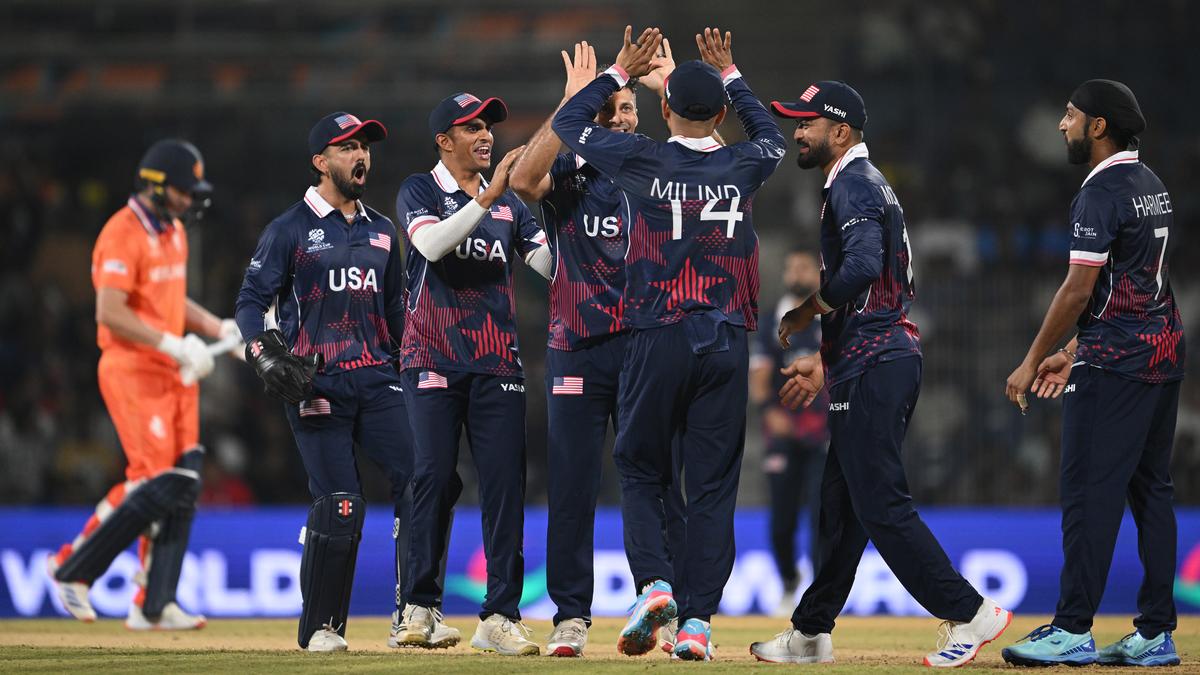
Later that evening at Mumbai’s Wankhede Stadium, the USA, contrary to the official broadcaster’s disparaging tone of coverage that centred around India possibly breaching the 300-run mark, reduced the defending champion to 77 for six. The host heaved a sigh of relief only after Suryakumar Yadav’s unbeaten 84.
Different strokes: Nepal added drama and excitement to T20’s marquee tournament, while Scotland, a last-minute entrant, finished third in its group.
| Photo Credit:
Getty Images
The next day, a major chunk of the 17,000-plus fans in attendance at the venue adjacent to Marine Drive were clad in Nepal’s red and blue as its national team provided Harry Brook’s England an almighty scare. If Lokesh Bam had dispatched the final ball from Sam Curran in a chase of 185 over the ropes, he would have sent the landlocked country on India’s northern border into a state of euphoria.
Making history
The spirit of Associate teams offering moments of magic has stayed intact right through. Even if Nepal was at the receiving end, it played its part in history unfolding when Italy, at the Wankhede on February 12, notched up its first-ever World Cup win.
That sentence may have elicited a quizzical look even until a month ago, when few casual fans knew Italy had a cricket team, let alone one that had qualified for its maiden World Cup. The land is widely renowned for its food, fashion and football, but cricket just didn’t seem to feature in its national consciousness. It is worth mentioning, however, that AC Milan, one of Italy’s most revered football clubs, was founded as the Milan Football and Cricket Club by English expatriates in 1899.
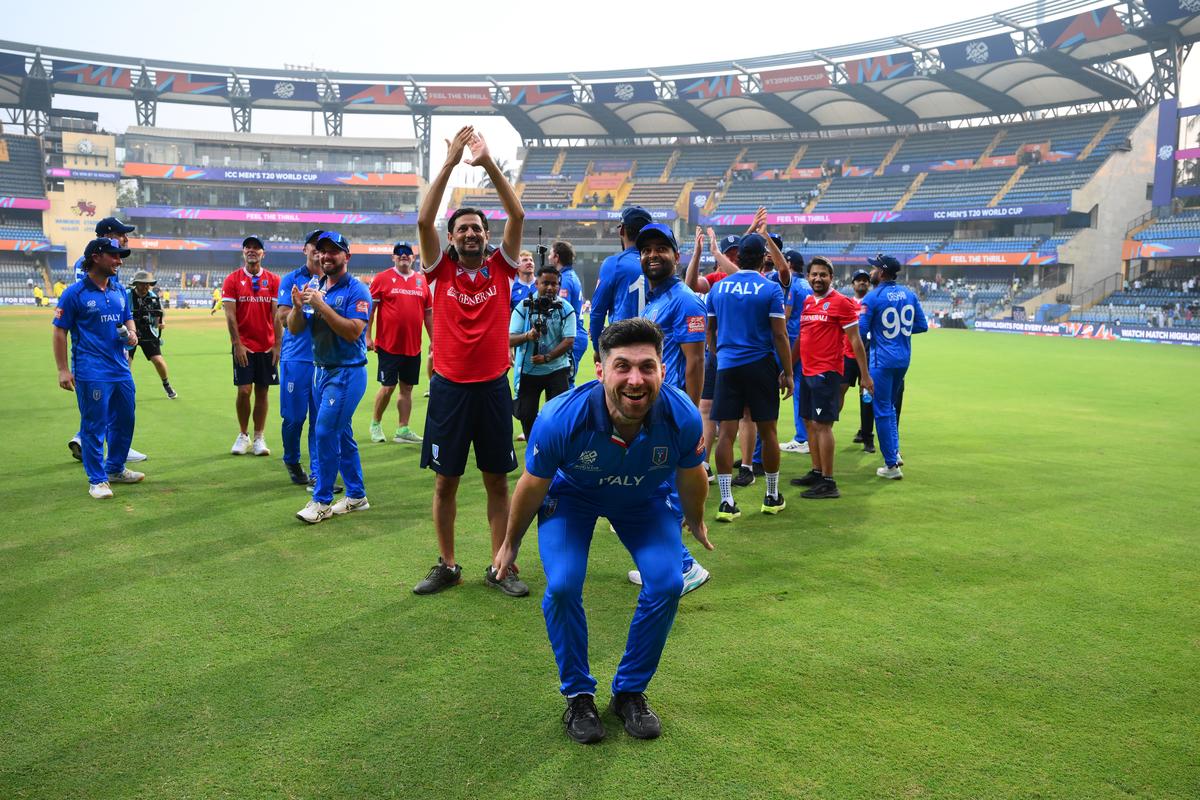
Italian flavour: A country known for its food, fashion and football made its first appearance at one of cricket’s pinnacle events. It also registered its first World Cup victory.
| Photo Credit:
Getty Images
Italy’s presence in the subcontinental showpiece is a firm step towards the augmentation of the cricketing map. The caveat, of course, is the motley make-up of the team: it essentially consists of Australian, South African and English cricketers with Italian ancestry as well as a few south Asian immigrants. None of the 15-member squad was born in Italy. JJ Smuts, who played six ODIs and 13 T20Is for South Africa before switching allegiance, has never even been to Italy.
Still, a taste of the Italian flavour has been available. Crishan Kalugamage, a native of Sri Lanka, moved to Tuscany in central Italy with his family in his mid-teens, and started tossing pizzas for a living before tossing leg-breaks and googlies. In Italy’s 10-wicket win over Nepal, the 34-year-old had a profound impact with three wickets.
What felt even more profound was the heartfelt speech that followed in Italian — a language hitherto unfamiliar to the cricketing world. “Un momento storico per l’Italia (a historic moment for Italy),” was how Kalugamage, with a Sri Lankan twang, began his brief address.
Whilst appreciating what the Associate teams have brought to this tournament, it is also necessary to lend an ear to their challenges. For nations like Canada and the Netherlands, for instance, cricket during the winter months is unfeasible. “We only have three months in a year to play cricket. We train indoors [the rest of the time],” says Canadian pacer Dillon Heyliger.
For the Namibians, a new stadium in Windhoek, inaugurated in 2025, is a sign of progress. The venue will host matches in the 2027 ODI World Cup. But more cricket, ideally against the full members, isn’t yet forthcoming. Before landing in India for the World Cup, Namibia hadn’t played a T20I for four months.
“It’s not rocket science. If you play more cricket, you’re going to get better. So, all the Associate nations are calling out for the same thing,” Namibia coach Craig Williams points out.
Few are as experienced as Lalchand Rajput, the current UAE coach who has worked with Afghanistan and Zimbabwe previously, in assessing Associate cricket.
Has he been pleasantly surprised by the performances of these teams? “I’m not, because we play among Associate teams. If you look at cricket all over the world, the smaller teams are really coming up. It is a good thing that cricket is growing,” he says.
Finding game-time
But Rajput recognises that the momentum will dissipate without more frequent game-time between World Cups. At the same time, Rajput realises that it is not a profitable proposition for the top teams to engage with the Associates in bilateral contests.
It is a dilemma, but the less-fancied sides have done their bit over the past couple of weeks. Now, it’s the ICC’s turn to act if it wants the world in the World Cup to stay relevant.