

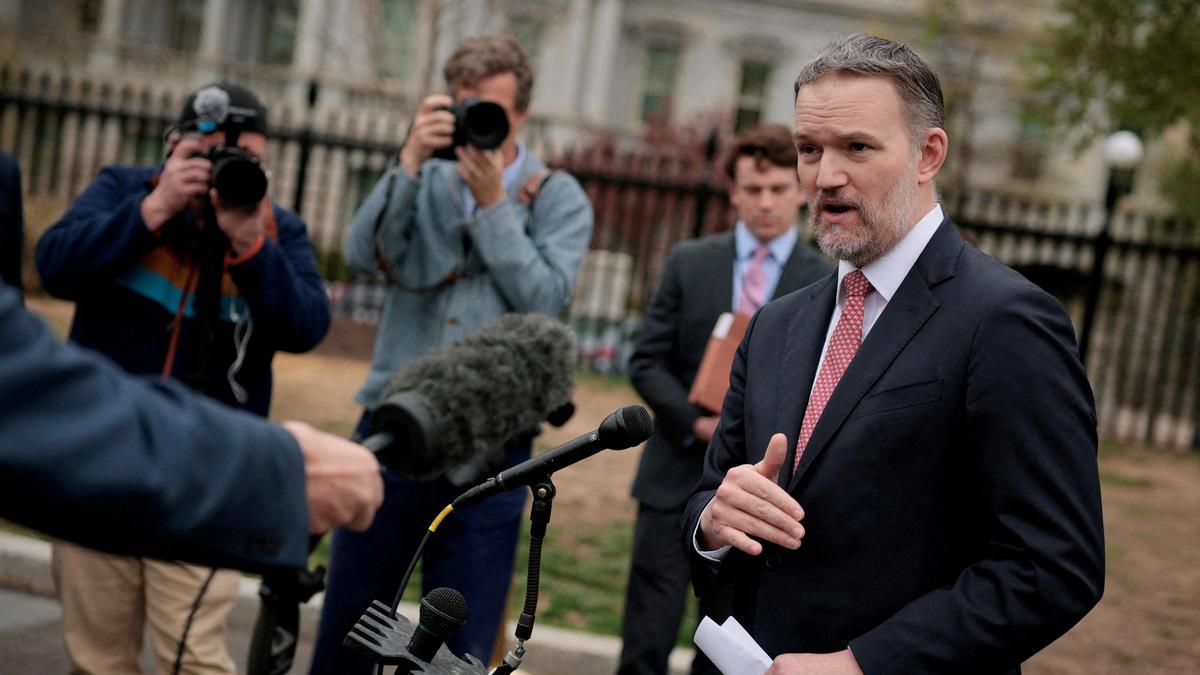
U.S. Trade Representative Jamieson Greer speaks with reporters at the White House in Washington, D.C., U.S. File
| Photo Credit: Reuters
A team of U.S. negotiators, led by U.S. Trade Representative Jamieson Greer, will be visiting India from June 1 to June 4 to “finalise the details” pertaining to the Interim Agreement between the two countries and take forward the negotiations on a broader Bilateral Trade Agreement (BTA), the Ministry of Commerce announced on Wednesday (May 27, 2026).
India and the U.S. issued a joint statement on February 7, 2026, agreeing on a framework for an Interim Agreement regarding reciprocal and mutually beneficial trade. The framework also reaffirmed the countries’ commitment to a broader Bilateral Trade Agreement (BTA) between the two countries.
Also Read | India, U.S. conclude ‘constructive’ in-person talks on trade deal, but no word on deadline
“In pursuance thereof, the Indian side visited Washington D.C. from 20-23rd April 2026 for in-person round of meetings with their U.S. counterparts,” the Commerce Ministry statement said. “To carry forward the discussions, the U.S. team led by the Chief Negotiator will be visiting India from 1-4th June 2026.”
“It is proposed to finalise the details of the Interim Agreement and take forward the negotiations under the broader BTA on multiple areas such as market access, non-tariff measures, customs and trade facilitation, investment promotion, and economic security alignment,” the statement added.
Also Read | India, U.S. looking at firming up trade deal soon
Uncertain outcome
Indian officials, including Commerce Minister Piyush Goyal, have in the past said that a deal would be possible only once details are clear on the tariffs the U.S. would be levying on India’s competitors.
The U.S. had in August 2025 imposed a total tariff of 50% on imports from India. In accordance with the joint statement of February 2026, the U.S. reduced this to 25% and was planning to further bring it down to 18%.
However, later that month, the U.S. Supreme Court ruled that the legal mechanism used by U.S. President Donald Trump to impose the tariffs was invalid and so scrapped the tariffs.
Explained | Where does the India-U.S. trade deal stand?
Mr. Trump then imposed a temporary 150-day tariff of 10% on all imports from all countries, which is set to expire on July 24. In the meantime, his administration also launched various investigations on the U.S. trade partners, including India, regarding alleged violations of human rights and fair trade practices.
The U.S. Court of International Trade (CIT) on May 7 ruled against this 10% tariff, and blocked its application on the appellants — two companies and the state of Washington. However, this decision has been temporarily paused by a U.S. federal appeals court at the request of the U.S. government.
“India’s approach is that we should get preferential market access, as was agreed to in the joint statement as compared to our competitors,” Mr. Goyal had told reporters on May 12.
Published – May 27, 2026 06:10 pm IST


