What do you do when you hit a trough? When what was once second nature has gone missing, not for a day or a week or a month, but for an entire year? When the runs dry up, when your signature strokes desert you, when the individual failures start to stack up even if, under you, the team is doing magical things?
Go back to the drawing board, for sure, but also work extra hard to keep negativity at bay, to disassociate yourself from the dangerous gremlins of self-doubt, right?
That’s easier said than done, of course. Not going back to the drawing board, because that’s what professional sportspersons do when they are confronted by rare failure. But how do you maintain the veneer of positivity when you know that you are letting yourself and the team down, no matter how patient and understanding they might be?
Primary vocation
Suryakumar Yadav is nothing if not a proud individual, a proud captain, a proud leader of men. Even as he steered India from one victory to another, including an unbeaten run culminating in the Asia Cup crown in the Emirates in September, he must have hurt badly at not being able to contribute with the bat. His primary vocation is as a batter, which is what earned him the leadership role in the first place. “I don’t mind not scoring so long as the team wins,” is a very politically correct statement, but Suryakumar was fooling no one. He wanted badly to score, to leave his mark, to turn the clock back and to emerge as a more fearsome version of the marauding self that once ruled the T20 ecosystem.
And therefore, as 2025 segued into 2026, the 35-year-old found the equanimity to take failure in his stride, aware that there was nothing he could do to correct the past but also flush with the realisation that he would not allow the immediate past to define him. A new, exciting challenge awaited him in the new year – the opportunity to emulate Mahendra Singh Dhoni and Rohit Sharma and become only the third Indian captain to lift the T20 World Cup. That he would have the chance to do so on home turf – Dhoni’s success came in South Africa in 2007, Rohit’s in Barbados in 2024 – was an added fillip.
For the whole of 2025, it was as if someone answering to the name of Suryakumar Yadav, resembling him physically but batting as if he were an impostor, had replaced the original. Shots that once flew off his blade to the stands where the audiences were part excited and part fearful let him down badly. The patented pick-up shot went AWOL, the drives down the ground disappeared, the first sign of aggression often brought about his downfall. Suryakumar shrugged off those disappointments, maintaining his million-dollar smile and crooning that he was only ‘out of runs, not out of form’. But the more he espoused that theory, the more one felt that he was desperately trying to convince himself, more than the outside world, that that was indeed the case.
No doubts, however, were raised about his continued presence in the larger scheme of things because he was doing all other things right. Why, he even started to win tosses, something Indian fans had lost touch with across formats and captains for a long time. He managed to separate the lack of runs from his responsibilities as skipper and leader. The string of successes meant there was no threat to his place at the helm, and rightly so because of what he had achieved in the previous couple of years and because of the knowledge that it was only a matter of time before he hit his straps.
Towards the end of December, at the conclusion of a five-match series against South Africa when his lean patch manifested itself in the form of an eerily unwelcome sequence of 12, 5, 12 and 5, SKY had gone 14 months and 22 innings with a T20I half-century. The argument that especially in this format, where impact is measured by strike-rates more than tall scores, half-centuries are passe didn’t cut ice because in each of those 22 outings, he batted at either No. 3 or No. 4, from where batters usually make merry and where their success is measured by both strike-rates and the number of runs scored.
Suryakumar used the time between the end of the South Africa series (on December 19) and the start of the New Zealand showdown (from January 21) most judiciously, assiduously working to rediscover his mojo. That entailed hours of hard labour at the nets because that is almost mandatory, whether in the runs or not, but then again, it isn’t as if he had allowed the grass to grow under his feet in 2025. Around his exertions at practice, he spent plenty of time with his young family and let his hair down in the company of close friends who, luckily, are the kind that tell you what you must hear instead of what you want to hear.
Having cleared his mind – sometimes, that is the most difficult thing to do when one is constantly involved in the practice-play-travel routine – and made the mental switch that went from desperation to relaxed confidence, Suryakumar announced himself in the five matches against the Kiwis, India’s last engagements before the defence of their World Cup crown, which begins in Mumbai on Saturday against United States. The earliest indications that the Suryakumar of old wasn’t too far away from expressing himself came in the opener in Nagpur. Opting to bat, India lost Sanju Samson and the returning Ishan Kishan within the first 17 deliveries when the skipper strode out to join Abhishek Sharma. He watched from the best seat in the VCA Stadium, the non-striker’s end, as the left-handed opener tore the Kiwis to shreds, but he wasn’t just content to sail in the younger man’s wake.
Without fuss, but with the authority that was once his calling card, Suryakumar eased to 32 off 22. He was overshadowed by Abhishek’s 35-ball 84 and a furious cameo down the order from Rinku Singh (44 not out off 20) but those who were looking for portents would have taken note of how the trademark strokes came without effort, of how comfortable he looked in the middle, of how the impostor had made way, belatedly but thankfully, for the real deal.
As if to reiterate that one hadn’t imagined things, Suryakumar produced a raging unbeaten 82 two nights later in Raipur. For a fair part of his 122-run alliance for the third wicket with Kishan, Suryakumar was content to play second fiddle as India charged towards their target of 209. Kishan, grabbing the unexpected lifeline thrown by a change in mindset of the team management, smashed 76 off just 32 deliveries to dominate the partnership after India had lost their openers with just six on the board, but Suryakumar wasn’t to be left behind. At one stage, the captain was 11 off 11; he finally finished 82 not out off 37 deliveries, a smashing compilation sealed and delivered with nonchalance as the swagger and the strut of the past came rushing to the fore.
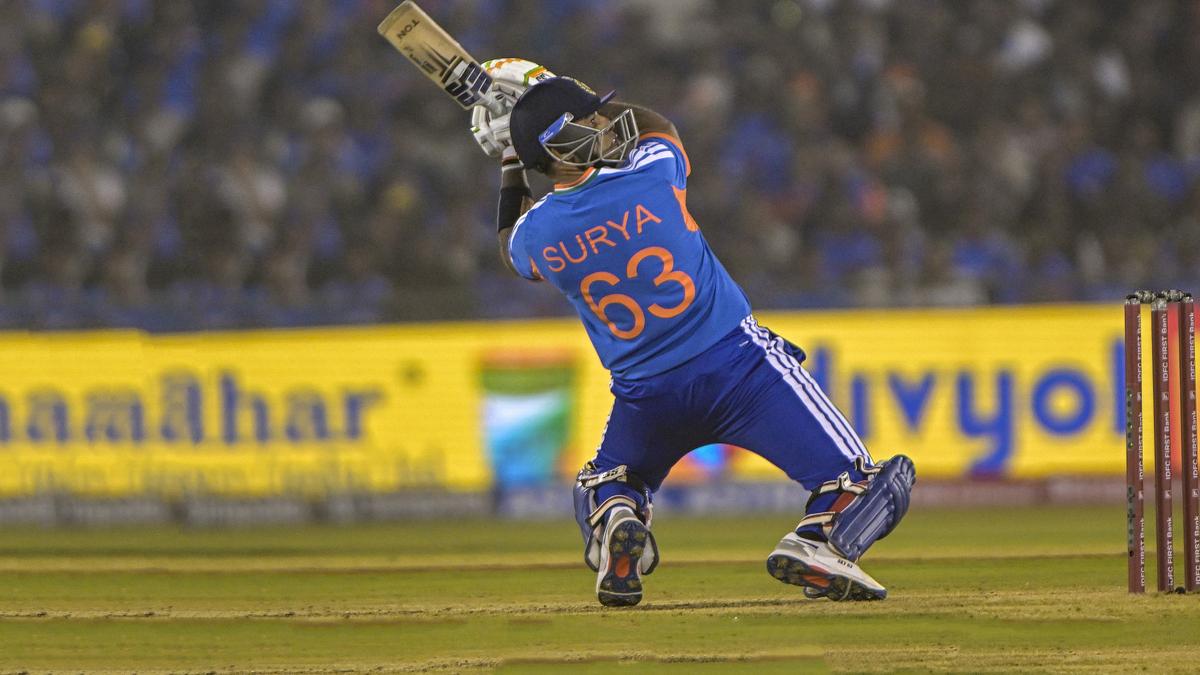
They say of champions – and that’s what Suryakumar is – that all it takes for them to ‘find’ themselves is one knock. Despite his sustained bad trot, Suryakumar still averaged in the mid-30s and struck at more than 160 per 100 balls faced at the start of the New Zealand series, a testament to the dizzying heights he had reached previously when he was the No. 1 batter in the world in the 20-format for well-nigh on two years. Having used Nagpur to convince himself that all was well, again, in his batting world, Suryakumar slid into the consistency that not so long back made him the most feared batter in the universe. After Raipur, he unleashed an unbeaten 57 (26b) in Guwahati and rounded off the series with 63 off 30 in Thiruvananthapuram, when India amassed 271 in their allotment.
In five innings, SKY had scaled the dizzying heights (for the rest of us) that were so commonplace for him, finishing with 242 runs at an average of 80.67 and a surreal strike-rate of 196.75. He reeled off 25 fours and 14 sixes; interestingly, or is it coincidentally, the only time he didn’t make a score of substance (8 in the sole loss in Visakhapatnam), he batted at No. 3 when Kishan was benched owing to an injury. As many as 234 of his series runs came at No. 4, which is perhaps where he will slot in at the World Cup, once Tilak Varma returns to the playing XI and Kishan moves up to partner Abhishek and replace the horribly misfiring Samson.
Mere formality
The Player-of-the-Series award was a mere formality. Suryakumar didn’t need that honour for affirmation. He wouldn’t have minded it one bit if it had gone to Kishan, who rounded off his international comeback (after more than two years) celebrations with a spectacular hundred in the final outing. It was the sixth time he was officially crowned the boss of a series, jointly with Sri Lankan Wanindu Hasaranga only behind Virat Kohli (7) for the most Player-of-the-Series awards in T20I cricket.
Timing has always been a Suryakumar forte – unlike with Kishan or Hardik Pandya or Shivam Dube, you don’t associate him with muscle and brute force – but the timing of his return to run-making ways couldn’t have been more opportune. Despite his outwardly infectious enthusiasm, his inability to pitch in would have rankled him more than he let on. Now that that box also has been ticked, expect more fireworks from Suryakumar – ‘The SKY is blue again’ – over the next month, when India seek to rewrite history and become the first team to successfully defend the T20 World Cup and the first side to go all the way on home patch.
An inspired choice to succeed Rohit as the 20-over skipper after the older Mumbaikar retired in 2024, Suryakumar has the chance to emulate the man from whom he has learnt so much about so many things. What a fascinating prospect that is.