
Paralyzed in 2022, the patient received a CAS brain-computer implant in 2025 and soon controlled devices
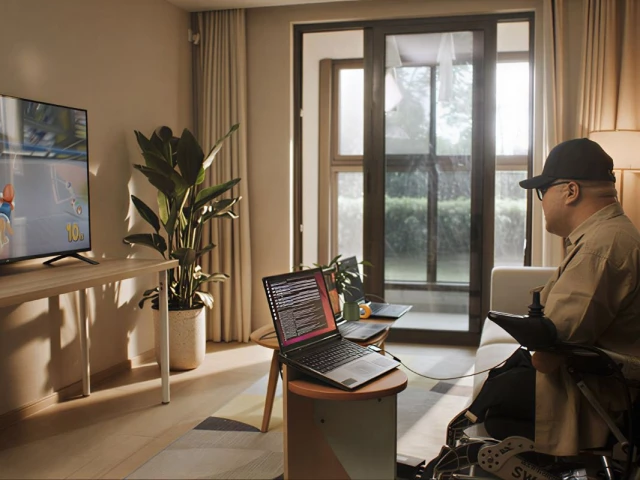
A patient involved in a BCI clinical trial plays a racing game at his home in Shanghai. PHOTO: CHINA DAILY
A patient suffering from tetraplegia steered a smart wheelchair through the neighborhood with only his thoughts and directed a robotic dog to fetch a food delivery. These scenes were achieved during a recent clinical trial of a brain-computer interface conducted by a team from the Chinese Academy of Sciences (CAS).
This shattered the conventional boundaries of rehabilitation, carrying the brain’s command from a two-dimensional cursor on a screen into full-bodied, three-dimensional interaction with the physical world.
Brain-computer interfaces are designed to create a direct communication channel between the brain and external devices. Around the world, research groups have already demonstrated the laboratory feats, including “mind typing” and robotic-arm control. The enduring challenge is to make those systems reliable enough to vanish into a patient’s daily life.
The patient became quadriplegic in 2022 due to a spinal-cord injury and received the brain-computer-interface system, developed by the Center for Excellence in Brain Science and Intelligence Technology under the CAS, in June 2025. Within weeks of training, he can reliably control a computer cursor and a tablet.
The researchers employed a high-throughput wireless invasive brain-computer interface system to enable the patient to stably control a smart wheelchair and a robotic dog using neural signals, achieving autonomous mobility and object retrieval in real-world settings.
Read More: China pioneers commercial use of supercritical CO2 power generation
It signifies that China’s research in the field is shifting from merely restoring basic interaction to expanding the real-life horizons of paralyzed patients.
The team also creatively fused two distinct decoding strategies to distill meaningful commands from noisy neural activities and boost the overall brain-control performance by more than 15 percent.
Moreover, the researchers squeezed the system’s end-to-end latency, from neural pickup to command execution, under 100 milliseconds which is below the body’s own reaction time, giving the patient control that feels fluid and natural.