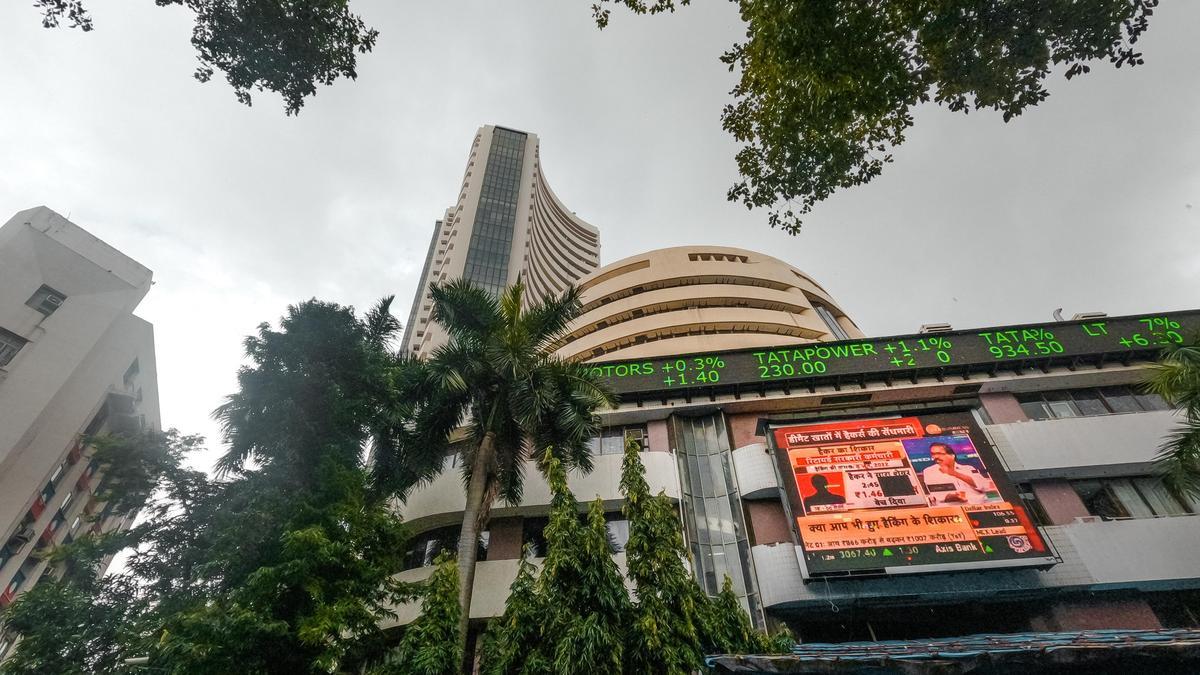
Equity benchmark indices Sensex and Nifty ended lower on Tuesday (January 13, 2026) after a day’s breather, as investors pared exposure to index majors Reliance Industries, L&T and Bharti Airtel amid global tariff-related concerns.
Market sentiment was also sluggish due to a weak start to the earnings season and continued flight of foreign capital from Indian markets, according to traders.
In a volatile trade, the 30-share BSE Sensex dropped 250.48 points, or 0.30%, to settle at 83,627.69. During the day, it declined 615.38 points, or 0.73%, to 83,262.79.
The 50-share NSE Nifty edged lower by 57.95 points or 0.22% to 25,732.30.
The session began on a negative note following disappointing results from IT major TCS and drifted lower for most of the session, though a rebound in the final hour trimmed some losses.
“Domestic equities experienced a downturn due to renewed concerns about potential U.S. tariffs on countries trading with Iran, overshadowing the initial optimism from the newly appointed U.S. ambassador’s positive statements on the trade deal. Investor sentiment remained cautious amidst the rupee’s weakness, rising crude prices, higher U.S. bond yields, and persistent FII outflows.
“On a brighter note, India’s December CPI remained within the RBI’s target range, reinforcing expectations of future rate cuts. However, the Q3 earnings season commenced on a subdued note, with lacklustre results from a leading IT major. Profit-booking was prevalent across most sectors, though small-cap stocks showed notable gains,” Vinod Nair, Head of Research, Geojit Investments Limited, said.
From the 30-Sensex firms, Trent, Larsen & Toubro, Reliance Industries, InterGlobe Aviation, Maruti, ITC, Adani Ports and Bharat Electronics were among the biggest laggards.
In contrast, Eternal, ICICI Bank, Tech Mahindra, State Bank of India and Tata Consultancy Services were among the gainers.
“…fresh selling in heavyweights across sectors capped the upside. Ongoing geopolitical and global trade concerns also continued to weigh on risk appetite, keeping trading largely stock-specific,” Ajit Mishra – SVP, Research, Religare Broking Ltd, said.
The country’s largest IT services exporter TCS on Monday (Janaury 12) reported a 13.91% drop in December quarter profit at Rs 10,657 crore, majorly on a one-time impact of new labour codes.
Meanwhile, retail inflation rose to a three-month high of 1.33% in December, mainly due to higher prices of food items, but remained below the Reserve Bank of India’s lower tolerance level.
Foreign institutional investors offloaded equities worth ₹3,638.40 crore on Monday (January 12), while Domestic Institutional Investors (DIIs) bought stocks worth ₹5,839.32 crore, according to exchange data.
U.S. President Donald Trump announced that any country “doing business” with Iran will have to pay a 25% tariff on its trade with Washington, a move that could impact Tehran’s major trading partners such as India, China and the UAE.
“Effective immediately, any country doing business with the Islamic Republic of Iran will pay a Tariff of 25% on any and all business being done with the United States of America. This order is final and conclusive,” Mr. Trump said in a post on Truth Social Monday.
The BSE smallcap gauge climbed 0.46%, while the midcap index dipped 0.1%.
BSE Telecommunication dropped 1.18 per cent, industrials (1.09%), capital goods (0.67%), consumer durables (0.63%), realty (0.56 per cent) and energy (0.51%).
“Indian equity markets witnessed sharp intra-day volatility on weekly expiry, with early gains giving way to profit-booking as the session progressed. The initial optimism was tempered by global tariff-related concerns, mixed reactions to Q3 earnings, and the usual expiry-driven swings,” Ponmudi R, CEO of Enrich Money, an online trading and wealth tech firm, said.
U.S. markets ended in positive territory on Monday (January 12).
Published – January 13, 2026 06:04 pm IST