
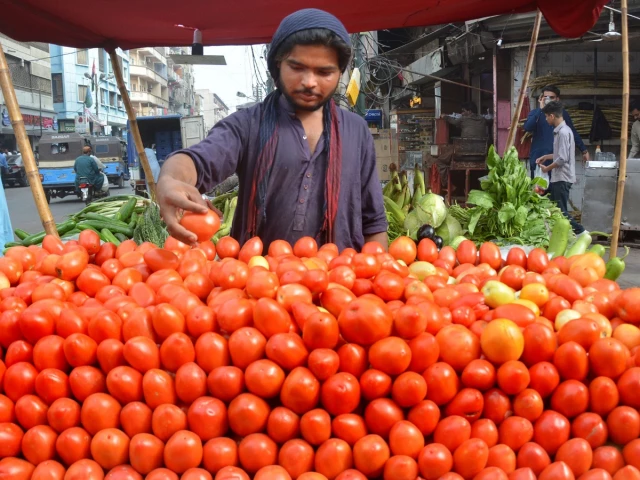
A vendor arranges tomatoes on his pushcart. The kitchen essential was selling on pushcarts for Rs400-450 and in supermarkets at Rs550-580 due to short supply in the market. Photo: Jalal Qureshi/Express
KARACHI:
Short-term inflation, measured by the Sensitive Price Indicator (SPI), recorded a year-on-year increase of 5.19% for the week ended February 19, 2026, reflecting increasing pressure from food staples and household energy tariffs despite notable declines in several perishable commodities, official data showed on Friday.
According to the Pakistan Bureau of Statistics (PBS), the combined SPI rose to 335.67 points compared to 319.12 points in the corresponding week of last year, while also registering a 1.16% week-on-week increase, which signalled a renewed uptick in consumer prices for essential goods after a brief easing earlier this month.
The annual SPI rise was largely driven by sharp increases in key food items and utility charges. Tomato prices surged 85.2% year-on-year, followed by wheat flour (31.33%), gas charges for the first consumption slab (29.85%) and electricity tariffs (17.33%).
Other notable increases included bananas (15.83%), red chilli powder (15.2%), beef (13.28%) and liquefied petroleum gas (12.22%), highlighting the broad-based nature of cost pressures on household consumption baskets.
Conversely, several essential food items posted substantial annual declines, partially offsetting the inflationary impact. Potato prices dropped 45.43% year-on-year, garlic (27.51%), gram pulse (23.3%), chicken (19.36%) and onions (18.1%), which reflected improved supply conditions and base effects from last year’s price spikes.
On a weekly basis, the SPI accelerated mainly due to higher prices of fresh produce and administered energy costs. Bananas recorded a steep 16.05% week-on-week increase, while electricity charges rose 15.41%, followed by garlic (5.86%), chicken (5.49%), onions (3.83%) and tomatoes (3.82%). Fuel rate adjustments also contributed, with diesel and petrol climbing 2.69% and 1.93%, respectively.
PBS data showed that out of 51 essential items, prices of 17 items (33.3%) increased, 12 items (23.5%) decreased and 22 items (43.1%) remained unchanged during the week, indicating that inflationary momentum was concentrated in a limited but high-weight segment of the consumption basket.