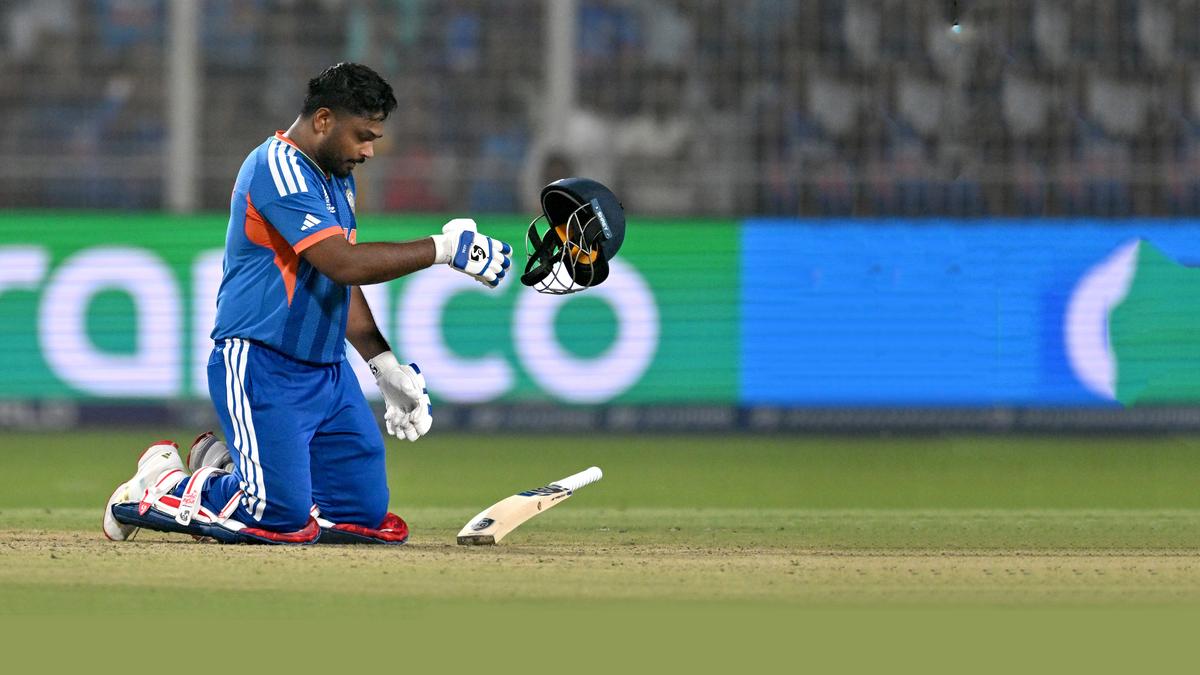
For a long, long time, Sanju Samson threatened to become one of the many nearly-men of Indian cricket. His ability and skills were never in doubt; few who have wielded the willow have made batting look so sublime and ridiculously easy, fewer still have dominated bowling attacks without seemingly hitting a ball in anger.
Yet, Samson often loomed as his worst enemy. Pretty little structures seldom made way for magnificent edifices, the outcome wasn’t always directly proportional to promise and potential. When he made runs, he looked a million dollars but those were neither munificent nor consistently significant enough for him to nail down a place in the national side.
His precociousness earned him an India cap in the Twenty20 format as far back as July 2015, when he was still a few months shy of turning 21, but in the decade and a bit since, he has made only 59 more appearances. His ODI debut didn’t happen until July 2021 but even though he boasts an average of 56.66 at a strike rate of 99.60 and made a century in his last outing, he hasn’t been able to add to his 16 caps since December 2023.
So, who is this Sanju Samson? Why is he such an enigma? What is it that has prevented him from giving full expression to his God-given gift – it has to be, because he bats at a level above mere mortals even when he gets out cheaply – when those evidently less talented have established themselves?
The answer, Samson himself will testify, is a combination of a lack of the quality of opportunity and his own self-doubt that has prevented him from taking the next step up. That, and a pronounced technical glitch that has only recently been ironed out, but whose value is already beginning to manifest himself.
Inconsistent run
The gap between Samson’s first and second T20I appearances appeared to be an indication of the roller-coaster ride that his career would come to resemble. After mustering a 24-ball 19 against Zimbabwe in Harare, he didn’t play a 20-over international for four and a half years. The comeback, mainly behind several hundred exquisite runs for Rajasthan Royals, wasn’t rip-roaring or fairytale-ish. Scores of 6, 8, 2 in his first three innings back were exasperating for the management duo of Virat Kohli and Ravi Shastri, for the legion of Samson fans and for the protagonist himself, especially considering that in a powerful line-up, he was given the No. 4 position.
It took Samson 13 innings to make his first substantial contribution, 77 off 42 against Ireland in Malahide in June 2022 when V.V.S. Laxman was interim coach of the Hardik Pandya-led outfit. Even that failed to break the inconsistent run; ten innings and 25 months straddled his first two fifty-plus scores, by which time he had already secured a T20 World Cup winner’s medal despite not playing a single game in the Americas in June 2024.
After that World Cup triumph, title-winning skipper Rohit Sharma and Kohli bid adieu to the 20-over game and Dravid stepped down as the head coach. Suryakumar Yadav was tasked with leading the T20 team into the future while Gautam Gambhir succeeded the man whose work ethic he tried to emulate as the coach and mentor. With massive chunks of experience having disappeared through the retirements of Rohit and Kohli (and Ravindra Jadeja), the new management group chose to invest in Samson at the top of the batting order, and the Kerala wicketkeeper-batter obliged with consecutive centuries against Bangladesh in Hyderabad (October 2024) and South Africa in Durban (November 2024).
Mounting woes
With preparations for the 2026 World Cup having begun in earnest, Samson seemed to have nailed down his place when he added a third hundred exactly a week after his second, but when have things ever been straightforward with him? Having embarked on a 111-107-0-0-109 n.o. run in four and a half weeks towards the end of 2024, he managed a frugal 51 runs in five innings against England, at home, in January 2025. A highest of 26 in the first game of the series was exacerbated by five dismissals to pacy deliveries banged into the surface, mainly by Jofra Archer. Suddenly, Samson wasn’t on firm footing any longer.
His woes mounted when, for some strange reason that they have still not been able to explain with any conviction, India’s selectors decided to bring Shubman Gill out of T20I hibernation and appoint him Suryakumar’s deputy for the Asia Cup in the UAE last September. Gill had to open, of course, and open alongside his good buddy Abhishek Sharma, who had taken the 20-over landscape by storm on his way to becoming the No. 1 batter in that format. That meant a demotion for Samson, to the middle order where he hasn’t played a lot for franchise or country.
Predictably, on slow pitches in Dubai, Samson struggled for fluency. He made a scratchy half-century against Oman in Abu Dhabi and a more fluent 39 off 23 against Sri Lanka in Dubai, but the die seemed to have been cast when he was replaced by Jitesh Sharma midway through the tour of Australia in October 2025. Jitesh had made a name for himself as a finisher for Royal Challengers Bengaluru during their march to the IPL title in 2025 and acquitted himself with reasonable success in his limited opportunities, but he went out as rapidly as he was recalled as Ajit Agarkar’s panel had a dramatic change of heart that saw Gill being dumped from the 20-over version.
Gill’s comeback to the 20-over side after nearly 14 months wasn’t a success by any stretch of the imagination. In 15 innings between September and December last year, in the UAE, Australia and at home, he topped 40 just twice; there were four single-digit dismissals and his average and strike-rate weren’t up to scratch. And so, after the home series against South Africa in December, he was given the heave-ho.
Samson went back up the order for India’s last assignment, against New Zealand in January, and produced a horror sequence of 10, 6, 0, 24 and 6. Meanwhile, Ishan Kishan was tearing up the record books and Abhishek was still blasting away which meant that by the time of the World Cup, Samson was again pushed down the pecking order and out of the XI. India decided left-right combinations were overrated, packed their top three with left-handers and went into the World Cup as obvious favourites, but within two weeks, they were forced into an overhaul which coincided with Abhishek going off the boil, Tilak unable to immediately find his touch after four weeks out following surgery, and off-spinners feasting on Indian left-handed openers in the first over for three games on the trot.
Suddenly, Samson came back into the reckoning. Not because of a mountain of runs, but because his right-handedness offered a different point of reference. He warmed up with an unexpected recall when Abhishek spent a night in hospital for a stomach infection, a bittersweet cameo of 22 off 8 both heartening and infuriating. But once India made up their mind to split up Abhishek and Kishan and push Tilak into the middle order, Samson was back at the top in his own right, starting with the first of four must-win games against Zimbabwe in Chennai.
Again, like he did previously in the tournament and has done numerous times in the last decade, he made a breezy start, 24 off 15 before falling to a very obvious plan, pulling a short slower one down the throat of deep mid-wicket. C’mon Sanju, clean up your act.
And so he did at the Eden, cleaning up his act and putting West Indies out of the tournament. In Chennai, he said later, he kept going hard because India were trying to set a target. In Kolkata, he knew what the target was – a redoubtable 196 – which compelled him to play differently, without taking too many risks once Abhishek and Kishan were packed off within the first five overs.
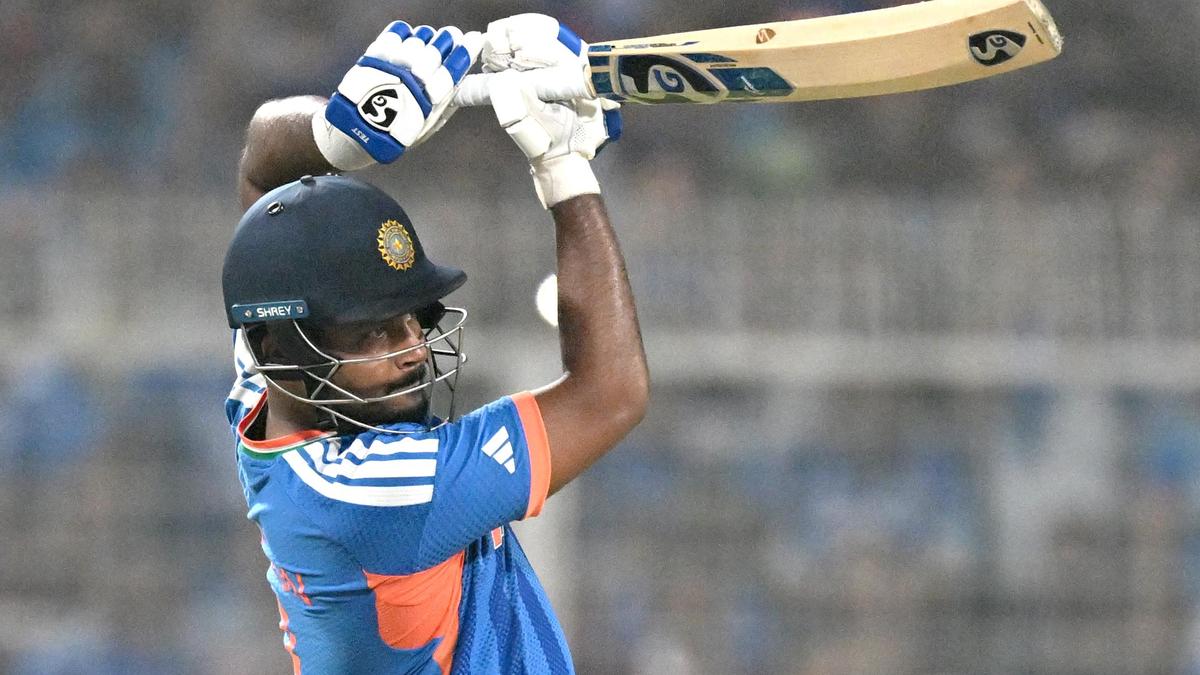
Samson on Sunday at the Eden was the Samson the cricket world has been waiting for a long time to see. There was grace and flair and style and elegance – how can there not be? – but there was also a grand sense of responsibility, of taking the onus upon himself to get the job done. There were little to no risks. The low-percentage strokes were put away, and a not-so-minor but crucial footwork change was executed to perfection as he ensured that he was operating from a stable base and his body weight was evenly distributed on both feet as opposed to earlier, when his pronounced trigger movement transferred all his weight on to the backfoot.
One of the keys to a successful hunt of a big total is to have someone from the top three bat through the innings. Samson had never done that previously, not in any game where he had opened the batting in a 327-match career. He had never seen a chase through, he had never remained unbeaten when victory was brought up. It wasn’t the most edifying statistic to possess.
And therefore on the biggest night (till now) of the year for Indian cricket, Samson decided he would tick that box too. First Abhishek and Kishan, then Suryakumar and later Tilak and Pandya fell. Whenever India looked like getting on top, they suffered an untimely setback and even though the target never went out of sight, there was tension and anxiety and a little unease. There shouldn’t have been, not given how Samson was batting, but nerves are nerves and one could sense that the packed gathering at the Eden knew that the game was in the balance when Pandya was dismissed to make it 17 needed off 10.
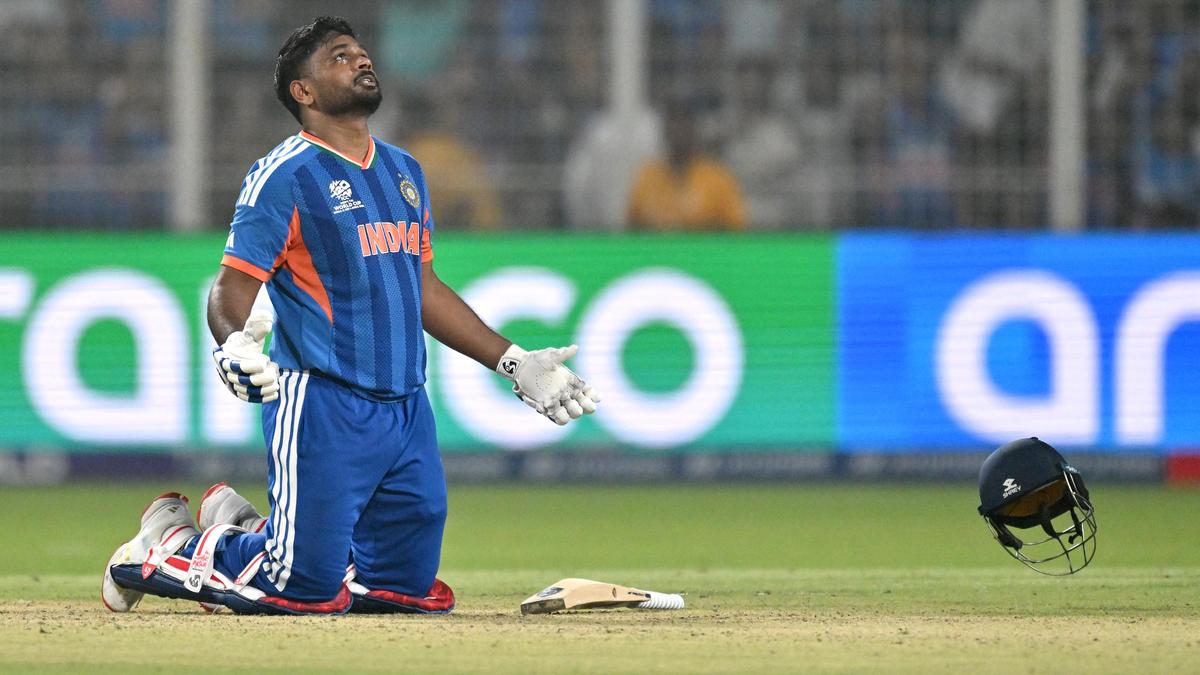
It was largely on the back of Samson’s 87 at the time that India had got this close. He received great help from Dube, who smacked two of his four deliveries in the penultimate over for fours, leaving India with only seven to get in the last. Samson whipped the first for six, smashed the second over mid-on for four. He sank to his knees, threw his hands up in gratitude and thanksgiving. What’s the fuss all about, he seemed to ask. We all know the answer, don’t we?