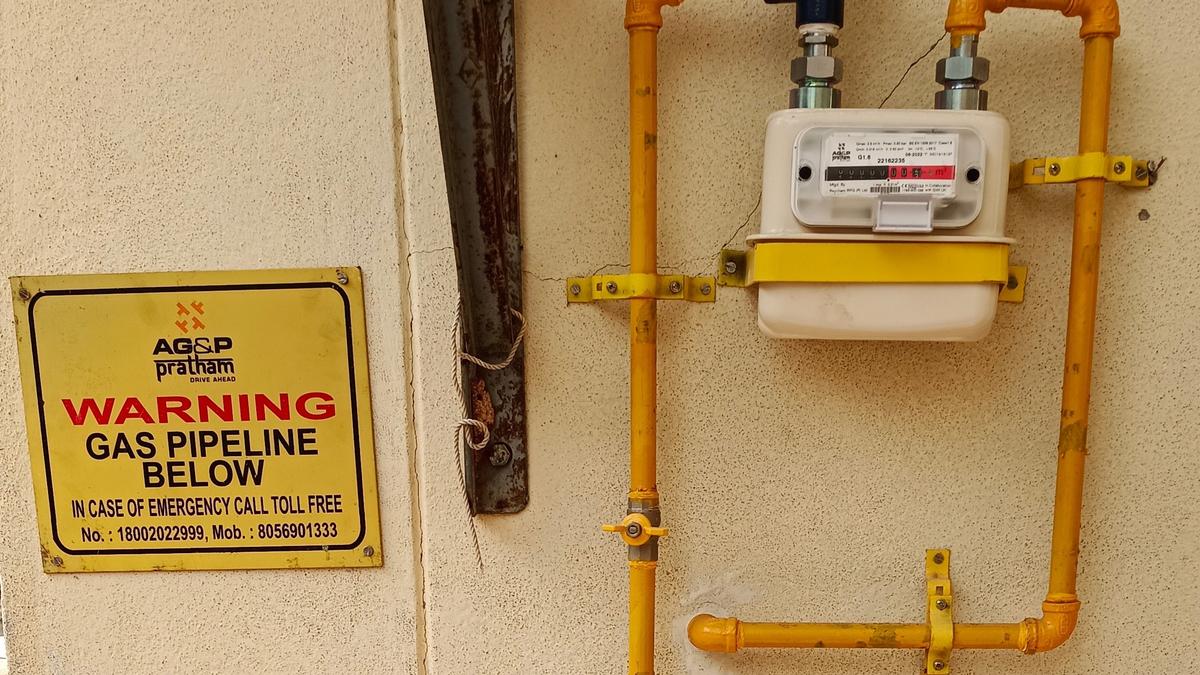
Representational image only. File Photo: Special Arrangement
The Petroleum and Natural Gas Regulatory Board (PNGRB) informed on Friday (August 21, 2026) that it has given its green light for the development of approximately 1,800 km of pipeline infrastructure for transporting Liquefied Petroleum Gas (LPG).
Spanning across six States — Telangana, Maharashtra, Uttar Pradesh, Uttarakhand, Karnataka and Goa — they are estimated to involve a capital investment of approximately ₹7,000 crore.

The pipelines sanctioned include that from Cherlapally (Telangana) to Nagpur (Maharashtra) which is a distance of 556 km, from Jhansi (Uttar Pradesh) to Sitarganj (Uttarakhand) which runs approximately 611 km, and 633 km from Shikrapur (Maharashtra) to Goa & Hubli (Karnataka) Pipeline. State-owned gas distributor GAIL (India) Limited would be developing these projects.
Upon completion, the latest-ratified pipelines are expected to augment the country’s overall LPG network by about 24% from about 7,700 km to about 9,500 km.
Major portion of India’s LPG imports are brought in via coastal locations and then are hauled across to other parts of the country.

“These projects will substantially reduce the movement of LPG tank trucks, thereby improving road safety, lowering logistics costs, reducing traffic congestion and significantly decreasing carbon emissions through a modal shift from road to pipelines,” the regulator stated.
It added that as the country continues to rely significantly on imported LPG, the extensive network would help impart “inherent system resilience”.
Published – August 21, 2026 09:23 pm IST