
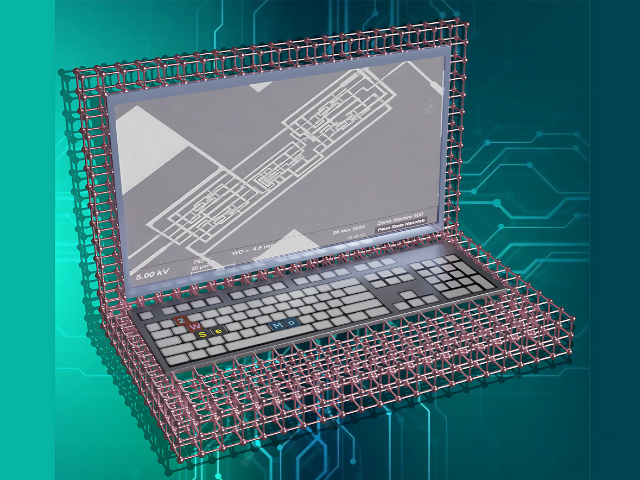
Engineers at Pennsylvania State University have constructed the world’s first computer entirely made from atomically thin two-dimensional materials, bypassing silicon entirely in a step researchers say could pave the way for more compact, efficient electronics.
The development process was published in Nature.
The new device is a functioning complementary metal-oxide semiconductor (CMOS) computer built using two 2D materials—molybdenum disulfide for n-type transistors and tungsten diselenide for p-type transistors.
These transistors are fundamental to regulating current in CMOS circuits, which underpin nearly all modern computing.
“This marks the first time a computer has been built entirely from 2D semiconductors,” said Dr. Saptarshi Das, a professor of engineering at Penn State and the project’s lead.
He added that while traditional silicon loses performance at atomic scales, “two-dimensional materials maintain their exceptional electronic properties at these thicknesses.”
The fabrication process used metal-organic chemical vapour deposition (MOCVD), a technique that produces ultra-thin material layers. The team produced more than 1,000 of each transistor type and adjusted their threshold voltages to create a fully functional CMOS logic circuit.
Though the prototype computer currently operates at modest speeds of up to 25 kilohertz—far slower than commercial silicon chips—it represents a proof of concept.
“Our 2D CMOS computer operates at low voltages with minimal power consumption,” said Subir Ghosh, a doctoral researcher and lead author of the study.
Designed as a one-instruction-set computer, the prototype is not aimed at immediate commercial use but lays crucial groundwork for future flexible, lightweight, and energy-efficient devices.