War-time credibility fuels defence export push as analysts see shift from marginal arms exporter to emerging supplier
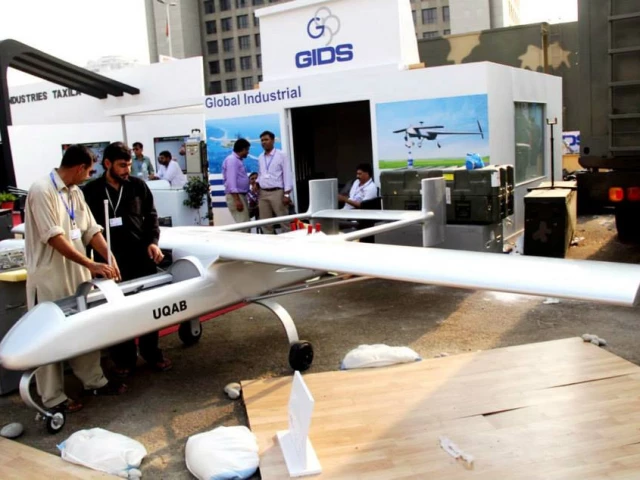
Uqab , a Pakistani drone in IDEAS exhibition. PHOTO: EXPRESS TRIBUNE
KARACHI:
Standing on recently gained credibility following its conflict with India, Pakistan is positioning itself among emerging global defence exporters, as the country lines up potential defence export orders worth $13 billion, a scale that could materially alter its external account dynamics and industrial landscape over the medium term.
“Post the success of Bunyan-e-Marsoos, Pakistan has seen a massive boost to its diplomatic standing with geo-strategic deals and engagements; a key outcome which is emerging from these engagements is the defence deals and defence agreements,” noted KTrade Securities Research Analyst M Faran Khan in a report.
According to a macro research note by KTrade Securities, Pakistan’s defence sector is entering a phase of accelerated outward orientation, driven by rising geopolitical demand, the successful deployment of indigenous platforms, and expanding state-to-state defence engagements across the Middle East, Africa and Central Asia. The estimated $13 billion pipeline includes fighter aircraft, trainer jets, armoured vehicles, drones, naval platforms and ammunition. If materialised, this would be equivalent to more than 80% of Pakistan’s current foreign exchange reserves and around 3.7% of gross domestic product.
This prospective surge comes against a backdrop of historically modest defence exports. Data from the United Nations COMTRADE database, compiled by Trading Economics, shows that Pakistan’s exports of arms and ammunition, parts and accessories stood at $22.38 million in 2024. Over the past decade, annual exports in this category have largely remained in the low tens of millions of dollars, underscoring the step-change implied by the current pipeline of deals.
Analysts say the difference this time lies in scale, geopolitical timing and the maturity of Pakistan’s defence platforms. Flagship products such as the JF-17 Thunder Block III fighter aircraft, Super Mushshak trainer aircraft, Karakoram-8 (K-8) jets, armed and reconnaissance drones, armoured vehicles and naval vessels are increasingly being marketed as cost-effective alternatives for countries seeking to diversify suppliers amid rising global defence spending.
So far, Pakistan’s defence exports remain overwhelmingly state-led, with production concentrated in military-run or government-owned entities. These include the Pakistan Aeronautical Complex (PAC) at Kamra, Heavy Industries Taxila (HIT), Pakistan Ordnance Factories (POF) at Wah, and Karachi Shipyard & Engineering Works (KSEW). These organisations design, manufacture and export jets, tanks, drones, naval platforms and ammunition under government-to-government frameworks.
However, Farhan told The Express Tribune that Pakistan’s private sector is expected to gradually enter the defence value chain, initially as a subcontractor to military-led organisations.
“At the moment, the army-led organisations are producing the jets, tanks, drones and other sensitive equipment,” Farhan said. “But with time, Pakistan’s private sector will also get into this business as a subcontractor to these organisations, depending on the sensitivity of the equipment.”
He added that Pakistan could follow a model closer to that of the United States, where universities and research institutions play a role in research and development, particularly in software, electronics and advanced engineering, while private firms participate in hardware manufacturing, systems integration and services. “On American lines, universities can contribute to R&D for software and hardware, and then the private sector can also contribute along those lines,” he said.
The research suggests that such a transition would not only expand export capacity but also create recurring revenue streams through after-sales services, maintenance, repair and overhaul (MRO), training, spare parts and upgrades – areas that often generate long-term dollar inflows beyond initial equipment sales. The broader macroeconomic implications could be significant. Pakistan’s total goods and services exports currently stand near $37 billion annually, dominated by textiles and agriculture. A successful expansion of defence exports would help diversify the export base, reduce vulnerability to commodity cycles and ease pressure on the balance of payments.
Moreover, KTrade Securities believes a stronger defence manufacturing ecosystem could generate spillover benefits for civilian technology sectors, including avionics, robotics, artificial intelligence and advanced manufacturing, while supporting skilled employment and industrial upgrading.
While the $13 billion figure remains a pipeline estimate rather than realised exports, analysts say even partial execution would mark a structural shift for Pakistan, from a marginal arms exporter to a meaningful participant in the global defence market.