

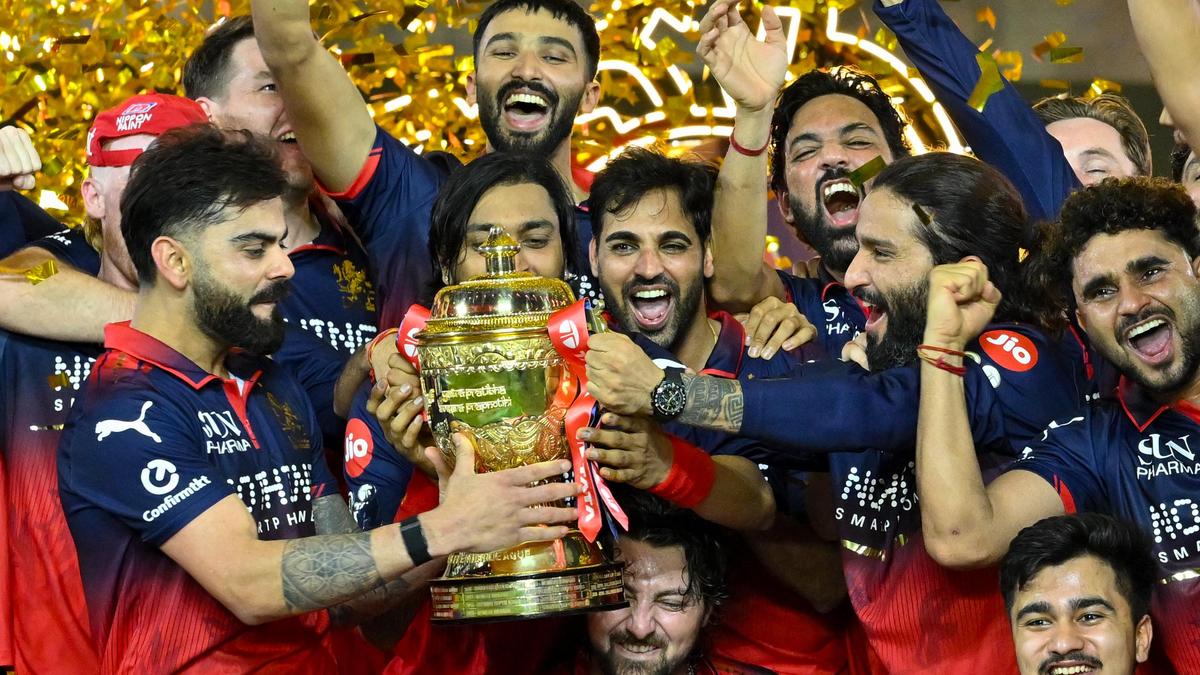
To assert with any certainty that there was always a sense of inevitability about Royal Challengers Bengaluru storming to a second successive IPL title can only come with the assurance of a mission already accomplished. But there is no denying that from the outset, it was clear that this juggernaut would take some stopping.
The weight of the world had been lifted from their shoulders last June, when they ended years of heartbreak with a six-run defeat of Punjab Kings in the final in Ahmedabad. At the same Narendra Modi Stadium, they etched their name on the trophy for the second time on Sunday night, brushing aside Gujarat Titans with a chilling finality that resonated with their army of fans across the world.
Rajat Patidar, the unassuming and unlikely hero of this remarkable transformation, couldn’t have given himself a better birthday gift. The Madhya Pradesh man turned 33 on Monday; he also turned a corner of sorts as he joined M.S. Dhoni and Rohit Sharma as the only captains to have successfully defended the IPL trophy.
‘Attacking’ the title
‘Defend’ was actually a word missing from the Bengaluru franchise’s lexicon all season long. They didn’t quite relish the tag of ‘defending champions’ because that’s not how they have reshaped their philosophy. It was therefore in the fitness of things that they attacked a second title rather than defended the first one.
The skipper was at the forefront of many a stunning cameo, though the more meaningful and numerically significant contributions came from two men who joined the franchise as teenagers so many moons ago.
Virat Kohli was picked up by the flamboyant but also prescient Vijay Mallya at the draft for under-19 players ahead of the inaugural edition. Kohli had just led the Indian colts to a memorable title run in Kuala Lumpur, even then showing a feisty aggression that remains his calling card.
Delhi Daredevils, who had the first bite at the draft cherry, passed up the opportunity to snap up the burgeoning local hero, investing instead in the left-arm pace of Pradeep Sangwan because they felt they already had enough top-order batting options in skipper Virender Sehwag, Gautam Gambhir, Shikhar Dhawan and AB de Villiers.
Gem of a pick
RCB’s turn was next, and they grabbed Kohli with both hands, sparking a bond for the ages. There is no gainsaying how Kohli’s IPL career, potentially even his India career, would have panned out had he turned out first for Daredevils (renamed Delhi Capitals). But with RCB, he has grown organically, from a young tyro occupying a dressing room populated by the likes of Rahul Dravid, Anil Kumble, Jacques Kallis and Shivnarine Chanderpaul, among others, to a leader of men and now an elder statesman who continues to be the fulcrum that has effectively kept Father Time at bay.
Virat Kohli played a huge role in RCB’s triumph.
| Photo Credit:
K.R. DEEPAK
Kohli is 37 and a half, a young man in all aspects except sporting, you’d imagine. In cricketing terms, even for a batter, 37 and a half is a lot closer to the end of one’s career than its beginning. But if you didn’t know who Kohli was and what his age was (which is impossible for anyone who has even a fleeting interest in the sport), you’d not even start to guess that he has been playing at the international level for nearly 19 years.
Even today, despite having achieved almost everything there is to achieve, among them World Cup triumphs in both the 50- and 20-over versions, he is energised by the scent of battle, by the prospect of taking on and taming the fastest, the craftiest and the wiliest bowlers in the business.
Internationally, he only plays 50-over cricket, and isn’t therefore seen in India colours as much as his adoring supporters would want. Maybe that has contributed to his freshness because over the last two months, Kohli has been a compelling, commanding figure who has towered over the others with his intensity and unhidden passion.
He is still prone to histrionics — needless, many might harangue — but even that is part of the larger-than-life Kohli persona, a way of rousing himself up that seems to be working wonders for him.
At the top of his game
Kohli finished as his franchise’s leading run-maker and fourth overall in the Orange Cap race. In the past, he has made plenty more than his 675 runs this season, but he hasn’t scored those runs at the same rate that marked his domination of this campaign.
Kohli hammered 73 fours — the third most after Sai Sudharsan (75) and Shubman Gill (74) — and 25 sixes as he struck at 165.84. The boundaries accounted for 65.5% of his runs, but he also didn’t forget the lifeblood of run-making, which is the humble single and slightly less modest two.
He egged on men a decade and more younger to keep looking for twos when even a run and a half was a stretch, he threw himself around the park with an enthusiasm that would have put the 15-year-old Vaibhav Sooryavanshi to shame, and — lest we should forget that avatar — he was in the face and ears of the opposition batters, snarling and growling and sometimes opting to ignore outstretched right hands after a game, such as with Travis Head of Sunrisers Hyderabad.
Skipper’s meteoric rise
Fears that the towering, inescapable shadow of Kohli would stymie Patidar’s growth as a leader of men have proved singularly unfounded in the last two years. Patidar’s has been an interesting journey with the franchise. Bought in 2021, released after a disappointing season and requisitioned late in 2022 as an injury replacement for Luvnith Sisodia, Patidar reminded everyone of his extraordinary skills with a century in the Eliminator against Lucknow Super Giants.
He missed the whole of IPL 2023 with a severe Achilles’ heel injury for which he underwent surgery but re-announced himself with 395 runs (SR: 177.13) in 15 outings in 2024. When RCB decided to move on from Faf du Plessis and cast their collective eye inwards for the next leader, their gaze settled firmly on Patidar, him with little leadership experience at any level. What a masterstroke that turned out to be.
The deciding personnel, Kohli certainly among them, were impressed by Patidar’s calmness and composure under pressure, the respect he enjoyed within the group and his tactical awareness as well as his ability to think on his feet. To the outside world, it might have seemed an optimistic gamble, but the wisdom of the move to elevate Patidar to the captaincy became increasingly obvious as IPL 2025 unfolded.
Patidar himself has grown in stature, his confidence evidently bolstered by ending RCB’s seemingly ceaseless barren run in the tournament. This season, he was at his aggressive best, fusing 501 runs with a staggering strike-rate of 192.69. He set stall as the consummate six-hitter, smacking 42 off them in just 260 deliveries and taking down the most celebrated bowlers, including Kagiso Rabada and Rashid Khan, with a majestic approach bordering on the disdainful. He has remained his own man despite the presence of such gargantuan figures as Kohli and Josh Hazlewood, leading by example and therefore not having to ask of his charges what he himself didn’t do.
Around him, the likes of his old mate Venkatesh Iyer, Devdutt Padikkal, Tim David and Krunal Pandya flourished with the bat, thriving on responsibility and role clarity. The aura around this batting group allowed them to carry the gifted but underachieving wicketkeeper-batter Jitesh Sharma with no discernible weakening of the team’s firepower.
Experience is gold
Such is the lot of the bowlers that they are often relegated to second-class status, but RCB haven’t allowed that to come in the way of their appreciation of the other teen-turned-veteran, Bhuvneshwar Kumar. ‘Bhuvi’ joined the franchise in 2009 when 19 and didn’t play a single game but is now the unquestioned leader of a solid bowling group with the peerless Hazlewood as his partner-in-crime and young Rasikh Salam more than holding his own, as evidenced by 19 wickets and an economy of 9.45.
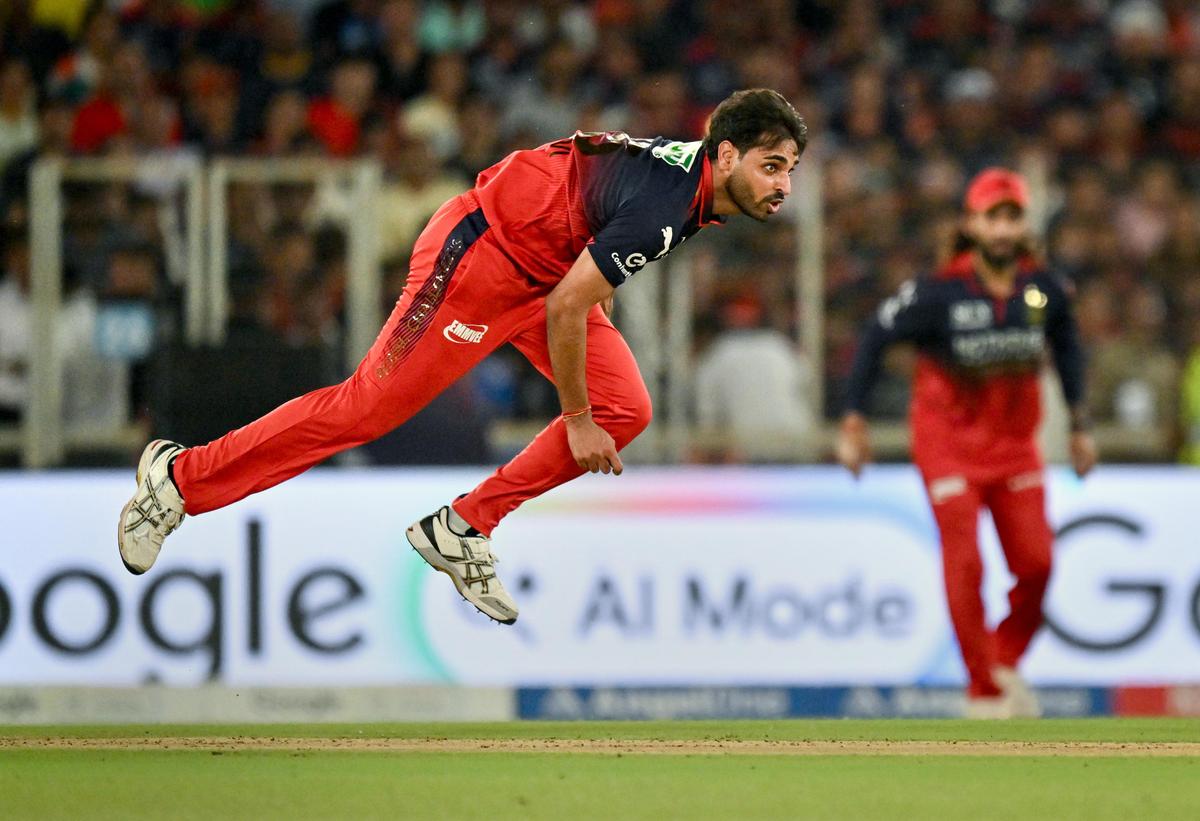
Bhuvneshwar Kumar was the second-highest wicket-taker in IPL 2026.
| Photo Credit:
K.R. DEEPAK
Bhuvneshwar is a shining example of going about his business with little pomp or fanfare, insulated from the reactions around him and sticking to his strengths while constantly evolving as a thinking bowler. He has added subtle nuances to his craft, including an ultra-effective knuckle ball, without sacrificing his core weapon, beautiful swing with the new ball. Bhuvneshwar won the Purple Cap for two years on the bounce, in 2016 and 2017, when he was with Sunrisers.
A decade on from his first taste of the bowling honours, he finished second on the wicket-takers’ list (behind Rabada) with 28 scalps, his exceptional economy of 7.95 the ultimate reflection of his outstanding control despite bowling in the most demanding phases of a T20 innings.
When he moved to RCB at the beginning of the 2025 season after 11 years with Sunrisers — he was one of the stars during the latter’s title march in 2016 — that too was seen as a punt, much like Patidar’s coronation. The previous year, Bhuvneshwar had taken only 11 wickets in 16 games, but RCB were willing to dish out Rs 10.75 crore at the mega auction to acquire his services.
It was money superbly spent; while Hazlewood was the leading wicket-taker for the side in IPL 2025 with 22 scalps from just 12 games, Bhuvneshwar played second fiddle with 17 sticks. The roles were emphatically reversed this time — the Meerut master was head and shoulders above the rest while Hazlewood was somewhat inconsistent, settling for 15 wickets and conceding 9.59 runs per over.
Together, though, this was a fabulous new-ball pairing, sometimes split by New Zealander Jacob Duffy, the T20 specialist who was signed as an insurance for Hazlewood but who had his moments, including a Player of the Match performance on debut in the season-opener against Sunrisers.
Fears that left-arm pacer Yash Dayal, who had a great IPL 2025, would be sorely missed were offset by the emergence of Rasikh as a bankable third, sometimes fourth, seamer, while Krunal’s street-smartness and the courage of leg-spinner Suyash Sharma, used sparingly but smartly, meant the spin was in capable hands.
Beyond Bhuvneshwar and Hazlewood, RCB didn’t have what seemed to be an intimidating attack — look, for instance, at Titans, who boasted Rabada, Mohammed Siraj, Prasidh Krishna, Jason Holder and Rashid — but then again, when have games and titles been won on paper?
RCB had Kohli and Bhuvneshwar, and a host of other match-winners, ensuring that the whole was significantly more than the sum of their impressive parts.


