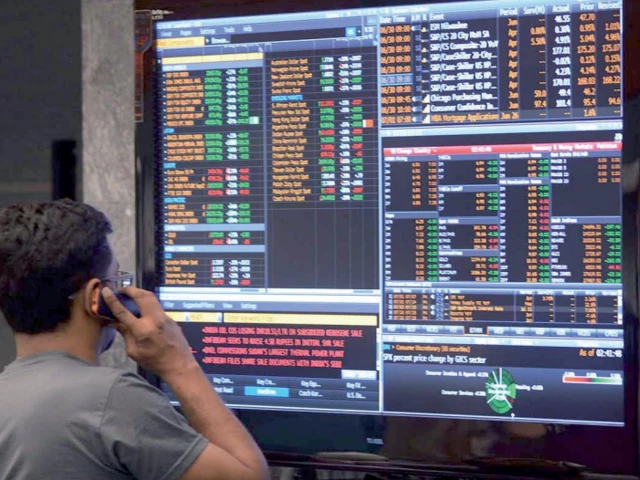

Investors fled to the safety of bonds on Friday as stocks extended their slide in both Europe and Asia after worries around the AI boom wiped trillions of dollars off the major U.S. indexes.
Europe’s FTSEurofirst and STOXX 600 benchmarks both fell more than one per cent early on as traders continued to fret that the Democrats’ victory in this week’s US midterm elections will lead to tougher rules around AI data centres.
Wall Street saw a modest bounce early Friday, especially for the Nasdaq later after its trillion-dollar plunge on Thursday, although that did not comfort Asia overnight.
Japan’s Nikkei and South Korea’s KOSPI both slumped about six per cent. For the Nikkei – as for Wall Street – that was the deepest one-day drop since U.S. President Donald Trump’s “Liberation Day” trade tariff panic of April 2025.
Taiwan plunged more than eight per cent at one point, before cutting losses as authorities scrambled to stem the selling.
“This has been brutal,” James Athey, a fund manager at investment firm Marlborough in London, said, explaining that retail and hedge fund selling were feeding off each other.
“The question is where we go now? We are still looking at indexes that are near record highs and a sector (AI) where capex is still massive. So I think it is going to be a huge test of market sentiment – and the belief in AI – in the coming days.”

The strain on equities meant government bond markets continued to rally, while the U.S. dollar, Japanese yen and Swiss franc all lured safe haven flows in the currency markets.
The yield on the benchmark U.S. 10-year Treasury note was at 4.84 per cent in Europe, hovering near the lowest level since Sept. 9.

Get weekly money news
Get expert insights, Q&A on markets, housing, inflation, and personal finance information delivered to you every Saturday.
The ten-year Japanese government bond yield dropped as much as nine basis points overnight to 1.795 per cent, the lowest since June 30. Triple A-rated German bunds then saw yields dip to 3.22 per cent, their lowest level since late August.
“Bonds are increasingly behaving like bonds again, with income re-emerging as the primary driver of returns and restoring their traditional diversification benefits,” said Masahiko Loo, chief fixed income strategist at State Street Investment Management.
“This looks more like a reassessment of AI policy risk than a reassessment of the AI cycle.”
A near 1.5 per cent rise in Nasdaq futures and a dip in Wall Street’s VIX “fear gauge” pointed to some respite for U.S. markets Friday.
Texas Governor-elect Gina Hinojosasaid on Thursday that the state – which already has a large share of U.S. data centres – will introduce new laws around them to protect local residents.
The tech-heavy Nasdaq went on to slump 5.5 per cent on Thursday – or US$2.5 trillion. Some $3 trillion was also wiped off S&P 500 firms, with investors worried the brakes will be applied to the AI boom more broadly.
“It’s actually a bit of a disaster,” said Christopher Forbes, head of Asia and Middle East at CMC Markets.
“All night, all day – we had client margin calls, client complaints … because it’s a very emotional thing, right? People are wedded to their positions and views on a stock or outcome and you’re telling them, look, you’ve just lost money.”
The jitters are hitting an AI trade already on shaky ground due to fears that the massive cost of the data centres and other infrastructure will limit future returns – the meltdown has been spurring margin calls and spooking retail investors and hedge funds alike.

AUTHORITIES ATTEMPT TO SOOTHE NERVES
Some of Asia’s authorities stepped in overnight to try to soothe nerves.
South Korea temporarily eased rules on retail investors’ leveraged investments and multiple sources told Reuters that Taiwan’s Ministry of Finance called senior executives at state-owned banks, instructing them to support the market.
Taiwan stocks closed down 4.5 per cent, recovering somewhat from their early morning slump. For the week though, the index clocked a 12.2 per cent dive, its biggest since 1991, LSEG data showed.
Korean AI chipmakers also trimmed some of their losses although still closed sharply lower. In Japan, tech investor SoftBank slid 11 per cent, with the cost of insuring its debt against a default jumping to its highest in four years.
“After damage like the sort we’ve been facing, it is difficult to think that we simply can bounce from here,” said Steve Sosnick, chief strategist at Interactive Brokers.
“We may be oversold in the short term, but the underlying questions and causes can’t simply be wiped away.”