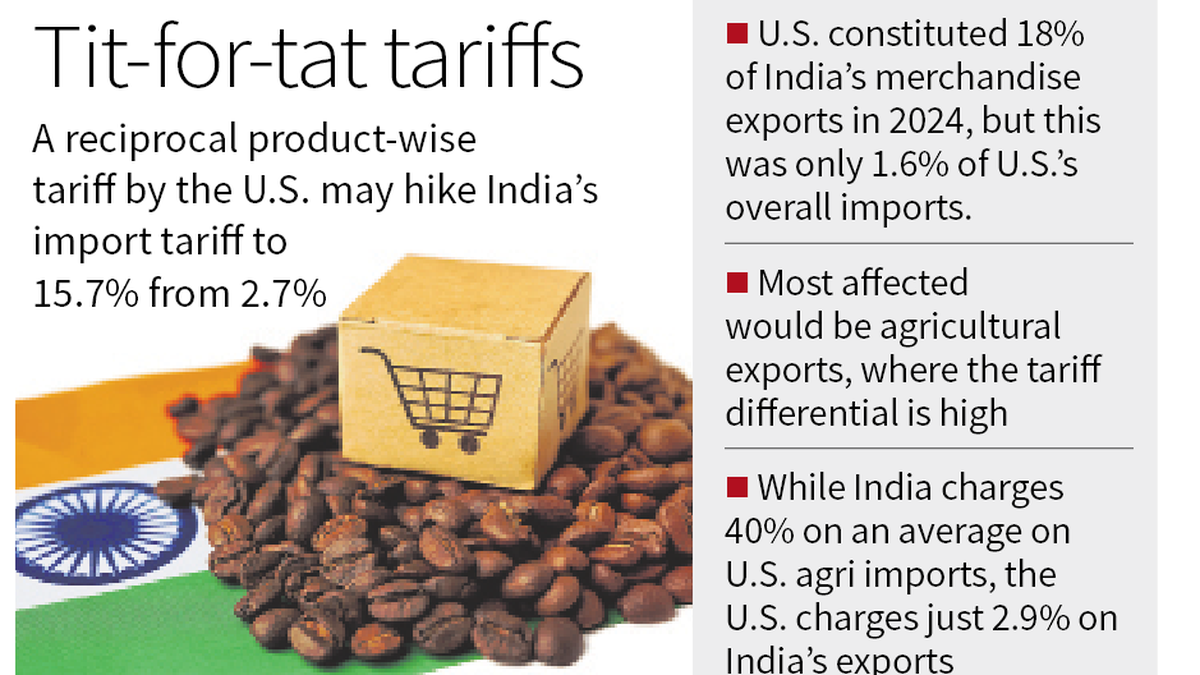
India is not likely to opt for across-the-board tariff reduction and may instead work around reciprocal tariffs by easing non-tariff barriers, according to economists at Barclays Research. “A reciprocal, like-to-like tariff by the U.S. may increase India’s import tariff to 15.7% from the current 2.7%, covering almost all exports,” according to the note.
A way to work around this would be easing non-tariff barriers, which may include expanding purchases from the U.S., according to Barclays.
It may be noted that U.S. President Donald Trump had said that non-monetary barriers would face retaliation with the same type of trade barrier.
The U.S. constituted 18% of India’s merchandise exports in 2024, while this was only 1.6% of U.S.’s overall imports. The difference between India’s import tariff on the U.S. and vice versa is 6.5%, according to a Nomura report. This is the highest among emerging economies, it said.
The most affected would be agricultural exports, where the tariff differential is high — while India charges 40% on an average on U.S. imports, the U.S. charges just 2.9% on India’s exports. Economists at Barclays estimate that India could face a 2.3% higher weighted import duty on agri products.
“Our analysis suggests that India possibly does not need to reduce import tariffs for some agricultural products, even with the looming threat of reciprocal tariffs,” the Barclays economists said.
Published – March 28, 2025 10:45 pm IST