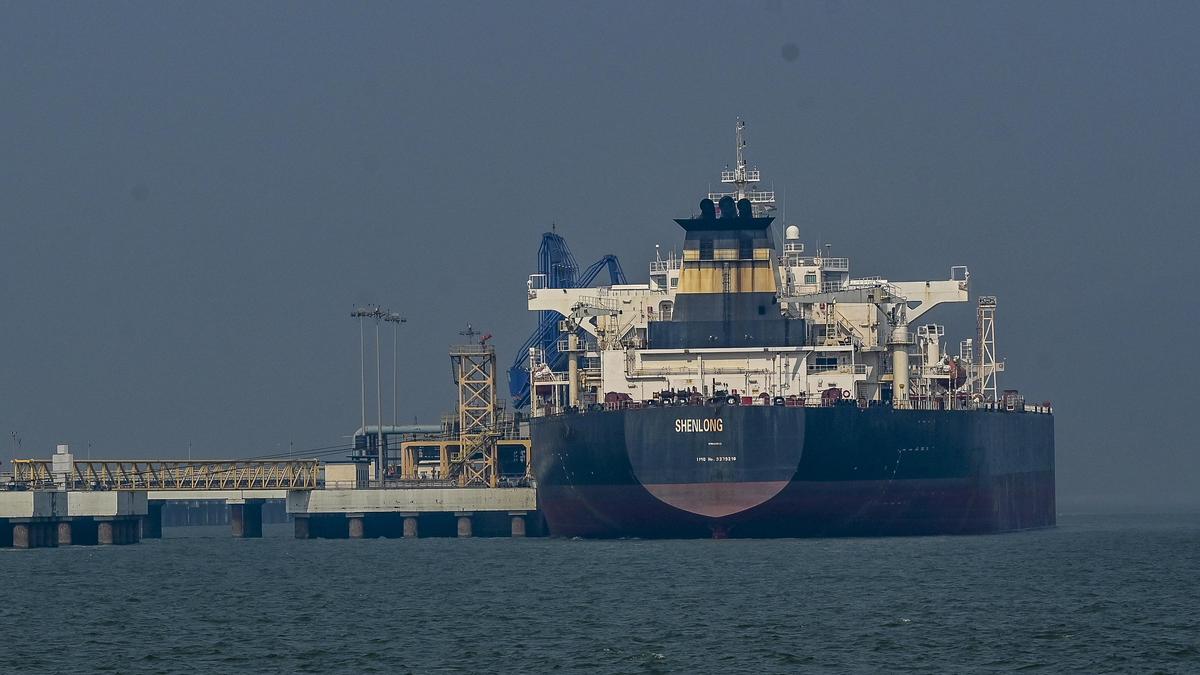
A crude oil tanker, ‘Shenlong’, that passed through the Strait of Hormuz, has arrived at Mumbai Port. File picture
| Photo Credit: Special Arrangement
The Indian government is “experimenting” with conducting trade with the West Asian countries in local currencies, in a bid to mitigate the fiscal double-hit of surging oil prices and a depreciating rupee, according to two senior officials in the government. Another objective is to save on currency conversion costs.
Follow the Iran Israel war LIVE updates
If this fructifies, it would mean India would be paying for about 80% of its oil imports using local currencies rather than the U.S. dollar.
Also Read | Explained: The India-UAE deal to trade with local currencies
“India is working out a mechanism to pay for imports from the GCC [Gulf Cooperation Council] countries in local currencies,” a senior government official told The Hindu.

Triggers for dollar alternatives
The triggers for this move, he explained, were the upward spiral of oil prices and the downward spiral of the rupee.
The price of the Indian basket of oil — which is a weighted average of the prices of various types of oil from Oman and Dubai and of Brent crude — stands at $123.15 per barrel currently, as per government data. This is up from an average of $69 per barrel in February 2026.

Simultaneously, the rupee touched an all-time low of ₹94.1 against a dollar earlier this week, before settling slightly higher. The exchange rate was at about ₹91.3 per dollar before the Iran war broke out.
A combination of these two factors has meant that Indian importers have had to pay much more for each import transaction conducted in the U.S. dollar, especially for oil.
Currency conversation savings
According to another official in the Ministry of Commerce and Industry, the other advantage India will see through such a local currency mechanism, is a drastic reduction in currency conversion charges.
“It is an experiment on which we are working,” the second official said. “Primarily to save on the cost of currency conversion at several stages. You save on the charges on converting the rupee to the dollar, the dollar to the local currency there, the local currency back to the dollar, and then the dollar back to the rupee.
“Each conversion costs about 1-2% of the total transaction value, and so about 5-6% will be saved if we just deal in local currencies, which is a lot when it comes to high value transactions,” he added.
Oil trade in local currencies
India currently already pays for Russian oil using a combination of local currencies and dirhams. Russia accounted for 30.4% of India’s oil imports in the April 2025 to January 2026 period. The GCC countries account for another 49%.

Taken together, such a local currency deal would mean close to 80% of India’s oil imports would be paid for in currencies other than the U.S. dollar.

Moving away from using the dollar for such high value transactions might, however, attract American ire. U.S. President Donald Trump has in the past threatened a 100% tariff on countries looking to adopt alternate currencies to the dollar. The U.S. Supreme Court’s decision might have removed this threat, but Mr. Trump’s determination to use tariffs as a compulsion tool remains.
Published – March 26, 2026 06:48 pm IST