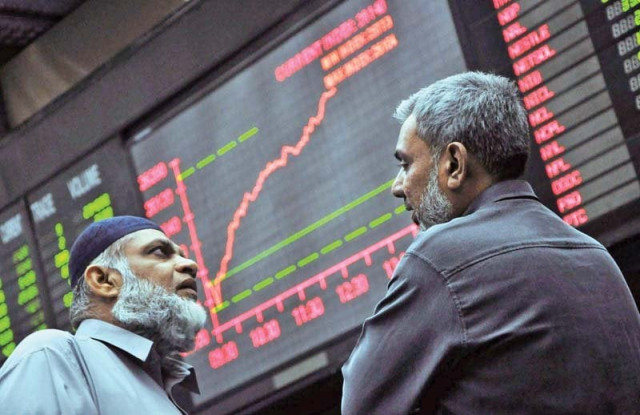
Foreign funds would divert their liquidity into buying Pakistan’s stocks. This would merely increases prices of shares and be profitable for those who already hold stocks. PHOTO: FILE
KARACHI:
Pakistan’s benchmark KSE-100 Index soared to a fresh all-time high of 169,964.52 points, gaining 1.66% week-on-week to close at 169,865, fuelled by the International Monetary Fund (IMF)’s approval of a $1.2 billion disbursement under the Extended Fund Facility (EFF) and the Resilience and Sustainability Facility (RSF).
On a day-to-day basis, the Pakistan Stock Exchange (PSX) began the week on a strong note, with the index gaining 1,218 points (+0.73%) to close at 168,303. The momentum continued on Tuesday as the KSE-100 closed at a new peak of 169,456, gaining 1,153 points or 0.69%.
On Wednesday, the index briefly breached the key psychological barrier of 170,000 during intraday trading, but profit-taking at and above that level pulled the market back, resulting in a flattish close at 169,452 points, down just five points. PSX attempted once again on Thursday to close above 170,000 but fell short, with the KSE-100 ending at 168,575, down 877 points or 0.52%.
On Friday, the third consecutive attempt, the market again approached the 170,000 level but narrowly missed it, with the index settling at 169,865, up 1,290 points or 0.77%.
Arif Habib Limited (AHL), in its weekly report, noted that the index increased from 167,086 last week to 169,865 this week, posting a gain of 2,779 points (1.66%). Sentiment was supported by the IMF’s $1.2 billion disbursement under the EFF second review and the first tranche of the RSF, along with the settlement of Pakistan Energy Sukuk (first phase), a step toward addressing circular debt in the power sector.
Remittances by overseas Pakistanis increased by 9% year-on-year to $3.19 billion in November 2025 compared to $2.92 billion in November 2024. On a month-on-month basis, remittances decreased by 7%. In 5MFY26, they rose 9% year-on-year to $16.14 billion.
This week’s T-bill auction saw the government raise Rs981.7 billion against a Rs1 trillion target, with strong participation of Rs1,925.1 billion. Yields eased slightly across all tenors by 13 basis points. Oil production inched up 0.1% week-on-week to 66,014 bpd, while gas output rose sharply by 6.1% to 2,917 mmcfd, supported by higher flows from Mari, Uch and Qadirpur.
Net metering’s share in total generation increased by 112 basis points year-on-year in October 2025, reflecting rising solar adoption and lower grid reliance. Overall power generation declined 3.7% year-on-year in October 2025. NEPRA expects power demand to grow 2.8% year-on-year in FY25. On a month-on-month basis, net metering units increased by 43.3%.
Auto sales (cars, LCVs, vans and jeeps) fell 11% month-on-month to 15,400 units in November 2025, though they increased 53% year-on-year.
Syed Danyal Hussain of JS Global noted that the KSE-100 regained momentum this week, closing at an all-time high of 169,964.52 points, up 1.7% week-on-week. He said sentiment improved following the IMF Executive Board’s approval and noted that the Fund reported Pakistan had met 8 of 13 structural benchmarks while introducing 11 new ones going forward. The IMF also revised down its GDP growth projection for FY26 to 3.2% from 3.6% earlier, while raising its fiscal and external sector outlook for subsequent years.
In other developments, the government approved a concessional tariff of Rs22.98 per unit on additional electricity consumption from the benchmark year to promote industrial and agriculture sectors. In the latest T-bill auction, the government raised Rs982 billion against a Rs1,055 billion target, with yields largely flat across tenors. State Bank reserves increased by $12 million to $14.6 billion.