

Trigger warning: This article has references to suicide. Please avoid reading if you are distressed by the subject.
A month ago, in Revaniya, less than 100 kilometres from the industrial hub of Rajkot in Gujarat, villagers woke up to the news of the suicide of a 60-year-old farmer, Dhanabhai Jadav.
Dhanabhai’s son, Bharat Jadav, 28, is yet to come to terms with the loss. Standing in front of his one-room hut, Bharat, who had a son recently, explained that Dhanabhai faced two problems: “First, the rate of cotton was going very low, to ₹1,200-1,300 per mann (about 20 kilogrammes). Second, the non-seasonal and excess rains of October 25 damaged crops, just ahead of the harvest. He could not come to terms with the fact that prices and production would be low.”
After conducting an aerial survey of the affected districts, Chief Minister Bhupendra Patel announced a relief and assistance package of approximately ₹10,000 crore for the losses and said the State government would purchase groundnuts, moong, urad, and soybean worth over ₹15,000 crore from farmers at support prices from November 9.
Bharat said his family is yet to get any compensation. “No one from the government came here. We did not get any compensation,” he said.
The family was working hard to make both ends meet, he added. “We hope that the crops of cotton, pulses, and peanuts in the seven bighas (about 4.3 hectares) of land we own will help us repay loans,” he said.
Rajubhai, a friend of Dhanabhai, has not visited his friend’s farm since his death. “I used to see him working tirelessly every day. All of us worked to make a living. If cotton failed, we tried growing peanuts. If peanut failed, we would try pulses. If that too failed, we would cultivate vegetables,” he said, while walking to his friend’s house across a mud road, away from the village centre. “This year, the damage was unprecedented and the decline in prices was unexpected. But I didn’t think that he would take such an extreme step. I wanted to tell him, ‘let us try chana dal (chickpea) next time.’ But it was too late.”
Following the rains of October 25, farmer organisations say six farmers have died by suicide in Gujarat. “Four of them were cotton farmers,” said Dayabhai Gajera, a leader of the All India Kisan Sabha, a peasant organisation that claims to have 1.5 lakh members. While the government has said it has offered compensation and assistance to the farmers, the Opposition has said the government ignored the deaths.

The deaths occurred in the Saurashtra region, famous for production of cotton, groundnuts, and pulses. The farmers are now staring at a crisis, as free entry of imported cotton has further reduced prices.
Problem of importing cotton
According to the Commerce Ministry, India imported cotton (raw and waste) worth ₹2,069.12 in October this year, which is almost twice as much as it imported last October (₹1,073.08 crore). Though India is the world’s second-largest cotton producer after China, the textile industry has been pushing for cotton imports, largely because countries such as the United States, China, and Brazil offer cheaper cotton. The industry, spread across the country, is India’s second-largest employer after agriculture.
Farm leaders, traders, and ginning millers in Gujarat say this year’s decrease in prices has been caused not just by rains, but also the import of raw cotton. “Last year, we got about ₹1,500 for a mann of cotton. As soon as the import tariffs were waived off, the amount decreased to ₹1,200-1,300,” said Gajera.
On August 19, the Union government exempted all customs duties on the import of raw cotton until September 30. It stated in a press release that the measure would bring relief to manufacturers and consumers. On August 28, the government further extended the import duty exemption until December 31.
“The decision, notified by the Central Board of Indirect Taxes and Customs, is expected to stabilise the input costs across the textile value chain, including yarn, fabric, garments, providing relief to manufacturers and consumers alike. This strategic intervention ensures that the textile sector remains globally competitive while safeguarding the interests of domestic cotton farmers,” the government said in a press release.

The government claimed that farmers’ interests are safeguarded through the Minimum Support Price (MSP) mechanism operated by the Cotton Corporation of India Ltd. (CCI), which ensures that farmers receive at least 50% above their cost of production.
“Imported cotton often caters to specialised industrial requirements and does not substitute domestic cotton,” the government explained in a press release. “Most imports occur during lean periods or when domestic stocks are insufficient, which minimises competition with peak domestic procurement periods. The government monitors cotton prices closely and retains the flexibility to impose safeguards as and when required.”
According to the Textiles Ministry, the provisional acreage of cotton for 2024-25 is 114.47 lakh ha. This is a decrease of about 1.2 million hectares compared to the acreage of 2023-24 (126.88 lakh ha). The government, however, expects that the yield will be similar to last season’s, of about 437 kg per ha.
The farmers claim otherwise. Ramkubhai Karpada, a farmers’ leader in Surendranagar, says cotton prices have remained the same for almost 13 years. “In 2012, the rate of cotton was ₹1,500 for a mann in the open market. The input cost was much lower then (at least ₹200 less for a bag of cotton seeds and ₹300 less for pesticides). Now the price of cotton is lower and the input costs are high. Hybrid seeds can cost between ₹850 and ₹4,500,” he said.
The MSP announced by the government is ₹7,710 for a quintal of cotton. Farmers argue that they get just about ₹4,500-6,000 for a quintal, which is almost half of the MSP. According to the government, only 34.04% of the cotton was procured under MSP operations in last year.
There are other logistics issues that worry farmers. Karpada said Surendranagar is one of the biggest production hubs of cotton. “But this district does not have a proper market or market yard under the Agricultural Produce and Livestock Market Committee (APMC). Farmers have to go to nearby districts to sell their produce. Farmers have been demanding a proper procurement system in the State. They are not getting the input prices. From top to bottom, the APMC system has been corrupted by a few influential traders. They deny prices to farmers on flimsy technical issues,” Karpada said.

The Opposition Aam Aadmi Party (AAP) has announced a series of protests, including mahapanchayats of farmers in each district of Gujarat. Mayur Sakariya is the president of the AAP’s farmers’ wing in Surendranagar. He also organises farmers in the nearby Botad district, also part of the Saurashtra region. “No farmer is getting MSP in this season. The government should have ensured procurement of cotton by the CCI under MSP. The fact is that the price has not increased in the last 13-14 years. That was why six farmers died by suicide,” he said.
A double blow
Farm leaders argue that cultivation has come down because of stagnation in the prices of cotton in open markets. “But the input costs are increasing. Why then should a farmer cultivate cotton? They are either shifting to peanut or pulses or not sowing anything at all,” Sakariya said, adding that the government’s decision to waive off import duties was a blow.
“This was done due to the pressure from U.S. President Donald Trump. Industry can now easily import cotton from the U.S., Pakistan, Brazil, and China. They are not buying cotton from Botad, but from abroad. It will be a double blow for farmers and MSMEs,” said Sakariya, who has cultivated cotton in 36 bighas of land.
Sakariya is at a district session court in Botad. He has come to meet about 80 farmers who are in various jails in Gujarat for protesting against the alleged corruption in APMC markets. He explained that farmers were not getting adequate price support and faced a decrease of ₹25 to ₹100 per mann. Sakariya said the farmers decided to hold protests in Botad on October 10, which was followed by a mahapanchayat after two days.
“Some miscreants attacked the gathering. Instead of arresting the miscreants, the police arrested 84 farmers on non-bailable charges. Only six farmers have got bail as of November 26. Several farmers were injured as they were attacked by the goons and lathi-charged by the police,” he said, adding that all of them are cotton farmers.
Industries also agree that the imports from the U.S. have increased. “Yes, there is a measurable increase in U.S. cotton exports to India, after the removal of import duty restrictions. The duty cut is one likely factor among others (supply shortfall and trade shifts are others),” said Mukesh Kansal, Chairperson, CTA Apparels.
Need to increase yield
Sagar Chandreshbhai Patel, a young entrepreneur, has been running his family’s ginning mill for the last 12 years. His mill, Ambika Cotton industries, was started by his uncles 26 years ago. A postgraduate in international business management, he joined his uncles after his studies.

“The youth does not like this work. There is more field work. We need to check every vehicle that brings cotton from farms — to ensure that the quality of cotton is good,” he said, adding that decrease in production of cotton is because of the low quality of cotton seeds used in Gujarat.
Patel, a farmer, is also widely travelled. He has attended global seminars and workshops on the industry. “Other countries have fifth or sixth generation of BT cotton seeds. Their per acreage yield is much higher than ours. We need to increase our yield. Only then will we be able to sell at an international rate. Indian cotton is the most expensive in the market. The prices are high because of low yield,” he said.
According to him, the problem has become severe in the last 5-6 years. “New seeds should be approved on an urgent basis. There is a price cap on sale of cotton seeds, as per the Cotton Seed Price (Control) Order, 2015. So we are not getting good seeds. Farmers are ready to pay more if there are good quality seeds that give higher yield. In one bigha, we get 12-15 mann cotton. In Brazil farmers, get 60-70 mann,” he said.
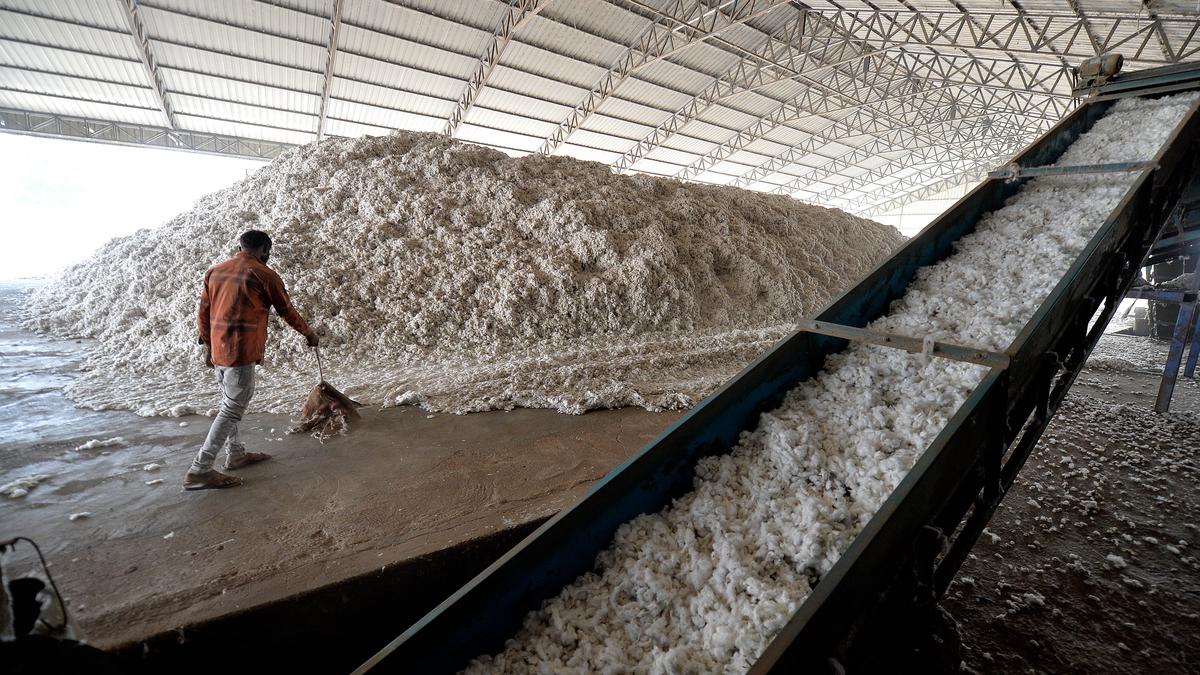
His factory processes 36,000 metric tonnes of cotton in a year. He increased processing after taking over the business. “Earlier, this area had 20 factories, but now only five factories are working. My products go to spinning mills in Gujarat and other States. We used to export to Bangladesh, but for the last three years, we have not been exporting there as our price is not competitive,” he said.
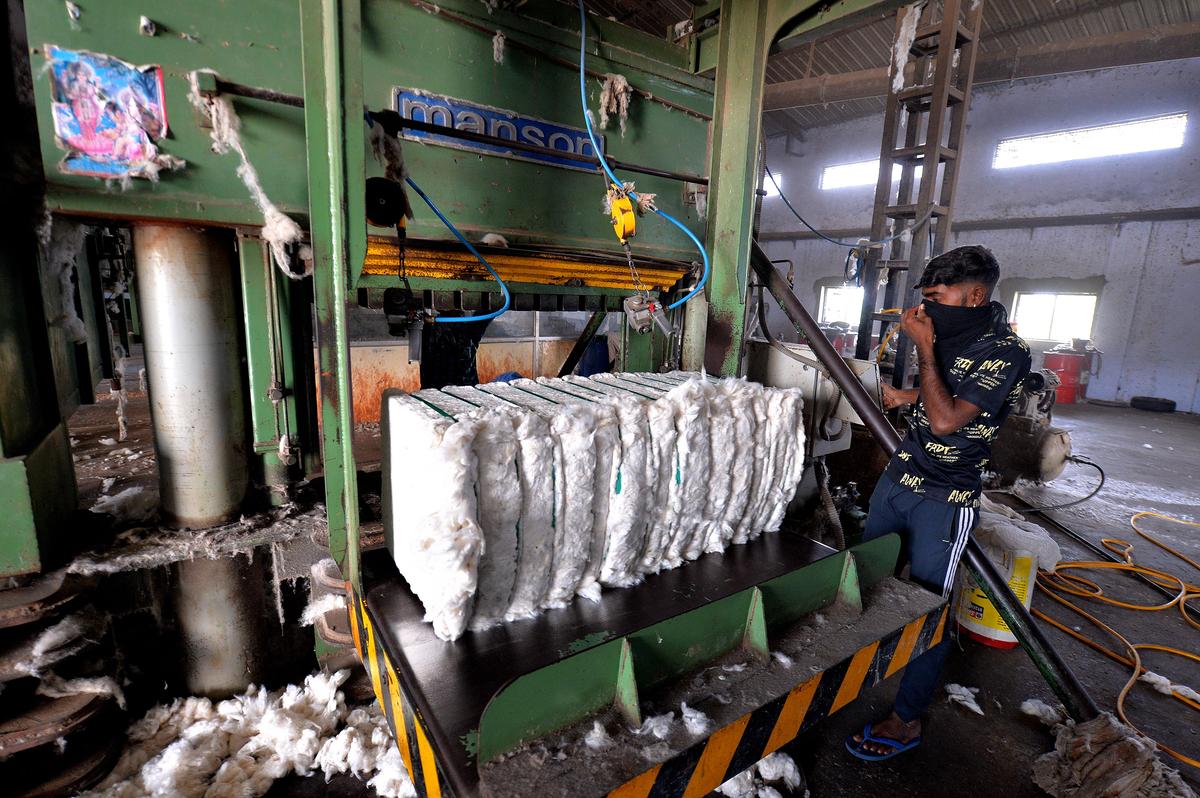
Workers at a ginning mill near Surendranagar, Gujarat.
| Photo Credit:
Vijay Soneji
He is concerned about the duty-free import of cotton. “If imports increase, spinning mills will benefit, but ginning mills will suffer. Usually in the months of November and December, spinning mills buy from us. Now, they are taking imported cotton. Our product has not moved from godowns,” he said.
Patel emphasised that farmers and ginning mills are facing a crisis. “Our production is coming down. We have given representations to government that the import duty should not be waived off beyond October 31. But it was not heeded. Some 70% of the ginning families in the State have closed down,” he said. Patel chose this industry but says none of his cousins did.
Moving to traditional cotton
Farmers are shifting from BT cotton to the traditional cotton seed, kala kapas, to reduce input costs. Rana Kripal, a farmer from Sadad, Surendra Nagar, believes that organic farming of kala kapas will help farmers resist imported cotton. “It doesn’t need pesticides and needs very little water. The input cost is lower and sometimes it gives more yield than BT cotton. The harvest will take another two months compared to the hybrid varieties. Two of my brothers also use this seed. Non-seasonal monsoons do not impact this variety. In this village, most people cultivate this variety,” he said.
According to him, traditional varieties resist pink bollworm, a major menace, as well. “People shifted to BT cotton as irrigation improved. Now people are shifting back to this variety. For 1 bigha, if it is BT cotton, the cost is ₹50,000. For this, it is about ₹30,000-35,000,” he said.
Gajera added that for the last 4-5 years, farmers are facing severe losses. He said the State government had last year estimated cotton production of 1 crore bales. This year, it is about 78 lakh bales. “The actual production will be around 65 lakh bales, much less than the target production. The government announced compensation for the deaths, but did not say anything about suicides,” he said.
Cotton is an emotional crop, added Gajera. “BT cotton provides more yield. But it is more vulnerable to diseases and fluctuations in climate. The seeds production is controlled by big private companies. There is no control on them. The new Seeds Bill draft will help these companies. The government is leading farmers to an age of darkness. Our future is uncertain,” he said.
If you are in distress, please reach out to these 24×7 helplines: KIRAN 1800-599-0019; Aasra: 022 27546669 or any of the numbers found in this link.


1733130350-0/Untitled-design-(76)1733130350-0-640x480.webp "HEC makes AI course mandatory for all degree programmes from 2026 | The Express Tribune")