Says plugging tax leakages will help boost revenues without imposing additional taxes
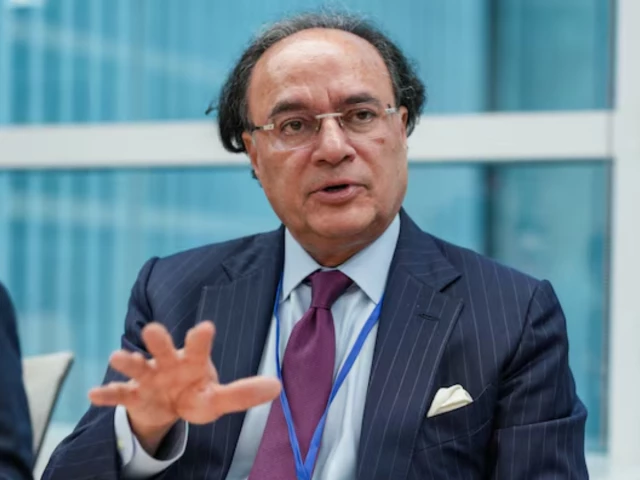
Pakistan Finance Minister Muhammad Aurangzeb. Photo: Reuters/ File
Finance Minister Muhammad Aurangzeb on Friday said the government had not imposed any new taxes in the federal budget for FY2026-27 and would instead focus on broadening and deepening the tax net through improved compliance and enforcement measures.
The finance minister unveiled the Rs18.8 trillion budget for FY2026-27 and set an economic growth target of 4% earlier today, while describing the budget as anchored in “stabilisation, reform and growth”.
Speaking on private television programme Aaj Shahzeb Khanzada Kay Sath, Aurangzeb said the government’s strategy was aimed at curbing tax evasion, leakages, corruption and collusion.
Read: Budget 2026-27: FinMin projects 4% growth as govt unveils fiscal, tax and reform agenda
“Deepening means addressing areas where there is tax evasion, leakage, corruption and collusion. We have to stop that, especially in the sales tax regime,” he said.
He added that plugging leakages through stronger compliance and enforcement would generate significant additional revenues.
The minister said public debate often focused on revenue shortfalls while overlooking the substantial growth in the country’s revenue base over recent years.
“Everybody talks about revenue shortfalls, but nobody notices that in the last few years, the revenue base has increased from Rs7 trillion to Rs13 trillion. It has never happened in the country’s history that the revenue base has doubled,” he said.
Thanking the provinces for supporting the federal government, Aurangzeb said the additional fiscal space created through provincial cooperation would not be used for relief measures but for strategic requirements.
“The additional fiscal space created through provincial support will not be utilised for relief measures. Given the active borders we currently have and internal security challenges in two provinces, whatever needs to be done for our defence and civilian armed forces will be done. We have primarily discussed this matter for that purpose, and I am grateful to the provinces for agreeing because of these strategic considerations,” he said.
Also Check: Budget 2026-27 income tax calculator: find out your new take-home salary
Responding to a question on how the government planned to provide relief without imposing additional taxes, the minister said the objective would largely be achieved through enhanced compliance and enforcement.
Asked about the government’s new scheme relating to exemptions at the point of sale for businesses with annual sales below Rs200 million, Aurangzeb said a disproportionate tax burden had long been borne by a limited number of sectors.
He said the government was now seeking to bring the manufacturing sector, exporters, the information technology industry and the salaried class into the documented economy.
“This should not only be viewed as relief but as a change in the direction of travel,” he said.
“This is only a beginning to bring them into a documented economy,” he added, noting that around 3.5-4 million people belonged to small-scale businesses and small and medium-sized enterprises (SMEs), and that the government was seeking to reduce the disproportionate burden on existing taxpayers.
Discussing measures for the private and export sectors, Aurangzeb said the government was significantly expanding the Export Finance Scheme and making additional funding available to exporters.
He added that despite the policy rate standing at 11.5%, Prime Minister Shehbaz Sharif had directed that exporters should be able to access financing at a rate of 4.5%.
On taxation measures for exporters, the minister said the overall rate had been reduced from 2% to 1.25% under the minimum tax regime.
He further said all super tax slabs had been abolished for exporters and traders with income below Rs500 million, while exporters above that threshold would continue to pay super tax at rates ranging from 8-10%.
Read More: Budget 2026-27: Govt cuts taxes, ends surcharge for four salaried class income slabs
“We received special directives from the prime minister and the cabinet to completely abolish the super tax on exporters. Now that those directives have been issued, I will work on that with my team,” he said.
Rejecting claims of a broader decline in exports, Aurangzeb said only rice and sugar exports had recorded a downturn.
He said exports of higher value-added textiles and sports goods had increased and expressed confidence that information technology exports would reach $4.5 billion during the current fiscal year.
The minister also praised the prime minister and the field marshal for their role in efforts aimed at addressing the ongoing conflict between Iran and United States, expressing hope that tensions would ease soon.
He cautioned that the government should maintain a buffer even if petroleum prices declined following a resolution of the conflict, noting that damage to energy infrastructure could have lasting economic consequences.
“This will not be an overnight situation where an agreement is reached tomorrow. God willing, with the efforts being made day and night by Pakistan’s leadership, progress can be achieved, but the effects of this situation will certainly extend into next year, and we have to prepare for that,” he said.