Innovation, industrial upgrading and expanding trade are sustaining growth, according to Q3 data
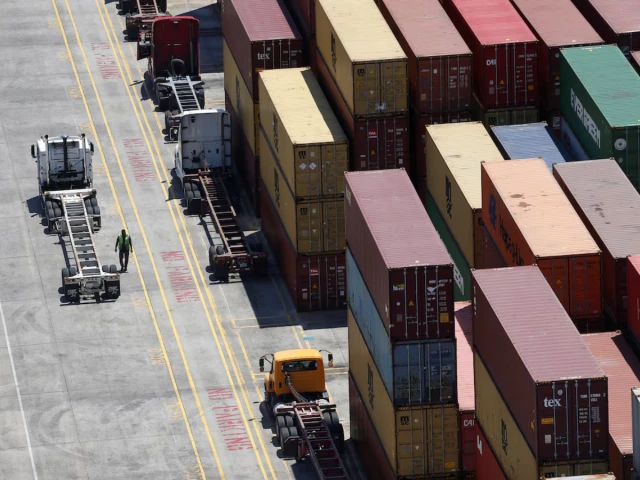
Workers stack empty shipping containers for storage at Wando Welch Terminal operated by the South Carolina Ports Authority in Mount Pleasant, South Carolina, US May 10, 2018. PHOTO: REUTERS
China’s economy gathered pace in the third quarter of 2026, offering reassurance to a global economy grappling with geopolitical tensions, volatile energy markets and uncertainty over international trade.
Growth of 4.5% year-on-year between July and September, up from 4.3% in the preceding quarter, highlights the resilience of the world’s second-largest economy.
Gross domestic product (GDP) expanded by 4.6% in the first nine months, generating economic output worth approximately 107.11 trillion yuan, or $15.94 trillion, according to data released by China’s National Bureau of Statistics on October 19.
The performance has kept China on track to meet its annual growth target, although sustaining momentum will depend on whether industrial expansion translates into stronger domestic consumption.
An important structural shift is underway as advanced manufacturing, robotics, artificial intelligence-related industries, digital services and green technologies increasingly supplement traditional sources of growth. These emerging sectors contributed more than 40% of economic growth during the first three quarters, according to the supplied data.
China’s economic performance came amid heightened international uncertainty, including geopolitical conflicts affecting energy markets and disruptions to global trade.
Industrial production increased by 5.3% in the first three quarters, while high-tech manufacturing grew by 14.3% and equipment manufacturing by 10.2%.
In September, industrial output rose by 5.5% year-on-year, while the services production index increased by 4.8%. Retail sales grew by 1.1%, and the surveyed urban unemployment rate edged down to 5.2%.
The expansion of emerging industries is particularly significant. Industrial robot output increased by 29.1% year-on-year in the first three quarters, lithium-ion battery production rose by 39.5%, and 3D printing equipment output surged by 62.5%.
Information transmission, software and information technology services expanded by 10.4%, while leasing and business services grew by 12.3%. Manufacturing accounted for 25.7% of GDP, up 0.6 percentage points from a year earlier.
Technological upgrading can improve productivity, reduce costs through automation, and strengthen industrial competitiveness. It can also modernise established industries, with ceramics manufacturers adopting 3D printing and coal mines deploying intelligent monitoring systems.
However, rising production does not automatically guarantee commercial success. Sustainable gains will depend on profitability, demand, continued innovation and businesses’ ability to compete without excessive reliance on state support or price competition.
Beijing’s fiscal and financial support measures will also need to encourage sustainable private-sector investment, employment and household spending.
China’s industrial expansion has considerable implications for international supply chains. Its factories produce machinery, batteries, electronic equipment and components used by manufacturers worldwide.
Goods trade reached 39.94 trillion yuan in the first three quarters, an increase of 18.8% year-on-year. Exports of mechanical and electrical products rose by 23.7%, accounting for 64.3% of total exports. Intermediate goods represented more than half of exports, underscoring China’s role as both a supplier of finished products and a source of industrial inputs.
Reliable Chinese production can help businesses maintain supplies and avoid delays. However, China’s manufacturing strength has also raised concerns among trading partners about industrial overcapacity, import competition and excessive dependence on a concentrated manufacturing base.
Supply-chain diversification is consequently becoming a strategic priority. Rather than ending commercial ties with China, businesses may seek additional production centres and alternative sources of critical components.
China is likely to remain influential in global manufacturing, but preserving its position will require technological advancement, predictable commercial conditions and deeper integration with international markets.
Trade by foreign-invested enterprises rose by 19% to 11.69 trillion yuan in the first nine months, according to the supplied data. Their intermediate-goods trade increased by 27.4%, while exports of high-tech products rose by 42.1%.
International companies are using China not only to reach its domestic consumers but also to access its suppliers, engineering capabilities and manufacturing networks for products intended for other markets.
German automobile manufacturer Volkswagen’s reported shift from an “in China, for China” approach towards “in China, beyond China” illustrates this trend. Meanwhile, Chinese robotics manufacturer EFORT Intelligent Robot reportedly recorded an increase of more than 50% in overseas revenue during the first half of the year.
Nevertheless, foreign investment decisions also depend on market access, regulatory transparency, intellectual property protection and geopolitical risks. China’s ability to attract sustained foreign capital will depend on whether the advantages of its industrial ecosystem outweigh these concerns.
Despite strong industrial production and external trade, domestic consumption remains central to China’s economic outlook.
September retail sales growth of 1.1% was modest compared with industrial expansion.
Real per capita disposable income increased by 4.4% in the first three quarters, while rural household income rose by 5.6%. Total retail sales of consumer goods and services reportedly increased by 2.6% year-on-year.
Higher incomes do not necessarily translate into equivalent spending. Consumer confidence, employment prospects, housing-market conditions and precautionary saving all influence household decisions.
Stronger consumption would help China reduce its dependence on external demand while creating opportunities for foreign businesses seeking access to Chinese consumers.
Policymakers must therefore ensure that industrial upgrading translates into higher household incomes, employment and living standards. Without a more durable recovery in consumption, industrial expansion alone may not resolve underlying economic imbalances.
China’s economic transformation is closely linked to its energy transition. The penetration rate of new-energy vehicles reportedly remained above 60% for six consecutive months, while energy consumption per unit of GDP fell by 3.1% in the first three quarters.
China’s scale in battery manufacturing, electric vehicles and related technologies gives it considerable potential to influence the global transition towards lower-carbon production. For emerging economies, affordable clean-energy technologies could help reduce fuel-import bills and diversify energy supplies.
However, declining energy intensity does not necessarily mean total energy consumption or emissions have fallen. The environmental impact must also be assessed against China’s energy mix and overall emissions trajectory.
China’s imports reportedly grew by 22.3% in the first three quarters, outpacing export growth. The upcoming China International Import Expo is expected to attract more than 4,100 overseas companies, offering foreign businesses a platform to showcase products and services.
Sustained import growth could benefit agricultural producers, industrial suppliers and consumer-goods manufacturers abroad. Greater openness, transparent regulations and predictable market-access conditions would help convert the scale of China’s economy into broader gains for international trade.
China’s economic trajectory carries particular significance for Pakistan because of their close economic relationship, established trade links and cooperation under the China-Pakistan Economic Corridor (CPEC).
China’s expansion in advanced manufacturing, robotics, batteries and digital services offers Pakistan opportunities to move beyond a relationship centred primarily on infrastructure development and imports. Cooperation could increasingly cover industrial technology, skills development, agricultural processing, renewable energy, logistics and export-oriented manufacturing.
Pakistan’s long-term interests would be better served by attracting productive investment, developing domestic supplier networks and enabling local businesses to participate in regional and international value chains.
Chinese companies seeking to diversify production could consider Pakistan as a manufacturing and export platform, provided commercial conditions are suitable. Realising this potential would require reliable energy supplies, competitive logistics, predictable regulation, access to finance and a skilled workforce.
Pakistan must also strengthen its industrial competitiveness as Chinese manufacturers move towards more sophisticated and automated production. Cooperation in renewable energy, electric mobility and digital technologies could address development needs, provided projects are commercially viable and supported by appropriate financing and technical capacity.
The central lesson is that China’s economic resilience can create opportunities for Pakistan, but these are not automatic. Pakistan must develop the domestic capabilities needed to turn trade and investment into employment, exports, technological advancement and sustainable growth.
China’s third-quarter performance highlights the importance of industrial depth, technological upgrading and policy flexibility in navigating an uncertain international environment. Advanced manufacturing, services and trade have helped sustain growth despite external pressures.
Yet the durability of this performance will depend on stronger household consumption, productive investment and a predictable environment for private and foreign businesses. Beijing must reconcile expanding productive capacity with the need for more balanced domestic demand.
For the wider world, China presents both opportunities and challenges. Its manufacturing capabilities can sustain supply chains and accelerate technological change, even as other economies diversify suppliers and protect domestic industries.
The central question is whether China can convert its industrial and technological advantages into a more balanced, productive, and sustainable economic model. The answer will shape not only its future development but also the opportunities and pressures confronting the global economy.