

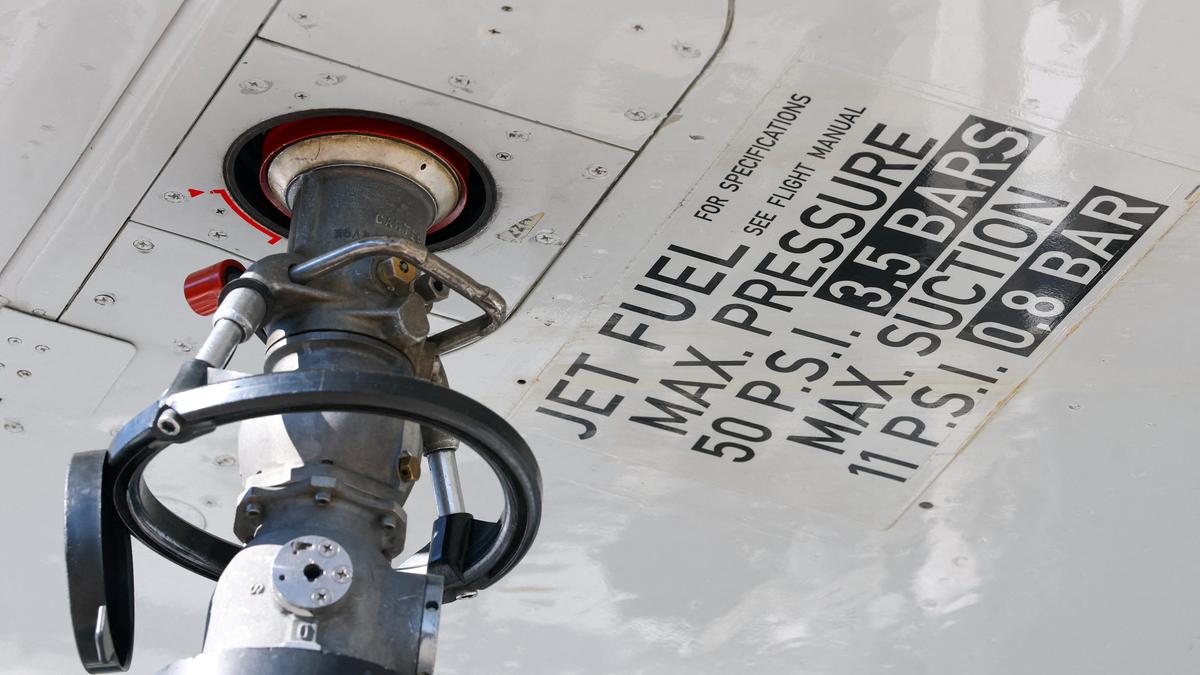
The government observed that international ATF prices surged nearly 2.5 times from ₹60.5 per litre in March to ₹142 per litre in May. File
| Photo Credit: Reuters
Seeking to cushion India’s airlines in the backdrop of escalating jet fuel prices because of the conflict in West Asia, the Union Cabinet on Wednesday (June 3, 2026) approved a one-time budgetary support of ₹10,000 crore to oil-marketing companies (OMCs) towards a price stabilisation fund.
The budgetary support would be made available to scheduled airlines in India for both domestic and international operations and would be provided in the form of interest-free advances to OMCs.
Hardeep Singh Puri, Union Petroleum Minister, held that the price stabilisation fund would help stabilise ATF prices in the backdrop of the West Asia conflict.
“The fund will help stabilise ATF prices for scheduled Indian carriers and will prevent disruption of airline operations while protecting air passengers from fare spikes driven by the geopolitical conflict involving several energy producers,” read his social media post.
The budgetary support would function like a self-sustaining revolving fund.
The Cabinet has sought that once the international ATF prices moderate, the differential amount shall be recovered from the oil-marketing companies (OMCs) and returned to the government exchequer.
It would be implemented through an MoU between oil-marketing companies and participating airlines that would mandate the latter procure ATF only from OMCs – either for up to three years or until the advance amount is fully recovered.
Officials at the Union Petroleum Ministry had informed on Monday (June 1, 2026) that state-run oil-marketing companies (OMCs) were presently incurring under-recovery of ₹30 on every litre of ATF meant for domestic scheduled carriers.
Further, the government observed that international ATF prices surged nearly 2.5 times from ₹60.5 per litre in March to ₹142 per litre in May.

ATF prices for domestic scheduled carriers were hiked 9% April 1 this year and have been kept unaltered since then.
In fact, Air India, along with its low-cost subsidiary Air India Express, and Indigo, together cut down 250 daily domestic flights from June amid rising prices of jet fuel. The move was expected to further escalate airfares.
The government informed that to protect air commuters from a potential sudden price shock, it had capped the ATF prices at ₹75.6 per litre. However, the continuing crisis did not offer adequate cushion.
“ATF accounts for nearly 40% of airline operating costs and during periods of extreme fuel volatility, can constitute up to 60% of total operating expenditure,” it held.
Published – June 03, 2026 05:43 pm IST


