

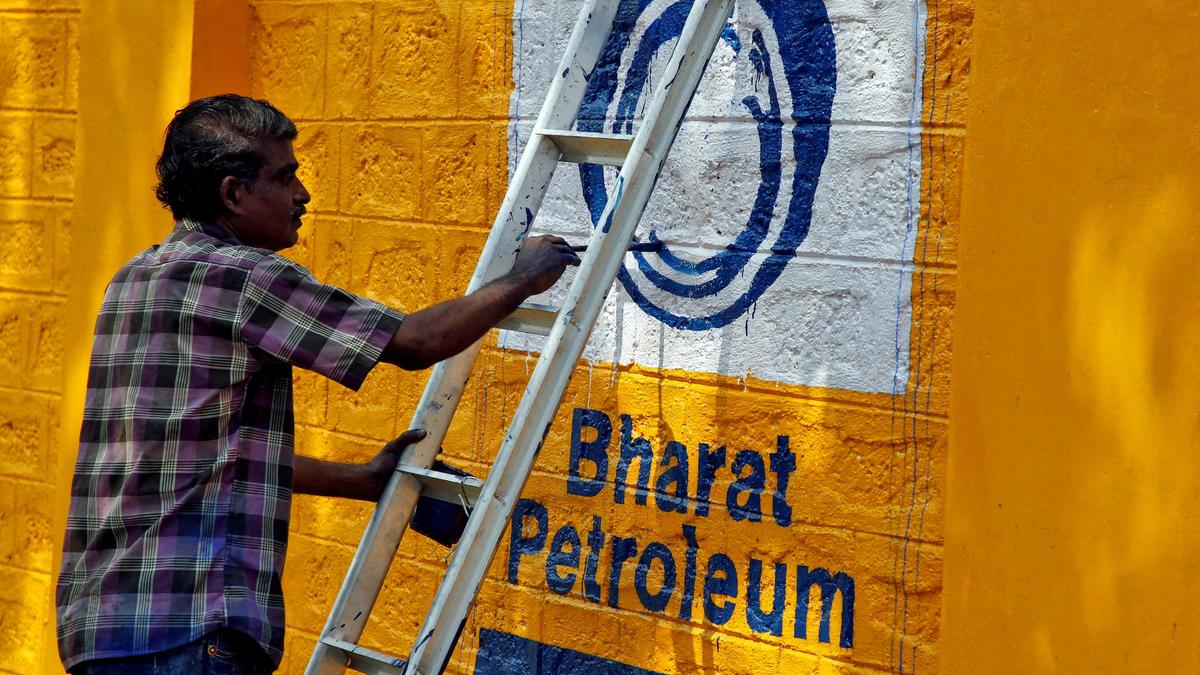
According to the senior executive at BPCL, Russian crude constituted about 25% of the overall basket in the third quarter of the previous financial year.
| Photo Credit: Reuters
The share of Russian crude oil in Bharat Petroleum’s overall basket has increased to about 40-41% from about 31% during quarter-ended March 2026, Vetsa Ramakrishna Gupta, Director for Finance of the state-owned oil-marketing company, told investors in an analyst call on Wednesday (May 20, 2026).
Mr. Gupta attributed the increased quantum of Russian crude also to its greater availability in the spot market.
“Percentage of Russian [crude] cargo has definitely gone up. It was 31% in the fourth quarter (of FY 2025-26), but in the current period, most of the supply on a spot basis, Russian crude is more available; therefore, offtake is higher at about 40-41%,” Mr. Gupta told investors.
According to the senior executive, Russian crude constituted about 25% of the overall basket in the third quarter of the previous financial year.
Responding to a query about the impact of U.S. sanctions, Mr. Gupta explained that, rather than Russian crude being sanctioned, certain entities were sanctioned. He maintained that BPCL made its purchases only from non-sanctioned entities.
“During the waiver you could buy Russian crude from any party, and with the lapse of waiver you can only buy from non-sanctioned entities,” he stated. “Whatever Russian crude we buy is always from non-sanctioned entities, be it the cargo vessel, port or supplies – those should be non-sanctioned entities.”
‘Crude supplies secured till July this year’
Overall, the official said that it has secured crude oil supply until July this year.
“We have diversified to eight new grades of crude [oil] during the year, covering four geographical regions,” he stated. “I would also like to assure that crude supplies have been secured till July 2026.”
Elaborating on the diversification, Mr. Gupta told analysts that Bharat Petroleum tested varied grades of crude in the previous financial year, including those from North America and Middle East spot cargoes.
“WTI is one destination we have tried, [alongside] Venezuelan crude we have also tried, and Middle Eastern spot grades are also available, like Murban, among others,” he stated. “Last year, we [also] tested new grades, that is, Venezuelan, Brazil and Angola. In spot many of the grades are available but major source continues to be Russia.”
Higher landed cost
In response to a query about landing costs considering the elevated freight and insurance costs, Mr. Gupta stated that they were indicatively higher by about $12 for every barrel, although adding that they are dynamic and change regularly.
“It [the landing cost-led premium] all depends on which source we take crude from but indicatively, in today’s date if you want to finalise any deal, if brent crude is $110 per barrel, maybe our landing [cost] would be about $120-122 per barrel though it is constantly changing,” he stated.
Separately, the senior executive told investors before the war, the additional cost for WTI crude used to be “brent plus $4-5” which escalated to approximately “$20 at the peak of the war”.
Published – May 20, 2026 10:26 pm IST


