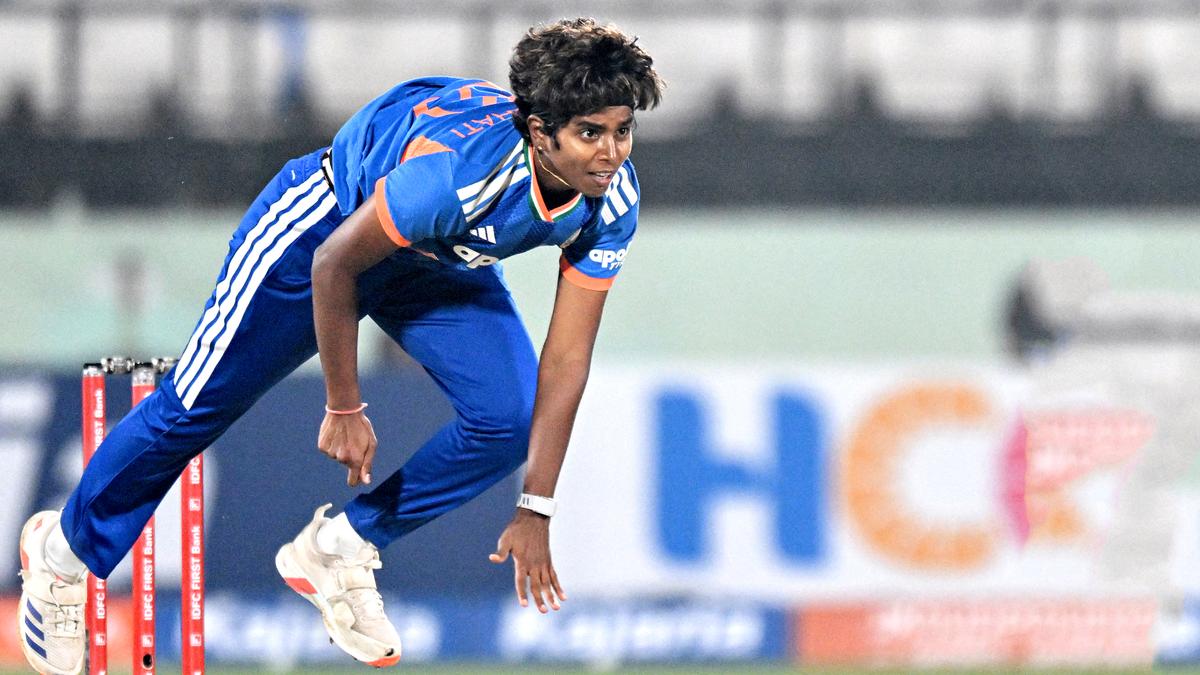
Before the glitz and glamour of the Women’s Premier League and the adulation from India’s recent World Cup triumph, Arundhati Reddy had been a trailblazer on the domestic front.
She featured for Railways from 2017-18 to 2022-23, during which time she played in 24 List-A and 21 T20s for the side as well as five T20s for Central Zone.
With playing time hard to come by, however, she decided to pack her bags, resign from a financially secure government job, and look for different – and hopefully greener – pastures.
Historically, women’s cricket in India has operated on shoestring budgets. Players across generations will narrate difficult tales of the big pinch on the pocket cricket as a career was, and how hordes of players walked away from the game due to their passion being anything but feasible to pursue.
Naturally, leaving a lucrative job with the Railways behind didn’t make sense to many, even in Arundhati’s family.
“People said I was doing a foolish thing, because my career was not the greatest at the time. Neither was I feeling the greatest with my game, nor was I even part of even Railways playing 11 then, so I decided to move on,” she told The Hindu.
“Railways did a lot for me. I got the job when my family needed it, it has helped me take care of my family. I left with a heavy heart.”
These decisions are not taken lightly. This is where the Women’s Premier League underlined why it was necessary within the Indian context. Arundhati’s contract with Delhi Capitals – picked for her base price of ₹30 lakh in the inaugural auction – gave her a cushion to look for a better gig. For the first time in her career, she had a financial safety net, allowing her to quit Railways without an immediate next destination in the domestic circuit.
Fortuitous move
“I didn’t think of going to Kerala. Biju [George] sir was part of the Delhi Capitals at that point. I called him to tell him that I had resigned from the Railways. It was a big decision, and I had to inform him about it. When asked about my plans, I said I have no idea. He promptly said, ‘Give me five minutes.’ He called me back and said that the [Kerala Cricket Association] secretary and the joint secretary were happy to have me.”
George’s views of Arundhati formed well before the Women’s Premier League took shape. He first spotted her at a Challengers tournament in Alur. The Hyderabad-native’s prowess with bat and ball earmarked her for the future, and he kept an eye on her performances ever since.
“I was unsure; it is a new state for me, but I said yes. In hindsight, going to Kerala was one of the best decisions I’ve ever taken because of the people there.”
Arundhati’s move to Kerala, in simple terms, ultimately resulted in a mutually beneficial relationship.
“She always wanted the team to improve, and with it, she was also working hard on herself. Leaving Railways was a huge decision for her, but one that worked out very well. She not only played very well but also gave us her inputs throughout that journey,” Suman Sharma, who coached Arundhati at Kerala, recalled.
Arundhati took time to settle in, starting with the Senior Women’s T20 Trophy in 2023. When the One Day Trophy came around, she made her mark, scoring 252 runs (including three half-centuries) at an average of 126 in five innings, while also taking four wickets.
“Kerala made Arundhati feel very comfortable. She was treated very well and she also did the same with them. She shared her experiences with the girls and helped them strategise or make their tactics. There was one-on-one talking with the players as well. It made a huge difference not only in Kerala’s performances but also in her own performances,” Suman added.
“She picked up a few Malayalam words very quickly. She made sure that everyone around her felt comfortable. She did not have the intimidating aura of a Team India player or a guest player. She merged with everyone very nicely, which is something I liked about her.”
That good form and her work ethic gave Meg Lanning the confidence to field Arundhati in all nine games of the 2024 season for Delhi Capitals. She picked up eight wickets at an economy of 7.62, looking fitter than ever too, while bowling 29.3 overs that season – the second-highest by a DC player.
Changing views
The move to Kerala brought about a massive change in perspective for an ever-hungry-for-success Arudhati.
“When I stepped into the Kerala setup, I was thinking about what to achieve and how to make the India comeback. What was waiting for me in the team was something else. I saw a girl who was probably shoe size 5 wearing a size 8, because she couldn’t afford the right fit. Almost everybody who was in that camp did not come from great financial backgrounds. I think almost 10 to 15 girls in that camp were not wearing the proper shoe size, and were wearing one that had probably been given to them by their brother or someone they knew who didn’t want the shoes anymore,” Arundhati said. “Someone’s father was in the ICU, someone couldn’t afford to get a kitbag for herself, and so on. Some had a lot of financial problems because they lost their family in the floods etc.”
| Photo Credit:
G. RAMAKRISHNA
Arundhati took a deep breath as she recollected her initiation into the setup. It was a perspective-turning experience that also reminded her to be grateful for the things she had and the battles she didn’t need to fight. It was at that moment that she swapped personal goals and began to enjoy her game from her ‘privileged’ position.
“All those stories changed me a lot. I thought, ‘Why am I worrying about comebacks and stuff like that? I am blessed enough to play this sport.’ The biggest blessing is being injury-free.”
“I’d played for Hyderabad and then Railways, where people came from good families financially. I never saw that side of life. So for them just to have a smile on their faces, even though they’re going through so much, that changed my perspective a lot, and that helped me a lot with my cricket as well.”
Arundhathi lauded Kerala for building some sort of financial stability to help players focus their energies, for the most part, on cricket. “Kerala that way does a great job. Once they pick you, they have schools and colleges in a cricket stadium. The education is taken care of, as is the stay, food, and they are also given money. That is why even economically disadvantaged parents are willing to send their kids, because it takes the burden off them.”
Lessons to learn
Those learnings and experiences meant the 28-year-old was ready with notes when she had a meeting with Nara Lokesh, Andhra Pradesh’s Minister for Information Technology, Electronics and Communications, before the Women’s ODI World Cup.
“We had a meeting with Nara Lokesh sir before the World Cup began, where he asked the team about how to empower women in Andhra Pradesh. One of the suggestions that I had, based on my experiences with Kerala, was… Andhra has a lot of districts. For the up-and-coming players, they should provide a stipend.” “It can be bare minimum. Parents will be more than willing to send their kids, because it takes the burden of training them off them. It could even lead to the girls getting government jobs. Every state needs to do this. It will help people come into the sport, because many still cannot afford cricket.”
What many do not know, and what Arundhati never speaks about, is that she has done her bit, above and beyond her calling, to ensure that youngsters face fewer hurdles in pursuing the nation’s favourite sport. She has even financially helped kids to buy decent equipment and gain access to good coaching.
“Arundhati understood the struggles of the players around her and helped them with whatever means she had, like giving them kits, shoes, pads, legguards and all to other players or even by just talking and motivating them,” Suman said.
Her own upbringing and early challenges influenced her drive to give back. Raised by a single mother, Bhagya Arundhati reaped the benefits of having an unconditionally supportive parent in her corner. And she did this while also handling her son Rohit’s traditional educational ambitions.
“I couldn’t afford a kit bag or shoes when I was younger. I was very blessed to have nice people around me. A lot of people helped me then. By providing stipends and education, it will help people who can’t monetarily manage to pursue cricket in the smaller areas,” Arundhati recalled.
“People like Harry di [Harmanpreet Kaur] coming from Moga, Smriti Mandhana from Sangli. They have come from small towns, not big cities. If people can become that big coming from there, there’s still so much talent to unearth.”
That, in a nutshell, is Arundhati’s story. It is not one of just wickets taken or matches played, but about doors held open for others still waiting to step through.
That said, as unfortunate as it may be, the world will judge this dreamer first not by her magnanimity but by her efficacy and utility for the nation’s cause in an India shirt, the ultimate destination for everyone toiling in the domestics. After making peace with the unsatiated itch to play during the ODI World Cup, the pacer has her sights on the T20 World Cup in England, where her prodigious swing and control – which was on display in Australia last December – could hold India in good stead, if she can master consistency.
She can look at her own life for all the motivation she might ever need to plug dips in confidence, should they ever arise, along the way. In walking away from security to chase uncertainty, the 28-year-old found more than just a career revival. In a game that has long asked women to choose between passion and practicality, her journey stands as proof that when opportunity meets intent, it can ripple far beyond the boundary rope.
As the women’s game in India enters a new era of visibility and investment – even at the domestic level, with the BCCI announcing a big hike in match fees – Arundhati serves as a blueprint of the fact that sustainable success lies not just in creating stars, but in building systems where no talent is lost for lack of means.