Thursday was supposed to be a happy homecoming for a trio of local lads in the first men’s international to be played in New Chandigarh. Much was expected of the Punjab triumvirate of vice-captain Shubman Gill, his opening partner Abhishek Sharma and Arshdeep Singh, the country’s leading wicket-taker in Twenty20 Internationals. Instead, each of them disappointed in the team’s crushing 51-run defeat by South Africa, a result that helped the visitors square the five-match series at 1-1.
Gill, who has had a miserable run since his return to the T20 national side at the Asia Cup in the UAE in September, courted a golden duck for the first time while Abhishek’s flourish was brief – two sixes in an 8-ball 17. Long before that, Arshdeep had had an evening to forget, conceding 54 runs in his four overs, his second-most expensive spell in the format, while going wicketless.
Just two nights previously, in the opener in Cuttack, the left-arm swing exponent had nicked off Quinton de Kock in the first over of South Africa’s stiff chase of 176 on a tacky track, and followed it up with the scalp of the dangerous Tristan Stubbs in his next over to an excellent catch behind the sticks by Jitesh Sharma. It was Arshdeep at his penetrative best; he was getting nice shape with the new ball and his disciplines were spot on. Such was the damage he had inflicted in his two-over spell (two for 14) that he wasn’t required to bowl again, the rest of the bowling group combining to send the Proteas packing for 74.
In New Chandigarh, after winning a rare toss, India opted to chase, understandable given that that is the preferred mode of operation in 20-over cricket these days and because the dew is such a prominent factor in India at this time of the year. South Africa, of course, were far better than 74 all out, and so they reiterated with de Kock in the forefront of their impressive tally of 213 for four.
The wicketkeeper-batter had made a seventh ODI century against India in the decider in Visakhapatnam on December 6, an effort that was in vain with Yashasvi Jaiswal, Rohit Sharma and Virat Kohli muscling the hosts to a commanding nine-wicket win with 61 deliveries to spare as they made a chase of 271 appear ridiculously straightforward. Having followed up the century with a duck, de Kock was determined to leave his mark once again, and he unleashed a flurry of strokes that drove India to despair.
A rare off-day
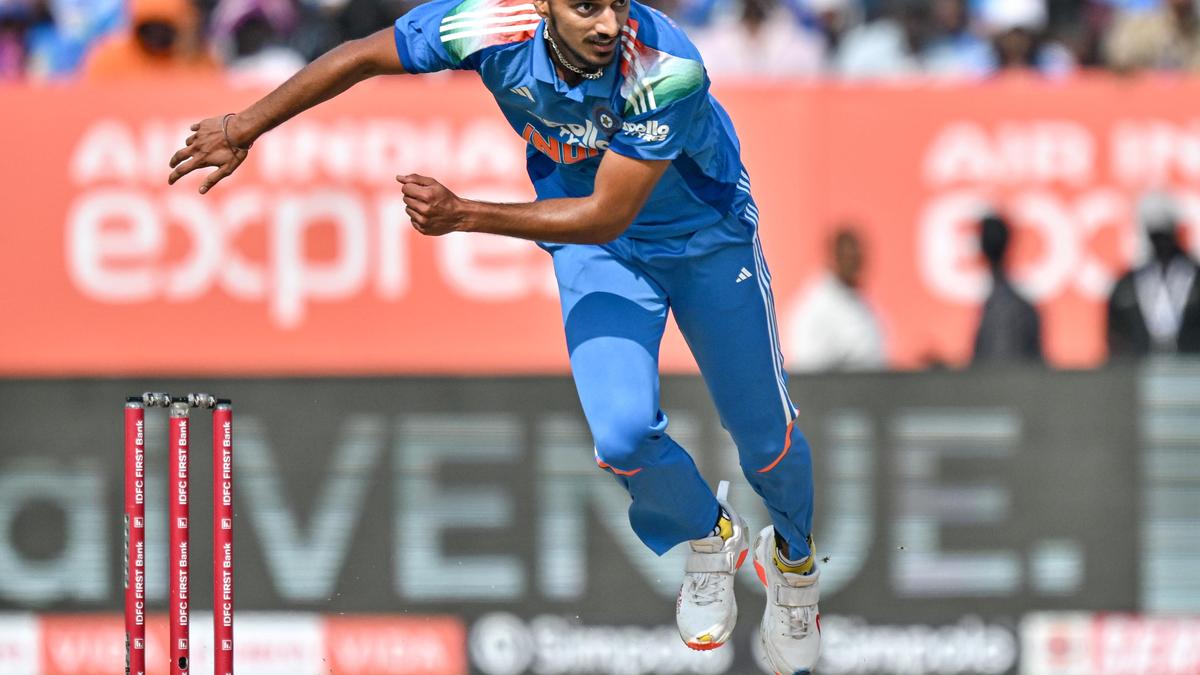
Arshdeep went for 20 in his first two overs, not great but not awful either, when Suryakumar Yadav brought him back for the 11th over, with the visitors on 90 for one. With 107 wickets from 69 matches at the start of Thursday’s play, the 26-year-old was entrusted with the responsibility of snapping a burgeoning stand of 52 (at the time) for the second wicket between de Kock and Aiden Markram, the captain. Instead, he ended up conceding 18 runs during a nightmare 13-ball over that included seven wides, including four on the bounce and six from seven deliveries.
The provocation for those four wides was a first-ball six from de Kock, who latched on to a slot ball outside off and slammed it over long-off. It was the cue for Arshdeep to stay away from the left-hander’s hitting arc, but in his desire to make him fetch the ball, he repeatedly transgressed the wide line outside the off-stump. Not all of them were massive wides, but given how reluctant the umpires are to give the benefit of the doubt to the bowler, they were deemed wide nevertheless. Arshdeep flitted between the disheartened and the resigned – at one stage, a wry, helpless smile flitted across his face – while in the dressing room, head coach Gautam Gambhir was seething. It’s anybody’s guess what irked him more – Arshdeep’s lack of discipline, or the marginal calls that went against his bowler.
By the time Arshdeep was done with the over, he was relieved that the ordeal had ended. Despite that six off the first ball, he conceded only five more runs to the batters, three singles and a two. Normally, that would have translated to an 11-run over, not ideal but definitely a spirited comeback after the first-ball damage. But the seven wides foretold another story, and were primarily responsible for India having to bring a fifth fielder into the 30-yard circle for the last over because they hadn’t got through their overs in time.
Arshdeep will get over this remarkable — for all the wrong reasons — night in quick time because if there is one thing he has showcased over the last three-and-a-half years that he has been an international cricketer apart from his immense skills, it is his resilience and mental toughness. In September 2022, he was trolled mercilessly and pilloried as ‘anti-national’, among other things, when he dropped Pakistan’s Asif Ali off Ravi Bishnoi’s bowling in a Super Four clash of the T20 Asia Cup in Dubai. Arshdeep himself bowled the final over and couldn’t defend the seven runs he had to play with. The dropped catch became a massive talking point on the social media court of (in?)justice and could so easily have broken the young man, but Arshdeep laughed it away, using the barbs and the criticism to toughen himself up.
With support from his close-knit family and his teammates who threw their weight behind him unconditionally, Arshdeep emerged stronger and better, quickly establishing himself as the No. 1 pace bowler once India decided to rotate out Bumrah, depending on which white-ball format held pre-eminence at that time. As he played more and more, Arshdeep topped up his skills but more importantly, he grew visibly in stature and confidence. If swing was his ally in the PowerPlay with the new ball, he became adept at bowling at the death too, bringing his immense variations into play. Primary among them are a mean, made-to-order yorker that homes in on batters’ toes, and a variety of slower deliveries that he mastered through hours of hard yards at practice.
Within no time, he became the go-to man for first Rohit, and then Suryakumar when the latter took over as captain in July last year. If Arshdeep didn’t play sometimes, it had less to do with his abilities and more to do with conditions. Take the T20 Asia Cup in Dubai in September, for instance. Because Hardik Pandya and Shivam Dube were both available and because India wanted to field wrist-spinners Varun Chakaravarthy and Kuldeep Yadav, Arshdeep wasn’t a starter in all but two matches, against Oman and Sri Lanka in the league phase and the Super Fours respectively, by which time India had already secured progress to the next stage and therefore could rest Bumrah.
In Abu Dhabi against Oman, Arshdeep ended a seven-and-half-month wait for his 100th T20I wicket, becoming the first Indian to achieve that milestone when he had Vinayak Shukla caught at deep mid-wicket. It was a wonderful achievement because Arshdeep was only in his 64th outing, and he was still just three and a quarter years young at the highest level. When Bumrah breached the 100-wicket mark in Cuttack with the wicket of Dewald Brevis, Arshdeep might as well have held a placard: “Welcome to the club, I was beginning to feel lonely.”
One can picture Arshdeep saying that. A balanced individual with a wonderful if wry sense of humour, he sees the positive in most things. Like most good men, he can seldom be kept down. As India head into the final straight of preparations ahead of the defence of their T20 World Cup crown in February-March, Arshdeep will be keen to bounce back from the Thursday mauling and re-establish himself as the leader of the pack, Bumrah or no Bumrah.
In this series against South Africa, possibly because of the prevalence of dew, India have desisted from fielding both Varun and Kuldeep in the same XI, a tack they might replicate at the World Cup when too the dew will not be inconsiderable. If that is the case, Arshdeep will be expected to deliver early breakthroughs and then come back and hold his own towards the end overs, where he has proved himself to be extremely competent. Alongside Bumrah, he forms a lethal combination — Thursday’s loss was India’s first defeat when the two quicks have played a 20-over game together — in what is a partnership of equals even though Bumrah is clearly the more acknowledged and celebrated of the pair.
Arshdeep has a long memory and uses that to good effect. He doesn’t harp on his failures so much as use them as stepping stones, as learning experiences that help him get better and more effective as a T20 bowler. He is aware, as much as anyone else, that the odds are stacked against the bowlers in a format that encourages unfettered stroke-making and where intrepid batters, armed with new tricks and flashy shots, are stretching the limited almost every single day. Where others might see an obstacle, though, Arshdeep perceives an opportunity. He has enough faith in his skills to comprehend that when there is the slightest hint of help in the form of swing, he will make an impact with the new ball. And he knows that at the death, when batters come after him, he has the resources to beat them at their own game.
Matches like New Chandigarh will happen in what is essentially a format of very small margins. A couple of inches closer to the batter, and Arshdeep would have gotten away with maybe just a wide or two. Even when the wides kept stacking up, Arshdeep showed character by sticking to the plan instead of bowling straighter and being picked off for boundaries in trying to close out the over. That speaks to an individual who isn’t fickle, who knows that the problem is not in the planning but in the execution. Mullanpur will remain a one-off, but it’s a one-off from which Arshdeep will pick up valuable insights as he targets more success – against the Proteas, against New Zealand next month and then at the World Cup.