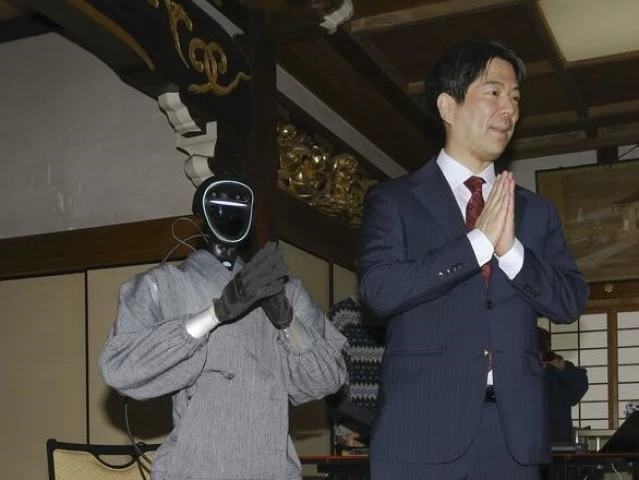
Seiji Kumagai, professor at Kyoto University, stands next to a humanoid monk robot in Kyoto, western Japan, on Feb. 24, 2026. PHOTO: KYODO NEWS
Japanese researchers have unveiled a robot monk powered by AI that they say can dispense spiritual advice and maybe one day ease shortages of its human counterparts.
Trained on even the most esoteric Buddhist scriptures, the University of Kyoto says the machine can answer sensitive questions that people may feel hesitant to share with other humans.
In addition, “Buddharoid”, as the diminutive two-legged humanoid is known, can offer a sense of presence at religious sanctuaries in addition to voice communications.
“In the future, it is conceivable that they may assist with or replace some of the religious rituals traditionally performed by human monks,” the university said in a statement on Wednesday.
The robot is the latest offering from Seiji Kumagai, a professor at the university’s Institute for the Future of Human Society.
Read: US AI giants accuse Chinese rivals of mass data theft
Using AI models from OpenAI and others, he has worked with engineering firms to develop religious AI chatbots like Buddha Bot and a catechism bot.
For his new creation, Kumagai installed his updated “BuddhaBotPlus” on a Chinese-made “Unitree G1” humanoid robot to create the AI robo-monk.
In a media presentation at a temple on Tuesday, Kumagai presented the robot — as yet without a face — wearing a simple grey garment.
It held its gloved hands together in a prayer form and walked around in front of reporters and performed other tasks.
As it sat on a chair, the humanoid gave advice to a young local journalist who confessed to thinking and worrying too much.
“Buddhism teaches that it is important not to blindly follow one’s thoughts or rush headlong into things,” it said in a soothing baritone to the journalist from national broadcaster NHK.
“One approach is to calm your mind and let go of the thought itself,” it said. Religious chatbots powered by artificial intelligence are already popular tools — as well as contentious — across all major faiths, used by millions of people.
Read More: YouTube exec says goal was viewer value not addiction
Kyoto already has a non-AI android called Mindar that delivers sermons, and in Germany in 2017, a robot was unveiled with a touchscreen with glowing hands that gave blessings in five languages.
But the new machine brings AI and robotics together, offering spiritual advice and holding religious conversations while also performing human-like physical motions.
Kyoto University said that ethical discussions must continue about the proper use of such tools in religious settings.
But with Japan’s shrinking and ageing population making the labour market tighter, the humanoids may take over some tasks in the future, the university said.
“In the future, AI humanoid robots are expected to be utilised in the religious field, such as assisting with or performing some of the religious rituals traditionally conducted by human priests,” the university said.
“This is anticipated to bring about a paradigm shift in religious culture.”