
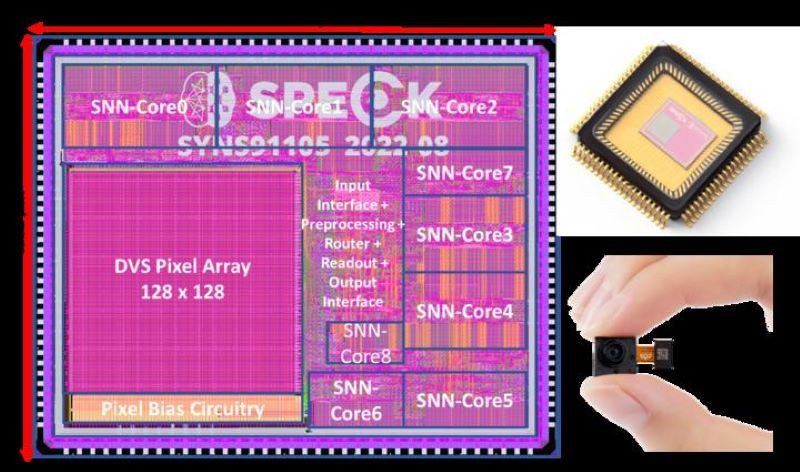
A team of Chinese and Swiss scientists has jointly developed an energy-efficient sensing-computing neuromorphic chip that mimics the neurons and synapses of the human brain.
The human brain, capable of processing incredibly intricate and expansive neural networks, operates with a total power consumption of merely 20 watts, significantly lower than that of current AI systems. Therefore, neuromorphic or brain-like computing offers promising energy-saving machine intelligence.
Read: AMD launches new AI chips to take on leader Nvidia
The researchers from the Institute of Automation under the Chinese Academy of Sciences and SynSense AG Corporation in Switzerland crafted this asynchronous chip, dubbed “Speck,” which boasts an impressively low resting power consumption of just 0.42 milliwatts, meaning it consumes almost no energy when there is no input.
Emulating the “dynamic imbalance” characteristic of the brain’s spiking neural networks, the team of scientists has devised an attention-based framework in which significant external stimuli often garner more attention from the brain.
The framework is adept at meeting the algorithmic demands of dynamic computing, achieving a real-time power as low as 0.70 milliwatts, according to the study published recently in the journal Nature Communications.
This work offers artificial intelligence applications a brain-inspired intelligent solution characterized by exceptional energy efficiency, minimal latency and reduced power consumption, said Li Guoqi, one of the corresponding authors of the study.