ISLAMABAD:
The International Monetary Fund (IMF) has revised upward Pakistan’s inflation forecast to 9.9% but kept economic growth unchanged at 3.5%, suggesting that it has not agreed to the government’s projections of relatively low inflation and high economic growth for this fiscal year.
The fresh figures have been released in the World Economic Outlook (WEO) report while the IMF’s staff-level report will be made public only after the loan tranches are approved by the executive board tentatively late November. According to the WEO report, which the IMF released on Tuesday on the sidelines of annual meetings, inflation in Pakistan could accelerate to 9.9% in this fiscal year. In April this year, the IMF had projected Pakistan’s inflation rate at 8.4% for fiscal year 2026-27, which it also maintained in July’s report.
The IMF has not given any Pakistan-specific reasons for the increase in inflation rate but it has also revised upward the inflation projections for the Middle East and Central Asia region due to the ongoing conflict that has impacted energy supply and prices. The rate is higher than the official target of 8.2%. During the recently concluded staff-level talks, the federal government and the central bank had maintained that despite inflationary pressures Pakistan would be able to meet the annual target.
The 9.9% inflation projection means that the IMF might also be seeking higher interest rates to contain the inflationary pressures.
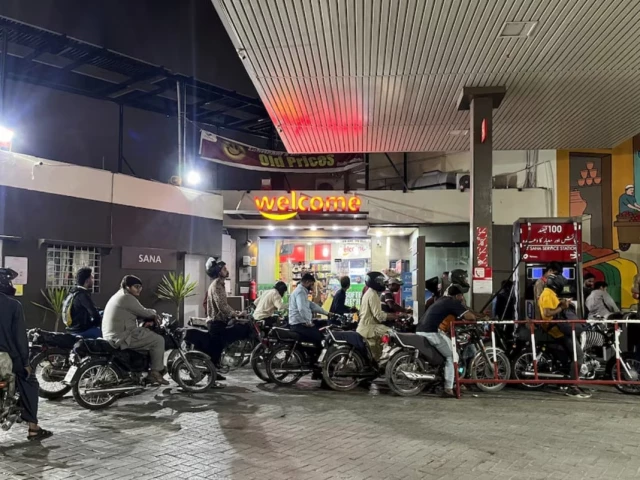
The government has been fully passing on the increase in fuel prices to domestic consumers in addition to charging heavy taxes. It has given Rs2,000 per month compensation to motorcyclists and Rs3,000 to small car owners. But the IMF has objected to the scheme, terming it broad and carrying high cost. The report underlined that global headline inflation rose in August, as energy prices bounced back following the short-lived ceasefire in the Middle East.
According to the IMF report, economic growth in Pakistan may remain at 3.5% in this fiscal year – a forecast that is unchanged compared to the lender’s previous projections. During the review talks, Pakistani authorities had tried to convince the IMF that the annual growth target of 4% will be achieved.
In an interview with Reuters, Finance Minister Muhammad Aurangzeb said that “I am still quite clear that we should clock north of 4%”. Pakistan has been following a prolonged phase of economic stabilisation under three different IMF programmes, which according to the World Bank is one of the reasons for higher poverty in the country.
In his detailed memo, Planning Minister Ahsan Iqbal has recently recommended to Prime Minister Shehbaz Sharif an eight-point new Growth-Compatible Fiscal Stabilisation Framework for higher growth and development instead of merely saying in polls that we “inherited an economic crisis” and achieved stability.
He wrote to the prime minister last month that Pakistan was increasingly achieving fiscal stabilisation by compressing development expenditure and borrowing more, rather than sufficiently expanding the revenue base and increasing exports.
“The electorate will judge the government on the economy it experiences in 2029: growth, employment, income, investment, exports, inflation, energy costs and economic opportunity,” he wrote.
The IMF has also projected a slightly higher current account deficit of 1% of the gross domestic product (GDP), or about $4.4 billion. It is around $450 million more than the IMF’s previous projections. The IMF said that in the Middle East and Central Asia, growth is projected to drop to 0.3% in 2026 before rebounding to 6.3% in 2027. Relative to the April projection, this is a downward revision of 2.2 percentage points for 2026 and an upward revision of 1.7 percentage points for 2027, consistent with a longer closure of the Strait of Hormuz, compared with the baseline assumptions in the April report, and a corresponding larger rebound after the Strait reopens, it added.
But the lender said that the global economy was showing resilience, which is reflected in its latest global growth forecast. The new global growth projection remains broadly unchanged from April, despite a more persistent energy market disruption than anticipated. Global activity is projected to grow at 3.1% in 2026 and 3.4% in 2027.
Global headline inflation is projected to rise to 4.7% this year, reflecting primarily higher commodity prices, and to fall back to 4.1% in 2027; the pass-through to core inflation is expected to be limited.
The IMF said that global activity in the first half of 2026 held up better than expected despite the dragging war in the Middle East and continuing strains from trade tensions. The technology cycle has provided a demand impulse, driven by strong investment in artificial intelligence (AI). The interaction of these forces – geopolitics and technology – has produced a split global economy: favourable terms of trade or technology-related exports and investment give some countries a cushion, whereas others face higher import bills and weaker demand.
But it said that resilience was under strain. Without shoring up supply capacity and replenishing policy buffers, the global economy could soon test the limits of resilience. Inventories in energy markets are dwindling and additional geopolitical shocks could still transmit rapidly through prices and supply disruptions, it added.