
China’s LHAASO identifies Cygnus X-3 as the most powerful particle accelerator yet discovered in the universe
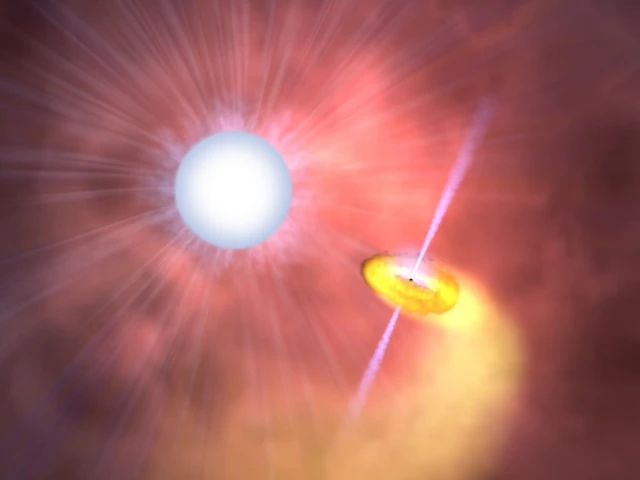
Cygnus X-3 is a high-mass X-ray binary system consisting of a compact object (likely a black hole) and a Wolf-Rayet star. This artist’s concept shows one interpretation of the system. PHOTO: JPL, NASA
Scientists using China’s Large High Altitude Air Shower Observatory (LHAASO) recently found that a remarkable binary system in the constellation Cygnus, Cygnus X-3, is the most powerful particle accelerator discovered to date, according to the Institute of High Energy Physics (IHEP) of the Chinese Academy of Sciences (CAS).
Cygnus X-3 is a binary system composed of a compact object (either a black hole or a neutron star) and a massive companion star. As the compact object voraciously accretes material from the intense stellar wind of its companion, it accelerates particles to extremely high energies. However, previous mainstream theories held that charged particles within the Milky Way could reach energies of about 1 PeV (peta-electron volt), scientists said.
Read More: OpenAI says has more than 1 billion active users
Through detailed analysis of the time variability and spectral characteristics of ultra-high-energy gamma rays, LHAASO has confirmed that Cygnus X-3 can accelerate cosmic-ray particles to energies of at least 30 PeV, said Cao Zhen, principal investigator of LHAASO and an academician of CAS.
Furthermore, LHAASO detected a 4.8-hour periodicity in the ultra-high-energy gamma-ray signal and constrained the particle acceleration region to roughly three times the solar radius, according to scientists.
Researchers noted that this discovery opens new avenues for investigating extreme physical processes near compact objects such as black holes. The related findings have recently been published in the journal National Science Review.
Located on a mountain at an elevation of about 4,410 meters above sea level in southwest China’s Sichuan Province, and covering an area of 1.36 square km, LHAASO is used for cosmic ray and gamma-ray observation and research.