

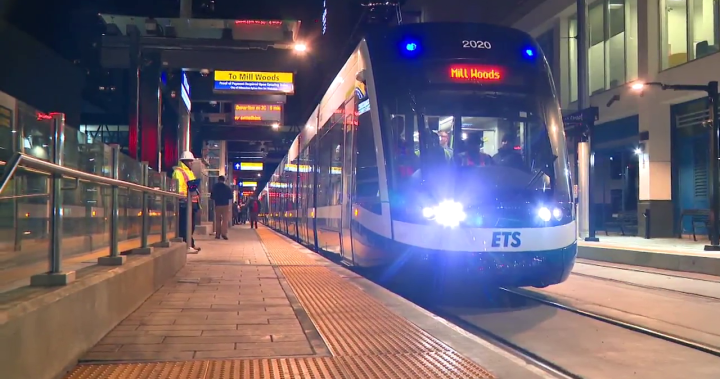
The City of Edmonton is ditching TransEd and shifting operations of the Valley Line LRT in-house to the Edmonton Transit Service — a move officials say will save taxpayers money.
“This is strictly a financial decision,” City of Edmonton manager Eddie Robar said, explaining the goal is to operate the public-private partnership line at a lower cost.
“We can do it at a price that’s more affordable for taxpayers.”
But how much money is a mystery.
The change will see TransEd, the private industry consortium contracted to build and operate the 13-kilometre Valley Line Southeast leg from downtown with Mill Woods, hand over operations to ETS over the next one to two years.
Edmonton transit is then expected to run the entire 27-kilometre long Valley Line once the west leg opens.
A City of Edmonton map showing the Capital Line, Valley Line and Metro Line LRTs.
City of Edmonton
That stretch of the line from downtown to Lewis Estates is being built by Marigold Infrastructure Partners.
It’s expected to open in 2028, pending successful testing and no big issues emerging as was the case for the southeast, which led to it opening three years later than scheduled.
That delay cut into the time TransEd was contracted to run the route: the southeast leg was set to open in December 2020 and be under TransEd’s control until December 2050.

Instead, the line opened in November of 2023, but the 30-year operating contract remained set to expire in 2050. The city is now cutting it short by more than 24 years.
City officials would not reveal details on projected savings on Tuesday, nor would it disclose the cost of the transition or any potential early contract termination payment to TransEd.

Get daily National news
Get daily Canada news delivered to your inbox so you’ll never miss the day’s top stories.
“You’ll see what the operational costs are through budget,” Robar said. “But as far as the numbers we’re talking about today, obviously there’s commercial operators involved in this, too … so we won’t be releasing those numbers today.”
Robar added the city expects to recoup any costs associated with exiting the contract within a short period.
“We’ll be able to recover our spend on what it costs us to remove from the contract within the first two years,” he said.

City officials stressed Tuesday the operations move is not a reflection of TransEd’s performance, describing it instead as a financial decision and part of a broader plan to have a single operator for the full line.
“I want to assure staff of both TransEd and ETS that we are taking a very thoughtful approach to this transition. We value the skilled workers who operate and maintain LRT service in our network,” said ETS branch manager Carrie Hotton-MacDonald.
Transit consultant David Cooper said consolidating operations makes sense as the system expands.
“When we have a full 27-kilometre line, it’ll be a little bit simpler to manage that line from an operations perspective,” said Cooper of Leading Mobility Consulting.
The city said riders are not expected to notice any disruption during the transition.
In a statement, TransEd said it is disappointed by the decision but respects the city’s direction.
The company said its focus will now be on working with the city to ensure a safe and smooth transition.
TransEd is a four-company consortium that originally consisted of Bechtel, Bombardier Transportation (now acquired by Alstom), EllisDon, and Fengate Asset Management. It was selected in 2015 to design, build, operate and maintain the 13-kilometre southeast leg of the Valley Line.

The project faced multiple delays and opening date setbacks, including cracks in concrete piers supporting elevated sections of track, underground cables needing to be replaced due to oxidization, and the discovery of a mysterious, car-sized concrete block in the North Saskatchewan River during bridge construction.
The line opened to passenger service on Nov. 4, 2023.
© 2026 Global News, a division of Corus Entertainment Inc.


