

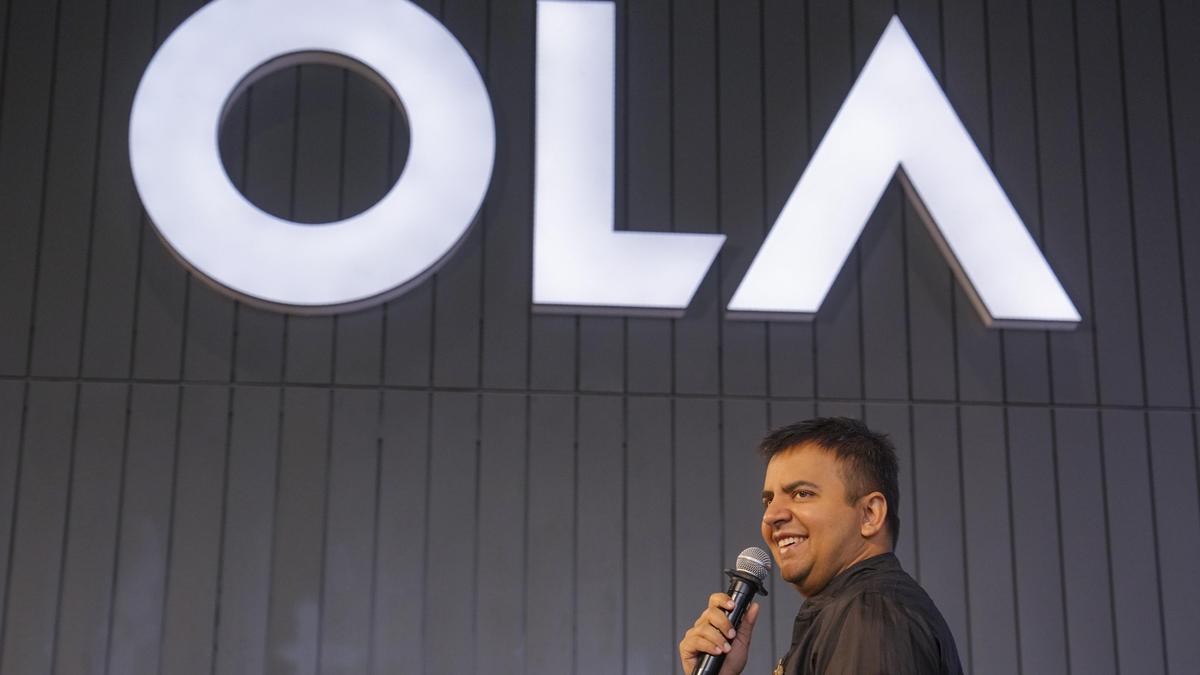
Ola Electric Mobility is looking to enter FY27 with renewed momentum, with founder and Chief Managing Director (CMD) Bhavish Aggarwal signalling a recovery in volumes, stronger margin visibility and tighter cost discipline following recent operational reset.
Speaking at the company’s Q4 and FY26 earnings conference call, Mr. Aggarwal said that Ola had used the past few quarters to fix execution issues and strengthen the business before scaling again. “Q4 was lower revenue because Q4 was also a quarter where we focused a lot on our operations, to fix the operations, and then scale again, both on cost as well as customer experience,” he said.
“We started scaling volumes again in the middle of March onwards,” he added. The company expects this recovery to show up meaningfully in Q1 FY27, guiding for 40,000-45,000 orders and consolidated revenue of ₹500-550 crore, nearly double the Q4 level.
Mr. Aggarwal said registrations rose from about 10,000 in March to 12,000 in April, with May trending towards 14,000-15,000. “We are growing registrations. Our orders are growing ahead of registrations but we have a production backlog now,” he said. Mr. Aggarwal added that demand had improved sharply, with Ola now operating at very low free inventory levels.
“Demand has increased so much that people are buying whatever they can find in the network from us,” he said, adding that inventory days had fallen to three to four days and that improving delivery timelines could lift volumes another 10-20% in the near term.
The rebound is critical because Ola Electric says consolidated adjusted operating Earnings before Interest, Tax, Depreciation, and Amortisation (EBITDA) breakeven is achievable at around 20,000-25,000 units per month, depending on pricing mix and commodity conditions.
Mr. Aggarwal said the company expects the volume rebound itself to take it to about 17,000-18,000 units per month, while better service stability and inventory availability could move it closer to 20,000-22,000 units over the next quarter.

Margins are emerging as the strongest pillar of the FY27 recovery story. Ola reported a consolidated gross margin of 38.5% in Q4 FY26, up from 34.3% in Q3 and 13.7% a year earlier. Excluding performance-linked incentive (PLI) benefits, gross margin stood at 33.5%. Mr. Aggarwal said this validated Ola’s vertically integrated model and was not merely incentive-led.
“We believe very strongly that our gross margins will remain a very strong structural advantage for us going into the future as we rebound our volumes,” he said. The cost base has also been reset. Consolidated operating expenses, including lease costs, fell to ₹428 crore in Q4 FY26 from ₹844 crore in Q4 FY25. Mr. Aggarwal said Operating expenses (OpEx) had halved year-over-year and could fall further to about ₹100-120 crore per month over the next couple of quarters.
“Because we are so vertically integrated on both the back end and the front end, almost 90% plus of our OpEx is actually fixed. That means operating leverage is very high,” he said. Ola also delivered its first operating cash flow positive quarter in Q4, with a consolidated Cash flow from operating activities (CFO) of ₹91 crore.
The auto business generated ₹213 crore of operating cash flow and ₹173 crore of free cash flow, which management said marked a shift from heavy build-out to disciplined scale-up. The company expects product quality and service improvements to support the FY27 recovery.

Warranty costs declined from more than ₹500 crore in FY25 to ₹59 crore in FY26, which Mr. Aggarwal said validated the Gen 3 platform. “We feel very optimistic about our sales as well as customer sentiment,” he said. Motorcycles are also expected to aid growth. Ola said bikes now account for about 15% of volumes, while its share in electric motorcycles is over 50%.
Mr. Aggarwal said the Roadster portfolio is seeing strong traction in northern India and that Ola is “constrained not by demand there, but by supply.” For FY27, Mr. Aggarwal framed Ola’s agenda around scaling volumes without heavy incremental capital. He said the auto capex cycle is largely behind the company, with annual maintenance capex expected at around ₹50 crore.
“The business’s CapEx cycle is behind it, and now the focus is on scaling up, utilisation and monetisation,” he said. With demand rebounding, margins holding firm and costs reset, Ola Electric is positioning FY27 as the year in which its integrated Electric Vehicle (EV) model begins translating more visibly into operating leverage and cash-flow improvement.
Published – May 22, 2026 07:22 pm IST


