

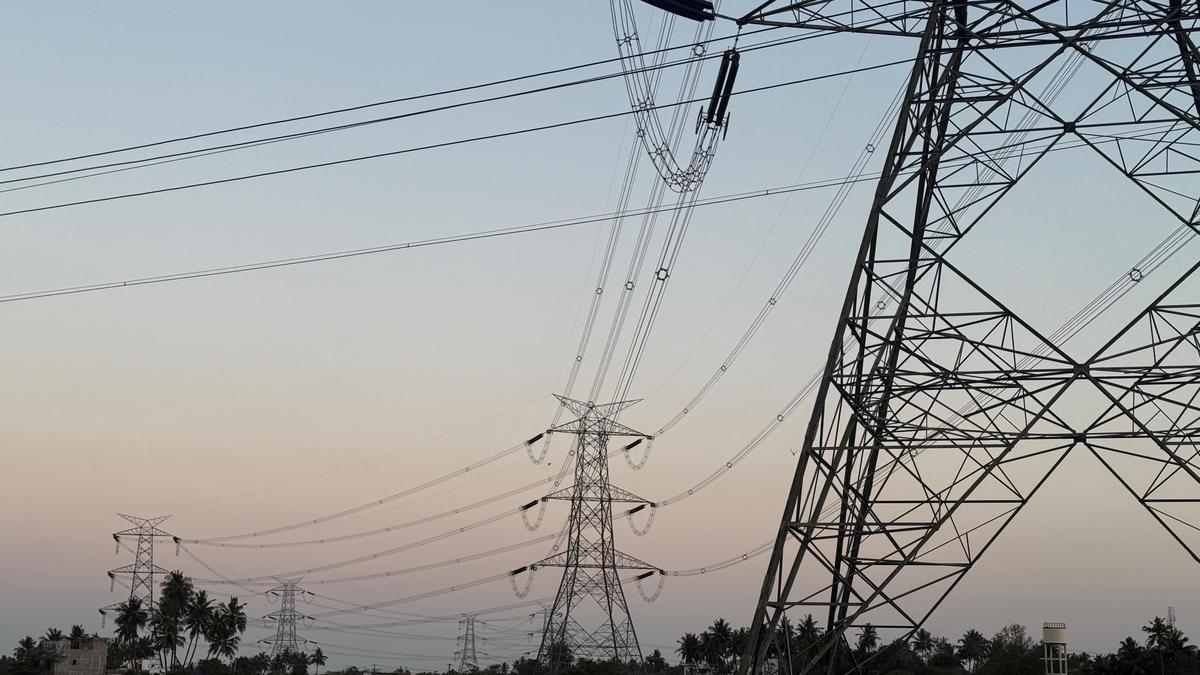
Representative image.
| Photo Credit: The Hindu
Amidst rising power demand with soaring temperatures across the country, India was able to meet a peak power demand of 260.45 gigawatts during solar hours at 3:40 p.m. on Tuesday (May 19, 2026), the Union Power Ministry informed on Tuesday (May 19, 2026).
The latest feat surpassed the previous peak of 257.37 gigawatts which was scaled Monday (May 18, 2026).

According to data from the ministry, thermal accounted for 61.5% of the power generated at the peak hour, solar 22%, wind 6.7%, hydro 5.3% and nuclear 2.7%.
Referring to the peak power demand met on Tuesday (May 19, 2026), the Power Ministry held, “This capacity to deliver on rising power demand is not a story of overnight transformation but one of sustained focus on generation, transmission and distribution over the past few years.”
As on May this year, India has an installed capacity of more than 538 gigawatts.
Of this, the installed renewable sources-based capacity is 283.46 GW inclusive of 150.26 GW solar, 56.09 GW wind, 11.75 bioenergy, 5.17 small hydro and 51.41 GW large hydro.
Nuclear power accounts for the remainder 8.78 GW of the installed capacity from non-renewable sources.
Published – May 20, 2026 02:16 am IST


