Says shortfall is created once demand exceeds 16,500MW, adds peak demand reached up to 20,000MW in past 15 days
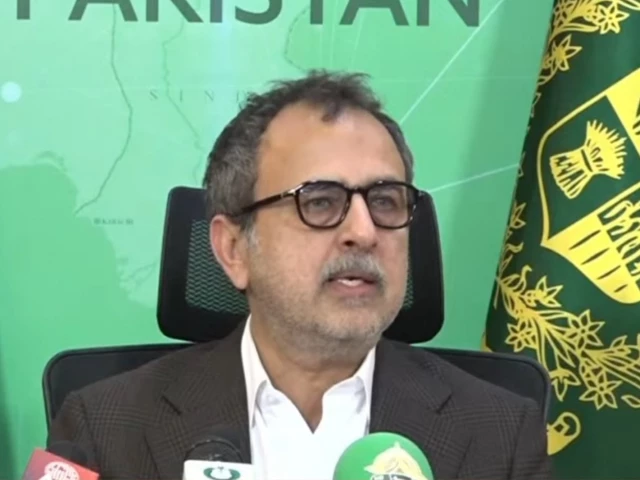
Minister for Power Sardar Ayaz Leghari addresses a press conference on Thursday. SCREENGRAB
Power Minister Awais Leghari on Thursday apologised to the nation for the widespread outages and load-shedding across the country, saying the crisis was caused by disruptions in LNG supplies due to the Middle East situation and other factors, adding that conditions would improve once supply lines reopened.
The country is currently facing a worsening electricity crisis, with the overall power shortfall reaching 6,500 megawatts (MW), leading to prolonged load-shedding in several regions and mounting public frustration.
According to sources, total electricity demand has surged to around 22,000MW, while generation remains limited to 15,400MW. The current energy mix comprises 1,500MW from hydropower, 9,250MW from thermal sources, 1,200MW from wind, 2,850MW from nuclear energy, 400MW from solar and 200MW from bagasse.
Addressing a press conference, the minister said supplies from abroad were disrupted due to the Middle East crisis, leading to the shortfall and load-shedding.
“After April 1, the supply of LNG from abroad came to a halt, and Qatar declared force majeure. From that day onward, a significant gap emerged in meeting requirements that were previously fulfilled during peak hours through gas-based power plants,” he said.
Apologising on behalf of the government, Leghari said he was answerable for the hardship faced by the public during evening and nighttime peak hours due to the inability to provide electricity.
“We acknowledge the difficulties the people are facing, and we offer our apologies. However, the circumstances are such that they are not within our control. Even then, we ought to apologise,” he added.
Read: Massive outages as deficit hits 6,500MW
He said that from 2017 onwards, owing to the efforts of the last government of the Pakistan Muslim League-Nawaz, the country had been rid of load-shedding.
The minister said electricity demand had increased by 3.8% this year, attributing the rise to the decreasing cost of electricity and the shift in captive power plants as part of the reform process.
Explaining the reasons behind the shortfall, he said the deficit had reached 2,500MW due to LNG-related issues. “Our LNG shortfall has arisen because fuel is not arriving from abroad, our plants are unable to generate electricity, and the lack of hydropower generation has further caused a shortfall of 1,530MW,” he added.
“The 2,500MW shortfall caused by gas shortages has arisen because supplies are not arriving from abroad. Owing to the ongoing tensions between Iran and the United States, as well as the situation in the Strait of Hormuz, we have not been receiving gas, while Qatar has also declared force majeure — a development already known to the public,” he said.
Commenting on reduced hydropower generation, the minister said seasonal conditions and rainfall in April had necessitated prioritising water use for agriculture. “In Pakistan, there is a clear principle that water from reservoirs is released when farmers require it; it cannot be discharged solely for the purpose of generating electricity,” he added.
He said that in April, minimum demand stood at 9,000MW, while in the past 15 days, peak demand had reached up to 20,000MW on different days. “Outside of peak hours — that is, during the daytime when there is natural light and demand is lower — no load-shedding has been carried out, nor will it be in the future, as there is no need for it,” he clarified.
Also Read: Govt announces over 2 hours of daily loadshedding due to rising costs
Leghari said that when demand crossed 16,500MW, gas-based power plants were required, and in the absence of gas, there was no alternative fuel available to bridge the gap.
“After utilising all available sources in Pakistan — imported coal, local coal, nuclear energy, hydropower and solar — once demand exceeds 16,500MW, a shortfall is created. At that point, loadshedding during the evening hours has to be increased gradually in line with the requirement,” he added.
He further explained that “if there is one hour of loadshedding across Pakistan, it means we are producing 500MW less than demand,” noting that the previous night’s demand exceeded production capacity by 3,000-3,500MW.
Terming the situation temporary, he said, “The good news for the public is that this is a transient phase. As soon as gas supplies resume and hydropower generation increases, loadshedding will come to an end.”
He added that the current situation was due to tensions between Iran and the US and disruptions in gas supplies, noting that even if hydropower generation had been lower by 1,500 to 1,600MW, sufficient gas-based capacity could have enabled production of up to 6,000MW instead of 3,000MW.
The minister said furnace oil power plants were operating at full capacity, but despite that, load-shedding had been carried out “in a fair manner” across both urban and rural areas.
“In the past two days, we have also had to impose loadshedding on industry, as it had become unbearable for the common man to endure more than three hours without electricity,” he said.