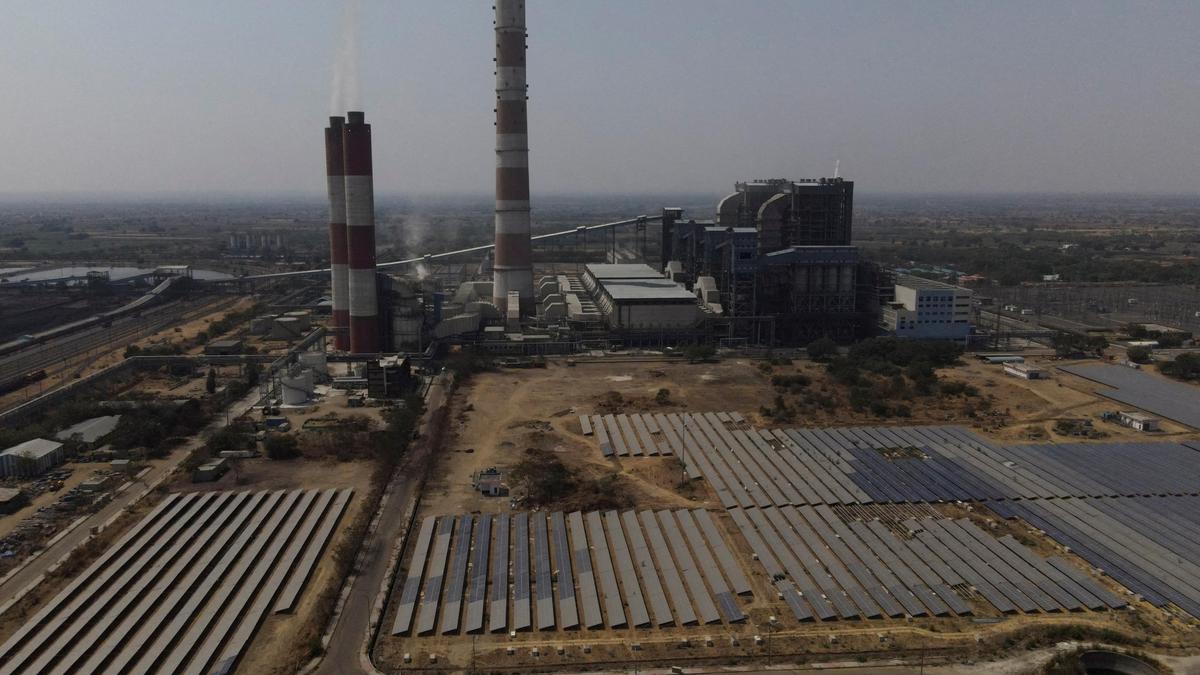
A drone view of solar panels and the NTPC (National Thermal Power Corporation) power plant in Solapur, Maharashtra. File
| Photo Credit: Reuters
India’s announcement of its revised Nationally Determined Contributions (NDCs) to the Paris Agreement — the term applied to the mitigation and other climate action targets that countries voluntarily commit to under the agreement — represents a considered step forward when India’s energy and development policies are encountering serious headwinds. It is clear that the government has opted for continuity and incremental advance with respect to India’s earlier NDCs. It is also clearly confident that its commitments will nevertheless be more than adequate in relation to its equitable share of global climate action, in keeping with climate justice and within its expected commitments as a developing nation.
As the press communique after the Cabinet approval of the updated NDCs noted, three specific enhancements have been committed. The first is an increase in the reduction of emissions intensity of its GDP, from 45% below 2005 levels by 2030 to 47% below 2005 levels by 2035. The second is ensuring that 60% of installed capacity for power generation is from non-fossil fuel sources, while the third is the enhancement of forest and tree cover carbon sinks to 3.5 – 4 billion tonnes of carbon dioxide equivalent above 2005 levels.
Published – April 07, 2026 11:01 pm IST