‘Riverless Water’ traces mass migration, displacement from Mirpur to Birmingham following dam’s construction
The Midlands Arts Centre (MAC) in Birmingham, United Kingdom, announced its final weekend of London-based Pakistani artist Saba Khan’s Riverless Water. The exhibition is grounded in South Asian water histories and an exploration of migration and displacement following the construction of the Mangla Dam in the 1960s.
Khan examines the human and environmental consequences of the Mangla Dam in Azad Kashmir, a project that triggered one of the largest migrations from Pakistan to the UK following its construction on the River Jhelum. The event has had a lasting impact on communities in Pakistan and Britain, particularly in the Midlands.
The arts centre shared a closing message on its Instagram, highlighting Khan’s exploration in her work. “Riverless Water marks a new chapter in London-based Pakistani artist Saba Khan’s practice, exploring environmental transformation, displacement and migration”, the centre captioned a post.
The exhibition notes that its 12 paintings, alongside archival material, video interviews, and drawings, trace historical moments surrounding the dam’s construction, which “led to the mass migration of people from Mirpur, Pakistan, to Birmingham.”
Beyond the dam, the exhibition delves into textile mills, factories, and the legacy of British colonialism in the post-partition era of Pakistan and India.
One of Khan’s works titled Cars Manufactured in the 1960s at the Longbridge Factory, depicts three cars floating on waves, evoking the waters released by the Mangla Dam. The painting references the submergence of over 280 villages during the construction, which displaced over 110,000 people from Mirpur and Dadyal.
The British government was one of the project’s international guarantors, the MAC wrote in a post on Facebook, adding that migrant status formed part of the settlement offered to local communities. “Today, around 70% of Britain’s Pakistani community originates from the Dadyal and Mirpur area affected by the dam,” the arts centre noted.
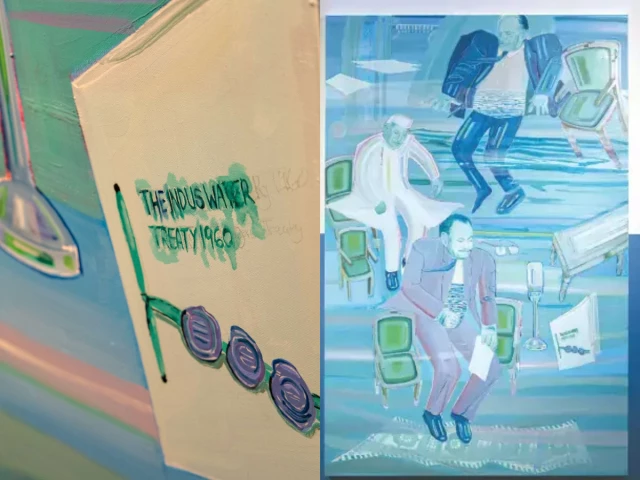
Along with reflecting post-industrial Britain through her work, Khan’s work also reflects significant historical developments such as the Indus Waters Treaty. Through such depictions, the artist highlights the psychological experience of migrants, addressing themes of loss and trauma.
Khan noted, “the early migration trends included men engaged in temporary factory work at employment sites such as the Longbridge car factory in Birmingham.”
Khan, who was initially researching the movement of bodies in the French Alps, later shifted her focus to the bureaucratic complexities of her home country, Pakistan. Drawing on research from the Water and Power Authority (WAPDA) and local archives, Khan approached her subject through a more nationally-grounded lens.
Her work stands as a powerful and distinctive visual exploration of Pakistan’s history and its diasporic communities.
Khan debuted her first solo exhibition in the UK this January and her current show is set to close on April 6 at the MAC.