
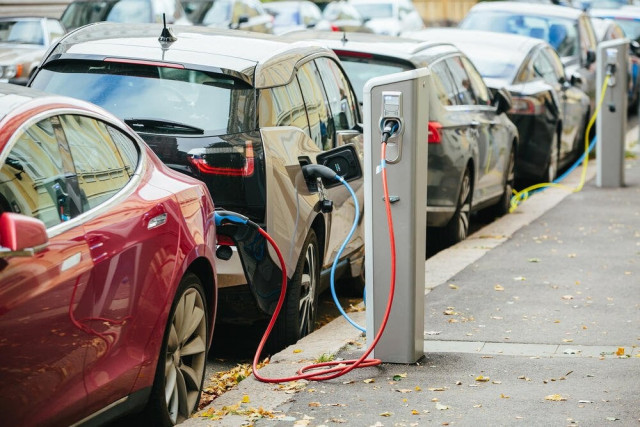
Spike in global fuel costs drives buyers towards electric vehicles, though shift may take time
The rising price of gasoline due to the Iran war has triggered anxiety and uncertainty for carmakers, dealers and vehicle owners, but for some, it has opened new opportunities.
Martin Miller, who owns a used electric-car dealership southwest of London, recorded his busiest Saturday just a week after the war began on February 28, when Israel and the United States launched strikes on Iran. The conflict has disrupted shipping in the Strait of Hormuz, through which around 20% of global oil supplies pass.
“We’re turning cars very, very quickly,” Miller said, noting that customers at his dealership, EV Experts, are increasingly concerned about rising petrol prices. He added that his team has been buying more electric vehicles at auctions “like mad” in anticipation of continued demand.
Read: Govt to review tax relief for hybrid EVs
Official data shows fuel prices have climbed sharply since the conflict began. In Britain, gasoline prices per litre have risen 7% as of March 16, while prices across the European Union are up 8%, according to the European Commission. In the United States, the average price per gallon has surged 27% to $3.72, data from the U.S. Energy Information Administration showed.
When buyers change behaviour
Historically, oil price shocks have influenced consumer preferences. The energy crisis of the 1970s, for example, pushed US buyers towards smaller, fuel-efficient cars, benefiting Japanese automakers.
Analysts say the current rise in fuel prices may not immediately shift consumer behaviour, as sustained increases are typically required to alter purchasing patterns. “Consumers are highly reactive to gas prices, but it tends to be that it has to hit a certain round number,” said Kevin Roberts of CarGurus, pointing to $4 per gallon as a key psychological threshold.
Some buyers, however, are already acting. Zach Xavier, a customer in Richmond, said he traded in his petrol-powered SUV for an electric vehicle and bought a second EV. “I’m trying to get in before everybody freaks out,” he said.
Despite rising fuel costs, data suggests US consumers have yet to significantly shift towards EVs. CarGurus reported no major change in search trends, while Edmunds noted only a slight increase in interest in electrified vehicles.
Europe ripe for EV Shift
Europe may see a quicker transition, analysts say, as electric vehicles already accounted for 19.5% of total car sales last year, supported by government incentives.
In Germany, online dealer MeinAuto reported a 40% increase in EV-related traffic since the war began. A Carwow survey found that 48% of respondents said rising fuel prices would influence their decision to consider an EV or hybrid.
Read More: Oil shock and the import trap
Automakers are also responding to the shift. Vietnamese manufacturer VinFast has introduced discounts for customers switching from gasoline-powered vehicles, citing volatility in global fuel prices.
However, experts caution that a large-scale shift in the United States remains unlikely unless fuel prices rise significantly further. EVs accounted for just 7.7% of new car sales last year, with demand cooling after federal tax incentives were withdrawn.
Research by Cox Automotive suggests most US consumers would only consider switching if gasoline prices reach $6 per gallon. “Unless you really need a car right now,” said analyst Stephanie Valdez-Streaty, “you might hold off.”