

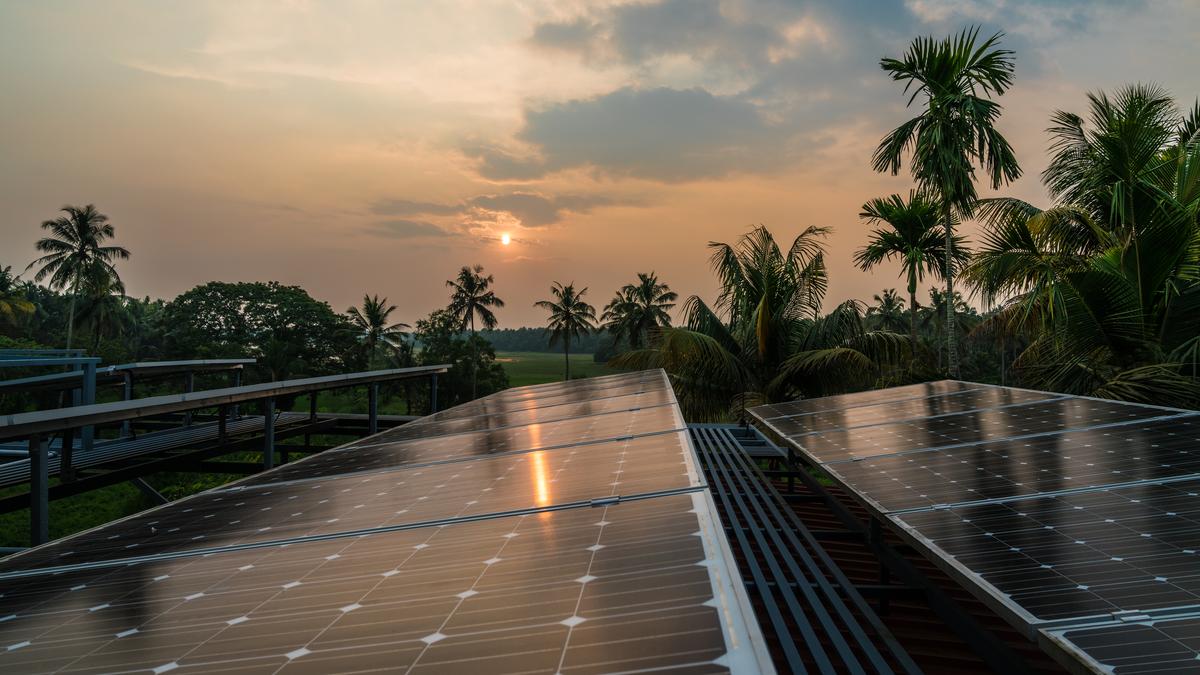
Image for representative purposes only
| Photo Credit: Getty Images/iStockphoto
As India’s solar energy capacity continues to accelerate, the domestic industry is seeking an enhanced Production-linked incentive scheme, second instalment of PM-Kusum and viability gap funding to accelerate potential for energy storage, in the upcoming Union Budget.
Referring to the wish list for the Union Budget, Subrahmanyam Pulipaka, CEO at the industry body National Solar Energy Federation of India (NSEFI), told The Hindu, “The sector has grown big today, we are no more a sub-sector of the power sector,” he stated, “We are the second-largest generator in terms of installed capacity, therefore, our aspirations have increased in the same proportion.”
PLI for capital-intensive components, help with domestic push
Mr. Pulipaka sought the government consider instituting a production-linked incentive (PLI) or a similar scheme, for manufacturing ingots. They are among the raw material utilised for making solar cells. “These are all capital-intensive parts,” he stated, adding, “We have done a decent job with PLI where we have established value chain up until the module wafer. We would need a bit of handholding and capital subsidy with ingots because these are also strategically important to us.”
Separately, Prafulla Pathak, Solar Energy Society of India (SESI) also insisted on good financial allocation for the industry to help push for overall indigenous production. “Earlier, we were dependent on neighbouring countries [for components]. However, now we see indigenously manufactured things are increasing, therefore, a financial support for that is what we are seeking.”
Consider PM-Kusum 2.0, PM Surya Ghar
Mr. Pulipaka also indicated the industry would look forward to the second instalment of PM-Kusum. The scheme, launched in 2019, endeavours to provide and energy and water security to farmer and “de-dieselise” the farm sector. The scheme is scheduled to conclude March-end. He urged that probable revised scheme provides for provisions that farmers “be able to use the same land for agriculture as well as for solar”.
Further, Mr. Pathak called for the government to consider providing “more momentum” to the PM Surya Ghar Yojna. The scheme seeks to install solar rooftops in households as a means to providing 300 units of free electricity each month. “We must increase the speed by providing funds, awareness to masses and regulatory changes to speed up process for adoption,” he stated.
Viability gap funding for energy storage
Finally, with respect to energy storage, Mr. Pulipaka also called for viability gap funding be extended not just to discoms but also to privately-owned renewable energy developers. “This would help increase pace of installation,” he held.
Published – January 12, 2026 09:24 pm IST


