

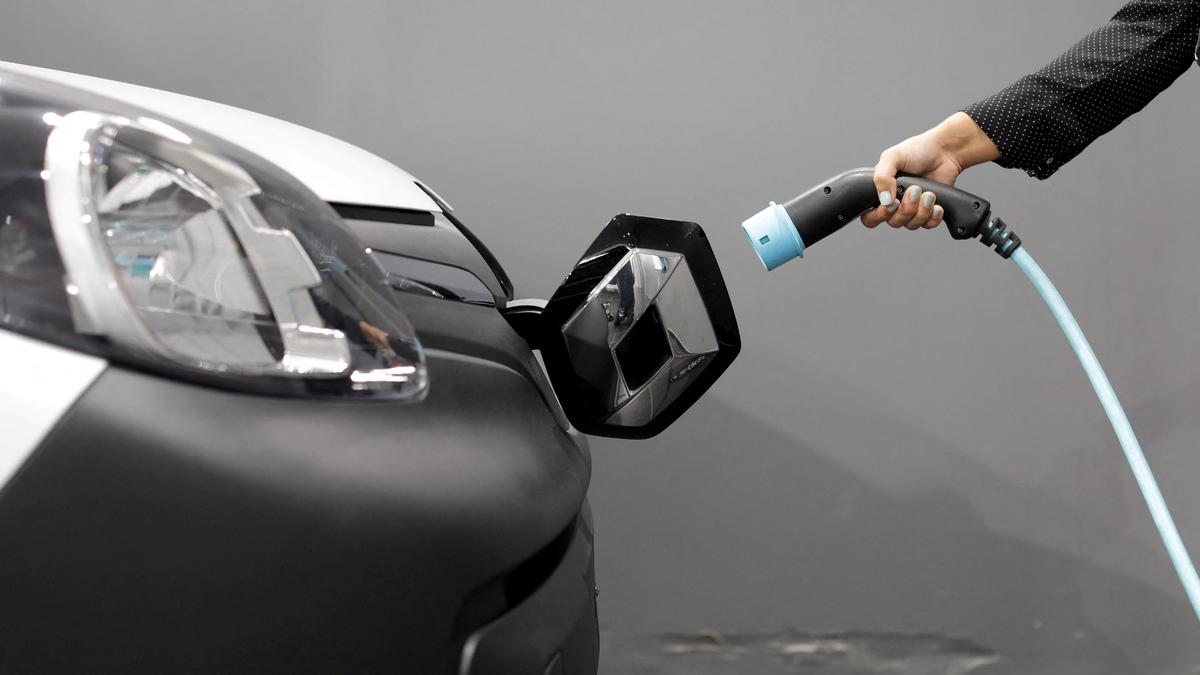
Image used for representation
| Photo Credit: Reuters
While electric vehicles (EVs) offer zero emissions, the carbon intensity of electricity generation plays a decisive role in determining the overall environmental benefit of EVs, Managing Director of state-owned Indraprastha Gas Ltd (IGL) Kamal Kishore Chatiwal stated Wednesday (January 7, 2026), also referring to studies conducted by the Central Electricity Authority (CEA) and International Energy Agency (IEA).
Speaking at the launch of the study on ‘Comparative Assessment of Vehicular Fuels in India’s Green Energy Transition’ of the Petroleum and Natural Gas Regulatory Board (PNGRB) and IGL, Mahanagar Gas Ltd, GAIL Gas, among others, Mr. Chatiwal emphasised, “Unless we green that, then the overall benefit may not accrue.”
Separately in his address, with respect to electric vehicular technology, Mr. Chatiwal observed that electrifying vehicles with lower capacity is easy. “As capacity increases, it becomes more complex and economically challenging to match other alternative fuels,” he elaborated, whilst urging the researchers to look at the “economic angle” of the paradigm.
“In India, the economic angle will always be very important,” he stated.
Tax equilibrium for CNG vehicles
Speaking at the same event, Suresh Manglani, Chief Executive Officer (CEO) at Adani Gas, suggested there must exist an “equilibrium level-playing field” for CNG vehicles and kits. He noted GST on electric vehicles (EVs) is at 5% whilst that of CNG vehicles is 18%. He urged the researchers look into the subject as well.
Further delving on the subject, Mr. Manglani suggested there must be a move from “transactionality” (that is, from CNG, CBG to EV and thereafter to hydrogen and LNG-powered vehicles) to “universality”. “So [the study must investigate] how do we move from transaction policy to universal policy. If some fuel is emitting ‘x’ percent of pollution, tax allocation should be accordingly given, why are we punishing CNG?”
Mr. Manglani further mentioned, “There is no way we can say that people should be only using CNG. Choice must be with the people on what vehicle they want to buy,” he stated, emphasising, “Only thing is, as a CGD industry we are looking at a fairness in tax policy.”
Published – January 07, 2026 07:56 pm IST


