

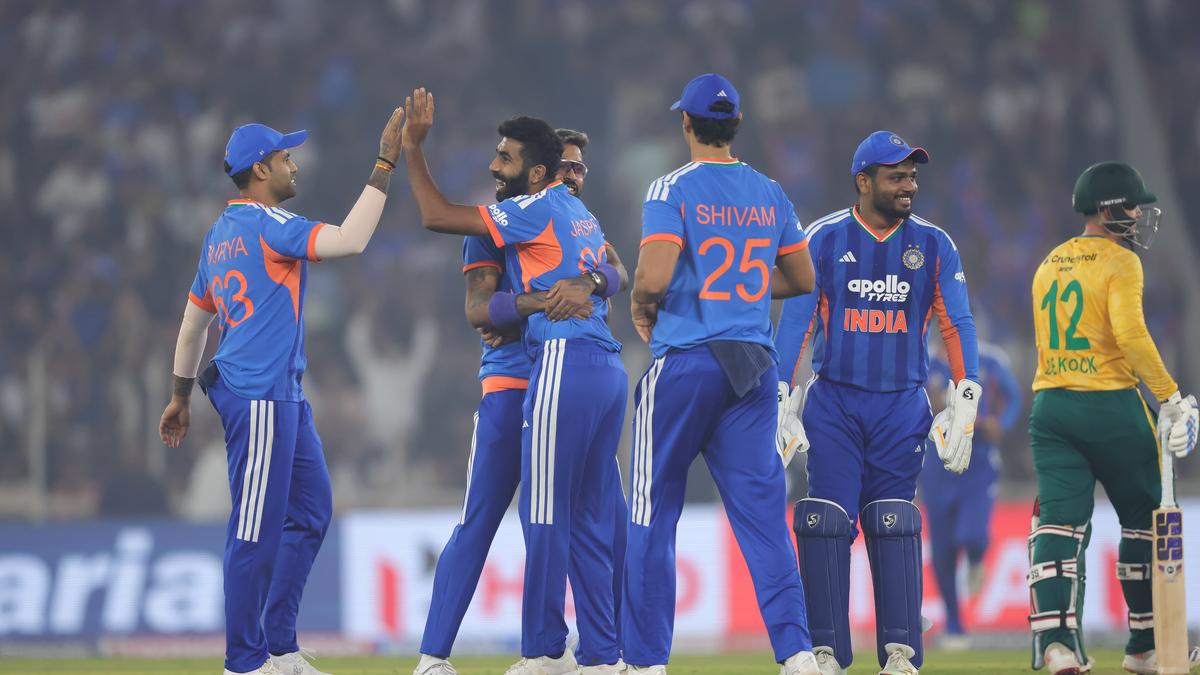
Eight editions of the T20 World Cup have followed 2007’s inaugural spectacle. Not once in all these years has a team lifted the sleek, silver-plated prize in successive campaigns — a fair reflection of the challenge of attaining consistency in a format inclined to fickleness.
Can India buck the trend? Can the two-time champion, on the back of winning the 2024 T20 World Cup in the Caribbean, manage another serious tilt at the title on home turf?
ALSO READ | Persistence outlasts rejection for Sanju Samson
Stacking wins
The results since that heady afternoon in Bridgetown have provided little reason to doubt India’s credentials. A change of captain and coach from Rohit Sharma and Rahul Dravid to Suryakumar Yadav and Gautam Gambhir unfolded soon afterwards, but victories have continued to stack up at an impressive rate in the 18 months since the previous iteration.
Of its 36 T20Is this cycle, India has won 29 (two in Super Overs) and lost just five (two no-results). Furthermore, it has won all seven bilateral series. At September’s eight-team Asia Cup in the UAE, Suryakumar and Co. stitched together an undefeated run.
Those are among the good bits. With just five T20Is against New Zealand to go before India’s T20 World Cup campaign kicks off on February 7, what has not been so good is the form of the captain, who has scored a meagre 448 runs in 31 matches at 17.92 since taking the reins. Suryakumar’s last half-century (75 vs. Bangladesh) dates back to October 12, 2024.
The 35-year-old’s pedigree isn’t up for debate. He is one of only four batters to amass four or more T20I centuries and has won the ICC T20I Cricketer of the Year award twice (2022, 2023). At his free-flowing best, he has an inimitable repertoire of strokes that accesses every nook and cranny of the outfield, and he is as adept at attacking pace as he is at dismantling spin.
ALSO READ | Class is useful, but form is everything in a T20 team
Even so, his lean stretch has gone on for far too long to not arouse concerns. True to Suryakumar’s easy-going demeanour, he took pointed queries on the chin during the announcement of India’s T20 World Cup squad. “Ye waala patch thoda lamba ho gaya [this patch has stretched a bit too long]. I’m sure everyone has seen this in their respective careers. I will also overcome it. I know what to do,” he grinned reassuringly.
Heavy is the head… Suryakumar Yadav’s pedigree isn’t up for debate, but he has scored a meagre 448 runs in 31 T20Is at 17.92 since taking the reins.
| Photo Credit:
Getty Images
Even more of a talking point, of course, is the last-ditch reshuffle at the top of the order. Having reposed faith in Shubman Gill as Suryakumar’s deputy and opening batter just ahead of the Asia Cup, the selection committee has abandoned that idea by dropping the Test and ODI skipper from the 15-member T20I squad entirely. Doing so at the eleventh hour is a tacit admission on the part of the selectors and team management that they were wrong to disrupt the opening association between Abhishek Sharma and Sanju Samson in the first place.
It would be altogether understandable if Samson has encountered cobwebs of self-doubt in the process. Despite smashing three hundreds as opener in 2024, he was shunted down the order and even out of the team recently. If he can overcome the latest hiccup, his tendency to tee off straightaway, coupled with Abhishek’s free-spirited aggression, should help India set the PowerPlay overs ablaze.
By deciding that a wicketkeeper at the top is the way to go, India has essentially opted for greater flexibility in the middle and lower order. While Hardik Pandya and Axar Patel are the primary seam- and spin-bowling all-rounders respectively, the multi-faceted traits of Shivam Dube and Washington Sundar will come into the equation based on the surfaces and opponents. Rinku Singh may not have as many strings to his bow, but as a finisher with ice in his veins, he is as good as they come. Such a wide spread enables India to have batting depth till No. 8 while also allowing for more than six bowling options at all times.
The Gambhir way
That has been Gambhir’s way ever since he transitioned to a role in the dugout. The 44-year-old’s predilection for players with multiple skills has probably hindered the Test team on occasion, but his excellent record as white-ball coach leaves no room to find fault.
“The captain and coach know what combinations they want to play. We’ve got a lot more options to play at different positions, which is what the team management is always looking for,” chief selector Ajit Agarkar said.
Another of Gambhir’s core beliefs in T20 cricket seemed to be the importance of left-right combinations in the middle and flexible batting line-ups. As recently as the Asia Cup, the coaching staff repeatedly stressed that other than the opening pair, every batter would have to be ready to slot in anywhere. But, like with Gill, there seems to have been a rethink here too. Much to Tilak Varma’s benefit, it frees up the southpaw to exhibit his flair at No. 3 regardless of whether Abhishek or Samson gets dismissed first.
ALSO READ | Arundhati and the power of perspective
“We’ve come to a point, Gauti bhai and I, that we’re not looking for left-right. It’s actually a little overrated. We’ve fixed the No. 3 position for Tilak, I want to bat at 4. We want to fix it so that Tilak is comfortable, he knows what his role is, and he’s enjoying that position,” Suryakumar said.
Conversely, there were no late modifications to the bowling pack. It points to the fact that Jasprit Bumrah, Arshdeep Singh, Varun Chakaravarthy, Kuldeep Yadav and Harshit Rana comprise a bunch of bonafide wicket-takers equipped to handle high-pressure scenarios.
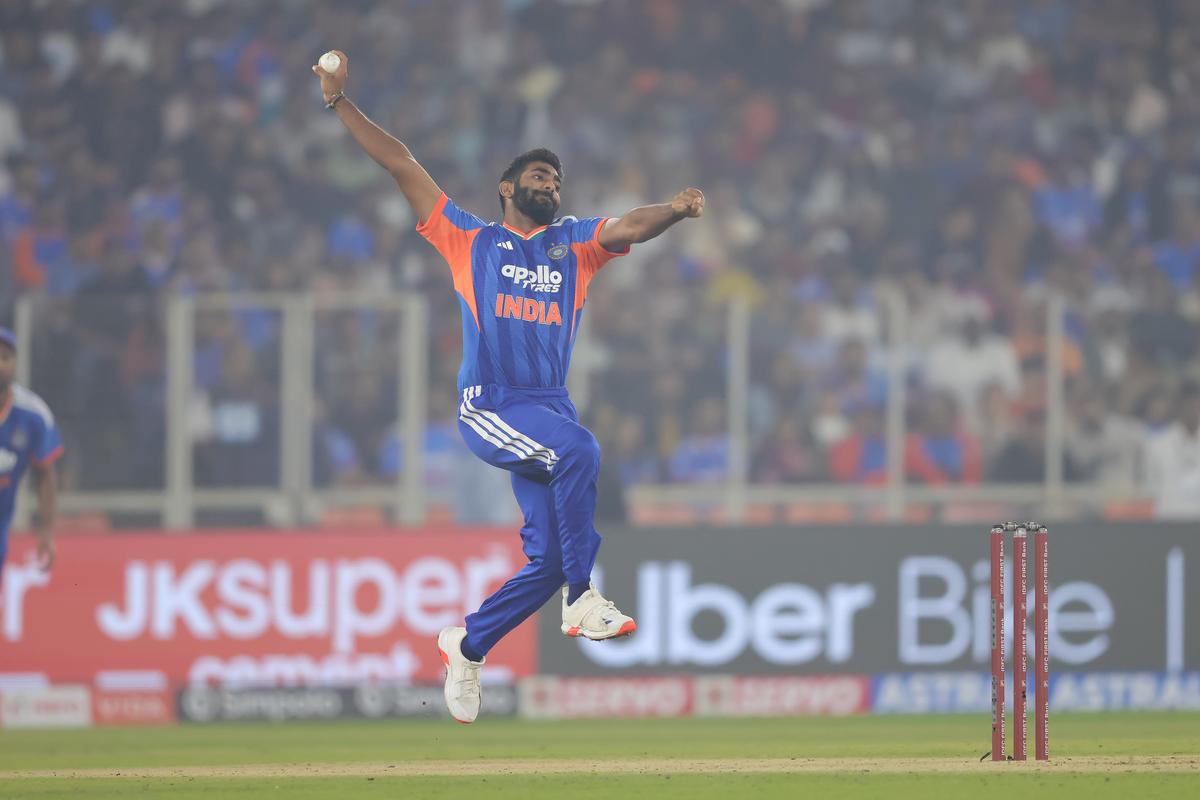
Both ace and trump card: India has an exceptional T20I bowling attack, but a lot will still rest on the peerless Jasprit Bumrah.
| Photo Credit:
Getty Images
All the same, a lot will predictably rest on Bumrah. Take, for example, India’s most recent outing against South Africa in Ahmedabad. Defending India’s 231 on a shirtfront, the 32-year-old spearhead returned extraordinary figures of 4-0-17-2 even as most other bowlers were met with a stern beating.
Between now and the start of the 20-team event, India should ideally have Bumrah wrapped up in cotton wool, so that his back, which takes much of the load of his unique action, is in the best possible shape to deal with the exertions of the biennial tournament. Does it need reminding how India shaped up in the 2022 T20 World Cup when he was missing with injury?
Cloak and dagger
Adding a tinge of intrigue to India’s attack this time is Varun’s mystery spin. With Gambhir being a vocal admirer, the 34-year-old from Tamil Nadu forced his way back into the set-up 14 months ago and hasn’t looked back. As 55 scalps in 33 games signify, the ability to strike at various stages of a T20 innings is his distinguishing characteristic.
For all intents and purposes, then, this Indian squad has the belligerence with the bat and the bite with the ball to mount a robust title defence. Will they all coalesce into a conquering force one more time? It is part of the allure of the T20 game that one can never quite tell.
Published – December 27, 2025 03:01 am IST


