India and Oman signed a Comprehensive Economic Partnership Agreement (CEPA) on Thursday (December 18, 2025), under which Oman will provide India duty-free access to 98.08% of its tariff lines, which covers 99.38% of what India exports to Oman.
India, on the other hand, has offered liberalised tariffs on 77.79% of its total tariff lines, covering 94.81% of what India imports from Oman. Apart from the tariff removal on merchandise exports, the deal also includes several concessions that are expected to benefit India’s service sector, including in terms of mobility of workers.
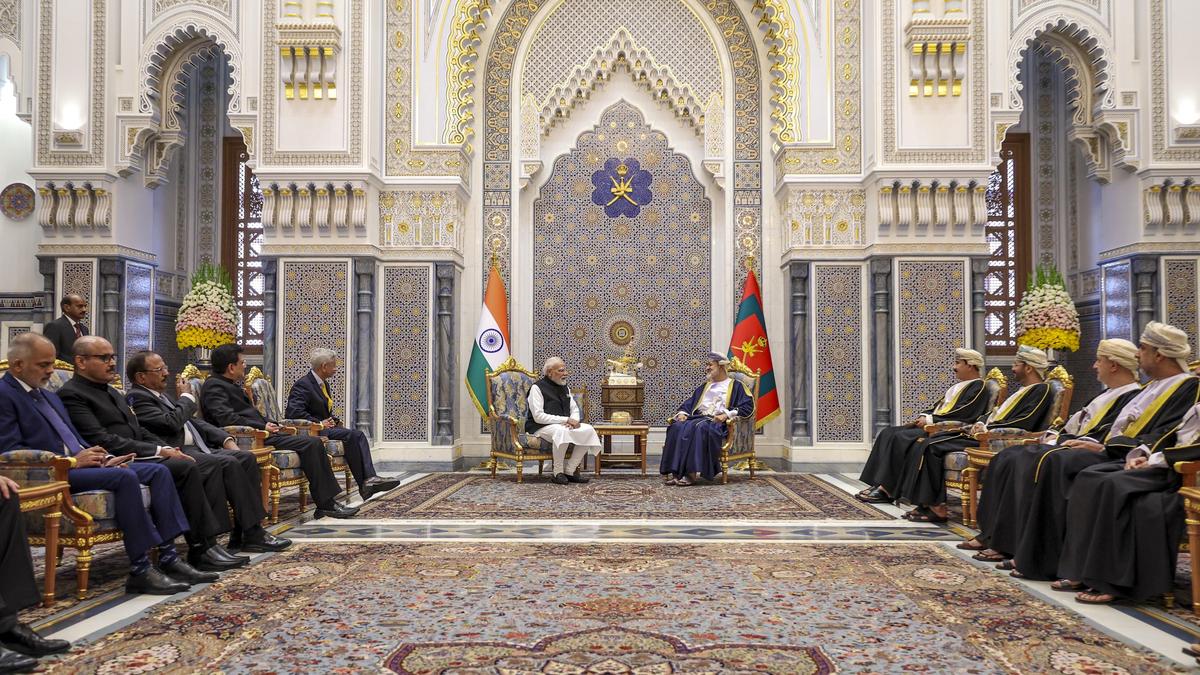
The deal was signed in Muscat by Commerce and Industry Minister Piyush Goyal and Oman’s Minister of Commerce, Industry and Investment Promotion Qais bin Mohammed Al Yousef in the presence of Prime Minister Narendra Modi and Sultan Haitham bin Tarik.
India exported $4.06 billion worth of merchandise to Oman in 2024-25, which made up 0.93% of India’s total exports that year. It imported $6.5 billion worth of goods from Oman, comprising 0.91% of India’s total imports in 2024-25.

Gateway to new opportunities
“The CEPA will infuse the India-Oman partnership in the 21st century with renewed faith and energy,” Mr. Modi said earlier in the day while speaking at the India-Oman Business Forum. “This is a blueprint for our future. It will give our trade new vigour and new trust for investments and will open the doors of new opportunities in every sector.”
This is the first bilateral agreement that Oman has signed with any country since it signed a deal with the U.S. in 2006. It is also the second deal India has signed with a country in the Gulf Cooperation Council (GCC), the first one being with the U.A.E. signed in February 2022.
Mr. Goyal had also pointed out that a trade deal with Oman also serves as a gateway for India to the Gulf Cooperation Council region, eastern Europe, central Asia, and to Africa.

Benefit to labour-intensive sectors
The Prime Minister added that CEPA will create new opportunities for growth, employment and innovation for the youth of both countries.
Taking to X soon after the signing of the deal, Mr. Goyal said that the deal would “significantly benefit” labour-intensive sectors, generating employment and strengthening MSMEs, artisans, and women-led enterprises.
According to the government’s press release, labour-intensive sectors such as gems & jewellery, textiles, leather, footwear, sports goods, plastics, furniture, agricultural products, engineering products, pharmaceuticals, medical devices, and automobiles will receive full tariff elimination under the deal.
“This is a balanced and ambitious agreement that will boost bilateral trade, strengthen supply chains, create employment, and deepen long-term economic partnership, in line with India’s vision of inclusive and sustainable growth,” Mr. Goyal had said about the deal earlier in the day.
India has kept sensitive products such as agricultural products, including dairy, tea, coffee, rubber, and tobacco products, gold and silver bullion, jewellery, and other labour-intensive products such as footwear, sports goods, and the scrap of many base metals out of the deal.
“For Indian industry, the CEPA with Oman enhances market access and trade facilitation while creating an enabling framework for services, investment, technology collaboration, and mobility of professionals,” Chandrajit Banerjee, Director General of the Confederation of Indian Industry said.

Enhanced mobility of workers
According to the release, a major highlight of the CEPA is the enhanced mobility framework for Indian professionals.
“For the first time, Oman has offered wide-ranging commitments under Mode 4, including a notable increase in the quota for Intra-Corporate Transferees from 20% to 50%, together with a longer permitted duration of stay for Contractual Service Suppliers — extended from the existing 90 days to two years, with the possibility of a further two-year extension,” the release said.
The agreement also provides for more liberal entry and stay conditions for skilled professionals in key sectors such as accountancy, taxation, architecture, medical and allied services, supporting deeper and more seamless professional engagement, the release added.

Boost to services sector
The agreement features a “comprehensive and forward-looking services package”, the government said, with Oman providing substantial commitments across a broad spectrum of sectors including computer related services, business and professional services, audio-visual services, research and development, education, and health Services.
“These commitments are expected to unlock significant new opportunities for Indian service providers, promote high-value job creation, and support expanding commercial engagement between the two countries,” the release said.
Oman currently imports about $12.52 billion worth of services from across the world, of which services from India comprises 5.31%.
“The CEPA further provides for 100% Foreign Direct Investment by Indian companies in major services sectors in Oman through commercial presence, opening a wide avenue for India’s services industry to expand operations in the region,” the release said.
Both sides have also agreed to hold future discussions on social security coordination once Oman’s contributory social security system is implemented.
Petroleum and mineral-based trade
India’s bilateral trade with Oman is currently dominated by petroleum products, oil, fertilisers and, to an extent, mineral products. Petroleum products accounted for 35.1% of India’s $4.06 billion worth of exports to Oman in 2024-25. Processed minerals accounted for another 9.2%.
The other major export categories include aircraft, spacecraft and parts (4.3%), cosmetics and toiletries (3.6%), and basmati rice (3.6%). Together, these five categories accounted for about 55% of India’s exports to Oman in 2024-25.
Crude oil and petroleum gases together accounted for 38% of India’s imports from Oman in 2024-25. Mineral or chemical fertilisers accounted for another 16.3%, acyclic alcohols 6.6%, and ammonia 5.8%. Together, these five categories accounted for a little more than two-thirds of India’s imports from Oman.