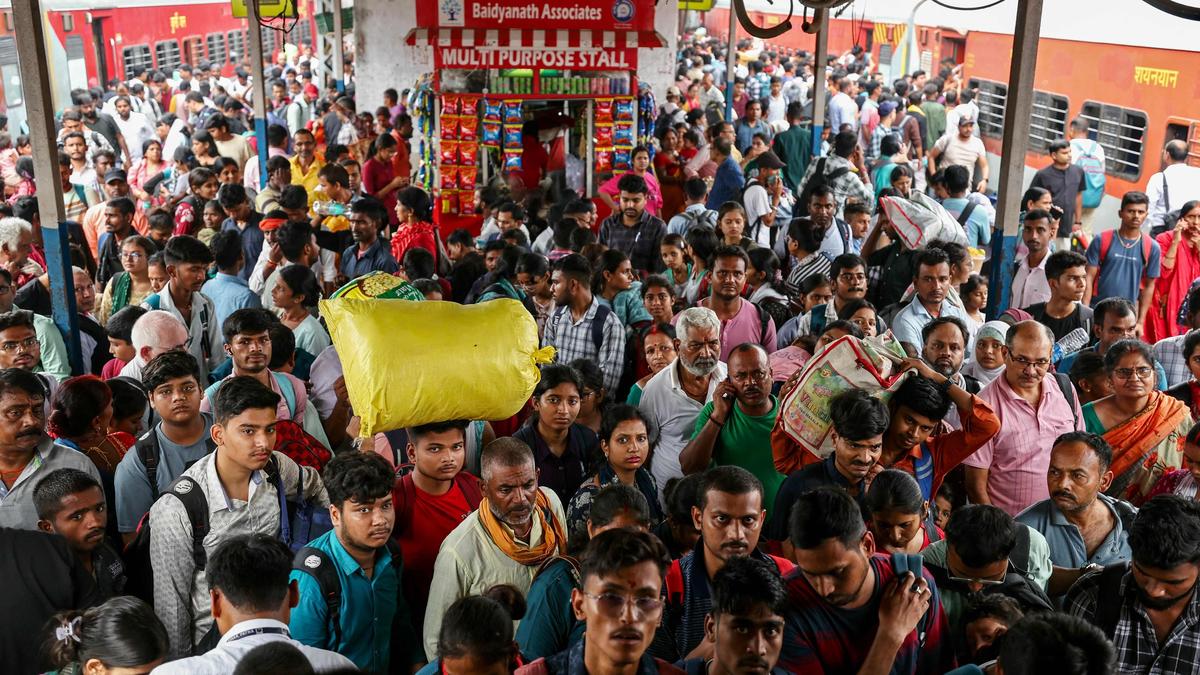
Passengers crowd at the platform as they arrive to board a train to their hometown a day after the Chhath Puja festival at a railway station in Patna on October 29.
| Photo Credit: AFP
In the past couple of months, India has witnessed its transport infrastructure come under massive strain. In October and November, trains to Bihar experienced immense rush, owing to migrants travelling home for Chhath Puja and the Bihar elections. Travellers were forced to travel in cramped and inhospitable conditions in unreserved compartments due to the paucity of trains. In December, the mass cancellation of Indigo flights owing to regulatory non-compliance led to stranded passengers and inflated prices.
Both events can be used to explain the reaction of prices and the responses of government and private players to demand and supply shocks. But the divergent behaviour of prices — and its effects — in these cases indicate the constraints imposed on welfare in a neo-liberal economy. Low prices of government services do not increase welfare unless accompanied by significant government investment, while deregulated prices only reduce welfare in the presence of monopolies.
Demand shock and Indian Railways
The sudden increase in demand for Bihar-bound trains in October is a classic indication of a demand shock. In the face of a given supply, such an increase in demand would lead to higher prices. If prices remain fixed due to government intervention, it would lead to an increase in the number of travellers far beyond the capacity of the trains. This led to overcrowded trains and hazardous travelling conditions. Standard economic theory would state that prices need to rise such that demand and supply are in equilibrium. While this would lead to the inability to travel for many, economic efficiency would be achieved.
Critics point to this as the fundamental issue with government services, where keeping prices low due to social compulsions leads to excess demand of services and rampant inefficiency. But this criticism misses a fundamental problem. It is true that low prices lead to overcrowding, but the answer lies not in raising prices, but ensuring an increase in supply. Prices for certain services like health, education and train travel must be kept affordable for welfare, but at the same time, there must be significant investment by the state to expand access.
This is difficult to do in a neo-liberal economy, which places strict constraints on government intervention in the economy. Limits are placed on the size of the fiscal deficit, limiting government investment. A route that increases government spending while maintaining the deficit is through raising resources by wealth and income taxation of the top 1%. As shown by Thomas Piketty and his team, modest taxation of the top 1% would be enough to raise a considerable amount to strengthen the Indian welfare state. This, however, would not be acceptable to domestic and global capital.
Monopolies and grounded flights
The solution, as advanced by many, is deregulation, and the entry of private capital into the provision of services. The logic goes that focusing on the profit motive ensures an efficient match of demand and supply, and investment in search of profit will ensure the expansion of services to all. However, the recent crisis surrounding Indigo has shown the shortcomings of this model.
The Indigo crisis is an example of a supply shock. The withdrawal of flights in the face of normal demand leads to price increases, amplified by the near-monopoly enjoyed by Indigo in Indian markets. The reduction in such a large amount of supply meant huge price increases for other flights and significant consumer loss. Supply restrictions for one firm in a market would not lead to such massive market-wide disruptions if the market was genuinely competitive.
Non-competitive pricing power was highlighted as a key factor leading to the rapid increase in inflation during former U.S. President Joe Biden’s term, which played a role in bringing Donald Trump to power. The massive supply disruptions brought about by lockdowns increased costs, but were translated into a cost-of-living crisis due to the presence of significant monopolies. The argument for flexible prices implicitly assumes a competitive economy, which requires government intervention to prevent the rise of monopolies.
On the liberal economy
The two outcomes are not distinct but are the consequences of a neo-liberal economy that places restrictions on the actions of the state but pushes for deregulation of private activities. The inability of the state to raise taxes and increase spending leaves them with no option but to keep prices low for essential services and struggle with the increased demand and the fallout from overcrowding. The withdrawal of regulation leads to the concentration of capital and the rise of monopolies, a feature of Indian markets today. Far from ensuring consumer welfare, unregulated private markets can lead to rising monopolies which lower welfare and lead to high prices, as seen in the case of Indigo and the U.S. The two travel disruptions may seem dissimilar, yet they are both logical outcomes of an economic model that prizes the private, and downplays the importance of the public. These massive disruptions will emerge once more, if the underlying tendencies towards monopolies and the degradation of public services are not arrested.
Rahul Menon is associate professor at O.P. Jindal Global University.
Published – December 10, 2025 08:30 am IST