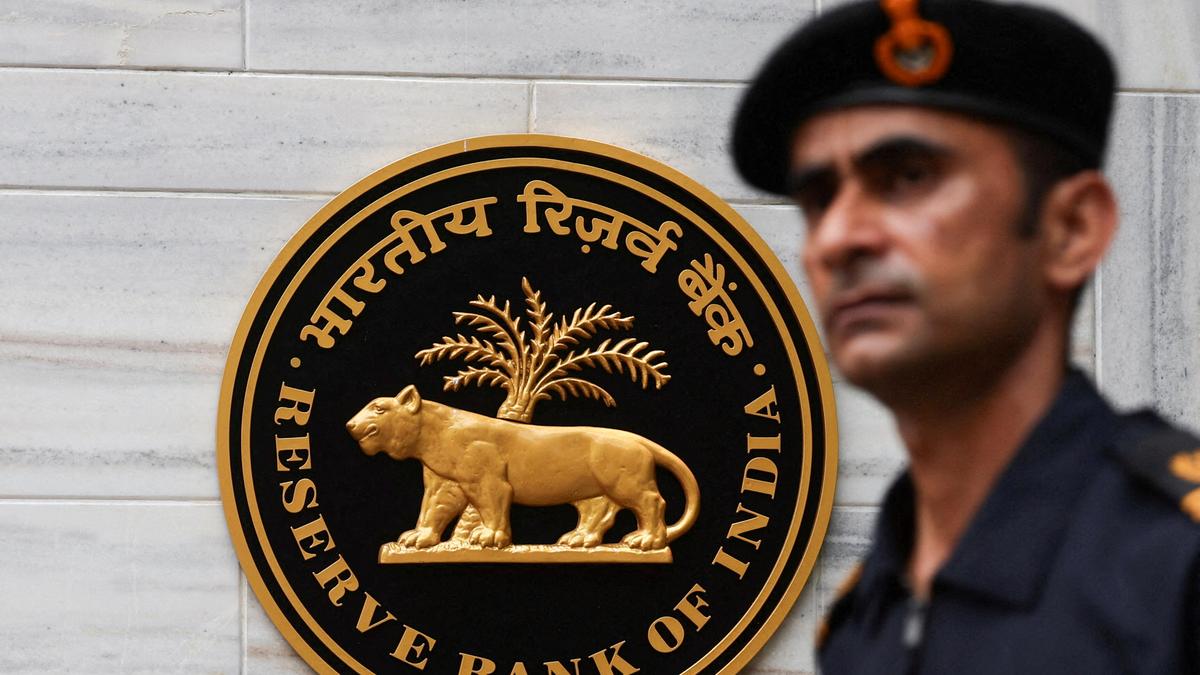
A man walks past the Reserve Bank of India (RBI) logo outside its headquarters in Mumbai. File
| Photo Credit: Reuters
In view of the evolving liquidity conditions and the outlook, the Reserve Bank of India (RBI) on Friday (December 5, 2025) announced to conduct Open Market Operation (OMO) purchases of government securities of ₹1,00,000 crore and a 3-year USD/INR Buy Sell swap of $5 billion this month to inject durable liquidity into the system.
Later during the day it also notified to purchase government securities worth ₹50,000 crore on December 11, 2025. The balance ₹50,000 will be conducted later this month.

“I would like to reiterate that we are committed to provide sufficient durable liquidity to the banking system. We continuously assess the durable liquidity requirements of the banking system due to changes in currency in circulation, forex operations, and reserve maintenance,” RBI Governor Sanjay Malhotra said in his monetary policy statement.
“Going forward too, we shall continue to do so. These measures will ensure adequate durable liquidity in the system and further facilitate monetary transmission,” he said.
Also Read | RBI raises FY26 GDP growth projection to 7.3%
At the post MPC meeting press conference Mr. Malhotra clarified that the Dollar Rupee swap was a liquidity measure and not to support the depreciating Rupee.
Answering multiple questions on the impact of the depreciating rupee, Mr. Malhotra said the RBI was comfortable at this level and has factored in the current level [of over 90 a Dollar] in its estimates for the projections.
“We allow the market the determine the rate of the rupee. We do not target any price level or any bands. We believe market is very efficient in the long run. In February 2025 we saw the rupee going to almost 88 level and in three months it came back to below 84,” he said.
“So these fluctuations and volatility does happen. Our effort has always been to reduce any abnormal or excessive volatility. The external sector is very strong and will remain string going forward,” he said.
“Also we are having sufficient [forex] reserves, current account is very manageable at about 1% or so. Given these strong fundamentals of our country, we should get good capital flows going forward. So I think we are in a very comfortable situation so far as external sector position is concerned,” he emphasized.
Answering a question from The Hindu on impact of tariff on the Indian economy Mr. Malhotra said, “Mostly the impact is minimal, its not high because ours is mostly a domestic demand driven economy. A few sectors [such as textiles, leather, shrimps and gem & jewellery] will be impacted and we and the government have given out certain trade relief packages.”
“I think it [tariff] is an opportunity for us and exporters have already started looking out and improving their productivity. They have also started diversifying. We should be able to come out of this stronger going forward,” he said.
He said India’s current account deficit moderated from 2.2% of GDP in Q2:2024-25 to 1.3% in Q2:2025-26 on account of robust services exports and strong remittances.
“In October 2025, merchandise exports contracted year-on-year, whereas merchandise imports continued to increase for the second consecutive month, resulting in a widening of the trade deficit. Healthy services exports coupled with strong remittance receipts are expected to keep CAD modest during 2025-26,” he said.
In his concluding remarks the governor said, “Despite an unfavourable and challenging external environment, the Indian economy has shown remarkable resilience and is poised to register high growth.”
“The headroom provided by the inflation outlook has allowed us to remain growth supportive. We will continue to meet the productive requirements of the economy in a proactive manner while ensuring macroeconomic stability,” he added.
Published – December 05, 2025 01:07 pm IST